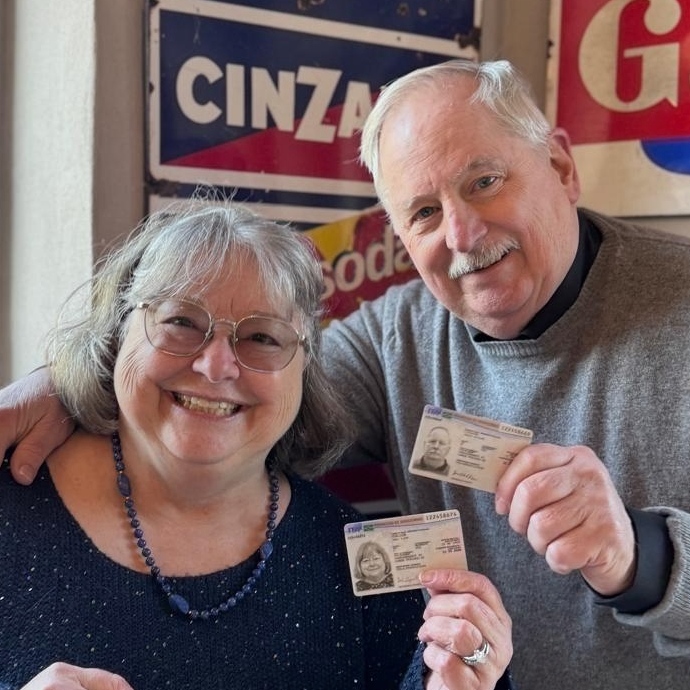
Saturday we reached a big milestone — we now have our permanent carta di soggiorno, or permission to stay in Italy indefinitely.
How We Got Here
2017–2019: What began as a dream of moving to Italy slowly turned into a rough idea, then a sketch of a plan, and eventually into a detailed, deliberate decision.
2019: We applied for Elective Residency visas while still living in the U.S.
2020–2022: After moving to Italy, we began the bureaucratic marathon:
Annual permesso di soggiorno
Official residency
Carta d’identità (national ID card)
Tessera sanitaria (health card) All of this took from March 2020 to January 2022.
Driver’s Licenses: After one year in Italy, you must get an Italian driver’s license. The written test is notoriously difficult — even for Italians. After lots of studying, we both passed. Jim even passed the motorcycle exam, so a Ducati may be in our future.
Annual Renewals: Every year we had to apply for a new permesso di soggiorno and tessera sanitaria. The permesso expires after one year but sometimes takes longer than that to receive, so you pick it up already expired and start all over again. A never-ending loop.
Year Five: After five years of residency, we became eligible for a permanent carta di soggiorno — and we applied right away.
Each application required piles of documents. I’ve lost count of how many times I’ve submitted our 14-page lease (always printed double-sided!).
The Stressful Part: The Suitability Certification
To apply for the permanent carta di soggiorno, we needed:
Everything required for a regular permesso, plus:
Italian language certificate (A2 level)
Criminal record in Italy
Certification that our home is “suitable for habitation”
We provided all documents except the last one. The last one was the hardest. Our apartment easily meets the standards, but the city wanted a properly scaled floor plan and additional documents we didn’t originally know were required. We asked the owners, the building association, a neighbor, even the building’s architect (who we know personally). Still — we could not get the last document.
Then, out of the blue, Tony (our Italian fixer for all things bureaucratic) told us our permanent carta di soggiorno had been approved and was ready to pick up. We still don’t know how or why, but we are so grateful. Truly an answered prayer.
What’s Next?
Our lease expires in two- and one-half years. Rent will probably increase after eight years at the same rate — which is fair — or the owners may decide to sell. If that happens, we don’t know what we’ll do. Long-term rentals in Lucca are currently scarce because of the conversion to short-term rentals. Maybe things will change in two years. Maybe we’ll compromise. Maybe we’ll move to another city. Buying isn’t likely — the tax implications and housing market are complicated and very different from the U.S.
Mostly, we’ll continue our retired life in Lucca. We usually have a major trip or event about once a month. In between, we plan for those adventures, study Italian, enjoy our hobbies, spend time with friends, and appreciate the simple rhythms of daily life.
After ten years of residency, we’ll be eligible to apply for Italian citizenship. That requires a B1-level language certification. I’ve already passed mine; Jim is studying for his now. We decided it’s easier to take the test at age 66 than at 71, and we’d prefer not to do it under pressure.
Reflections
I often say Italy “dares” you to live here. The bureaucracy can be slow, confusing, and sometimes absurd. Expats usually respond in one of two ways: frustration or acceptance. We realized we had officially joined the second group the day we waited 45 minutes for new tessere sanitarie, only to be told (in very polite Italian) that the computer was down and nobody knew when it would be fixed. Jim suggested we try again tomorrow; I suggested we give it a week. There wasn’t much point stressing; an expired health card doesn’t really change anything.
People often ask if we like living in Italy better than in America. The truth is, two big life changes happened at the same time: we retired and we moved to Italy. I can’t compare working life in America to retired life in Italy. What I can say is this: even knowing everything we know now — every document, every line, every impossible requirement — we would still do it again.
In June, Jim and I spent twelve days exploring Umbria, the stunning region just southeast of Tuscany. I shared plenty of photos on Facebook of the towns we visited — each beautiful in its own way — but I held back on Spello. Why? Because what we experienced there simply cannot be captured in a few pictures or captions. Spello deserves more. It deserves more — a story.
And that story is about Le Infiorate.
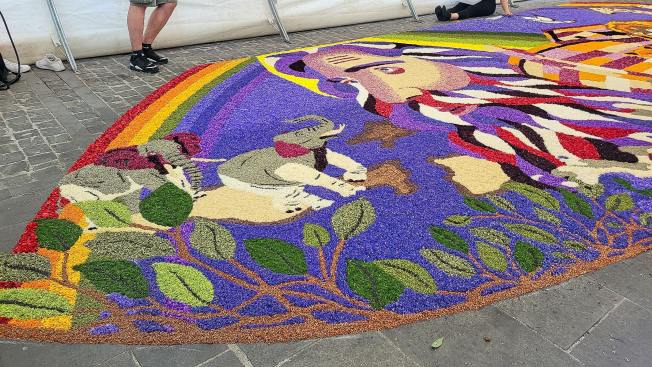
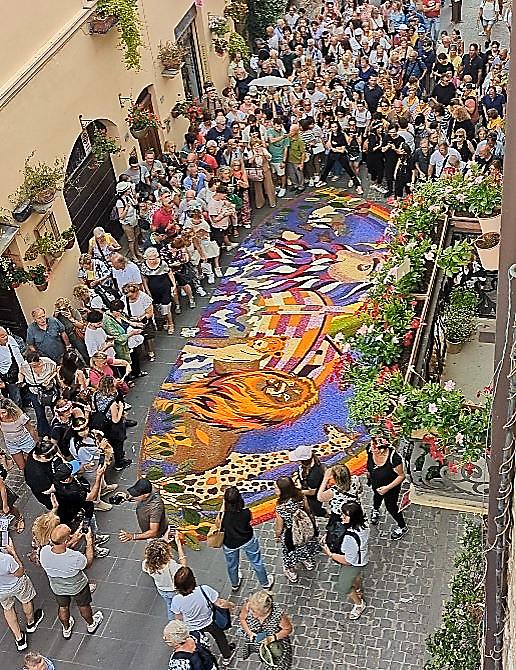
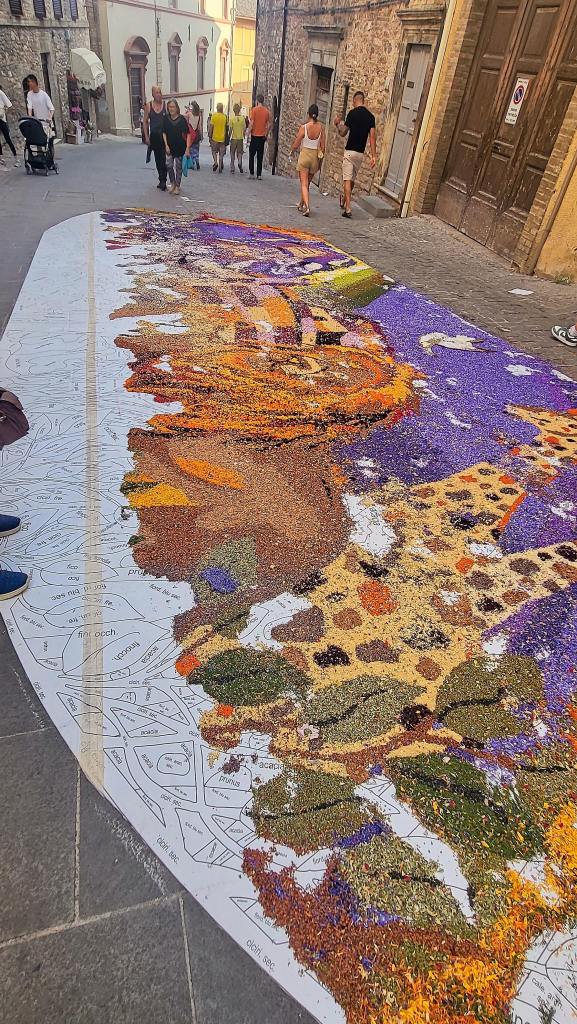
Every year, on the feast of Corpus Domini (Corpus Christi), the streets of Spello are transformed into a living canvas—flower carpets that stretch for meters, designed and laid down entirely by hand using flower petals, leaves, and seeds. No glue or adhesives are allowed; instead, water is misted on to keep the petals fresh and in place. The effect is dazzling: sacred art underfoot, created in the middle of the night, and gone by sunset the next day. The official website is https://www.infioratespello.it/.
Here’s a brief overview of the main events of Le Infiorate:
Saturday Morning–Afternoon: Local groups mark the street with large design templates and set up tents to cover the designs from wind and rain.
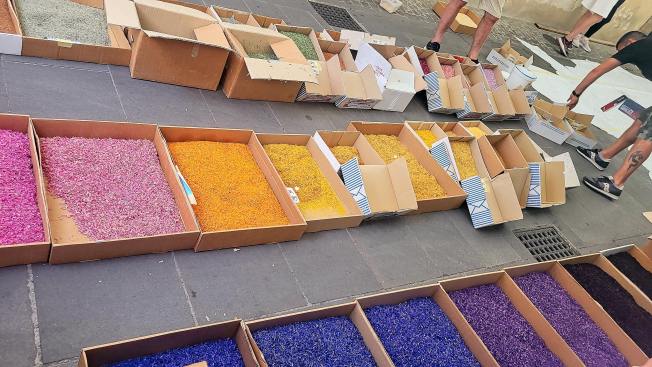
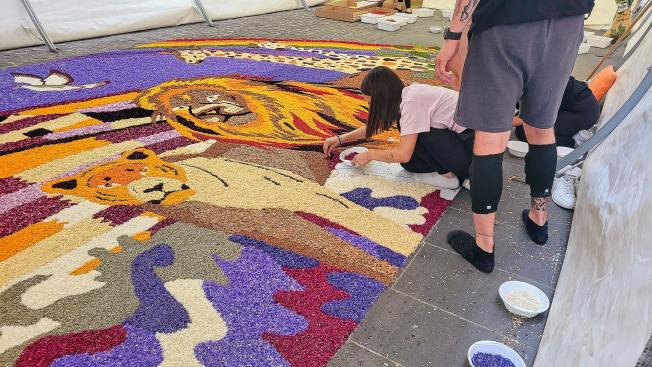
Saturday starting at 6pm: Volunteers begin work and continue through the night, preparing thousands of flower petals, carefully separating colors and textures, then placing petals by hand onto the designs using tweezers, cards, and their hands — with plenty of chatting, singing, and sharing food.
Sunday at 8am: All designs must be completed, because the judges start their walk through town assessing each carpet in several categories.
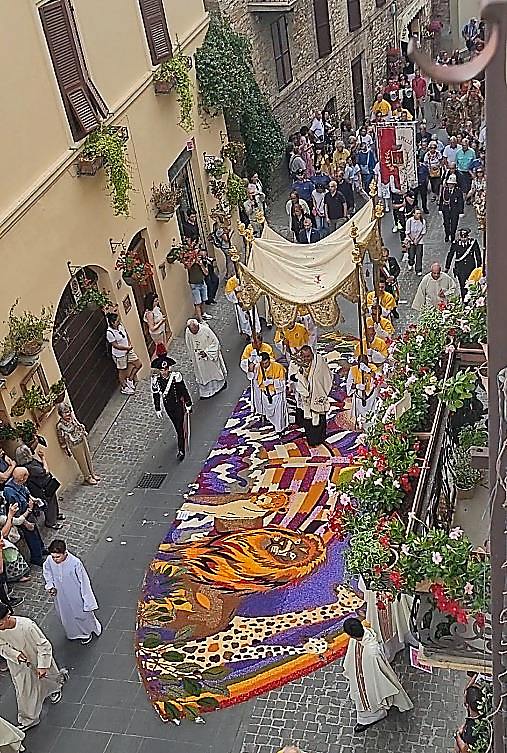
Sunday at 11am: A religious procession passes over the flower carpets, a symbolic act that also marks the end of their brief lifespan.
Sunday Evening: The streets are cleaned, and the petals are swept away, leaving only memories—and lots of photos—of this fleeting, floral art.
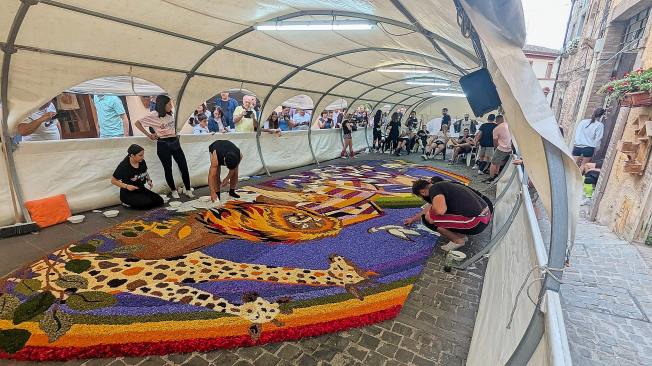
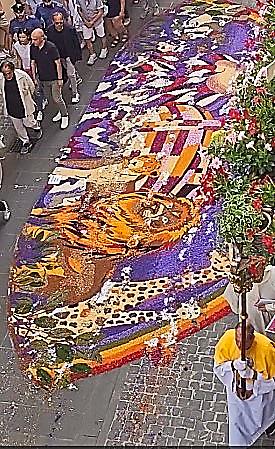
We arrived on Saturday morning and, to our surprise, discovered that our apartment was right along the procession route. Throughout the day, we explored the town and saw around 60 different flower carpets designs. However, we paid special attention to the one just outside our door. I used photos of that particular design to illustrate the Infiorate process.
Saturday 11:00 AM: Each group has a tent for their work. They place a large white sheet of paper with the design and colors of the flowers on the street. They may use wallpaper glue to secure it.
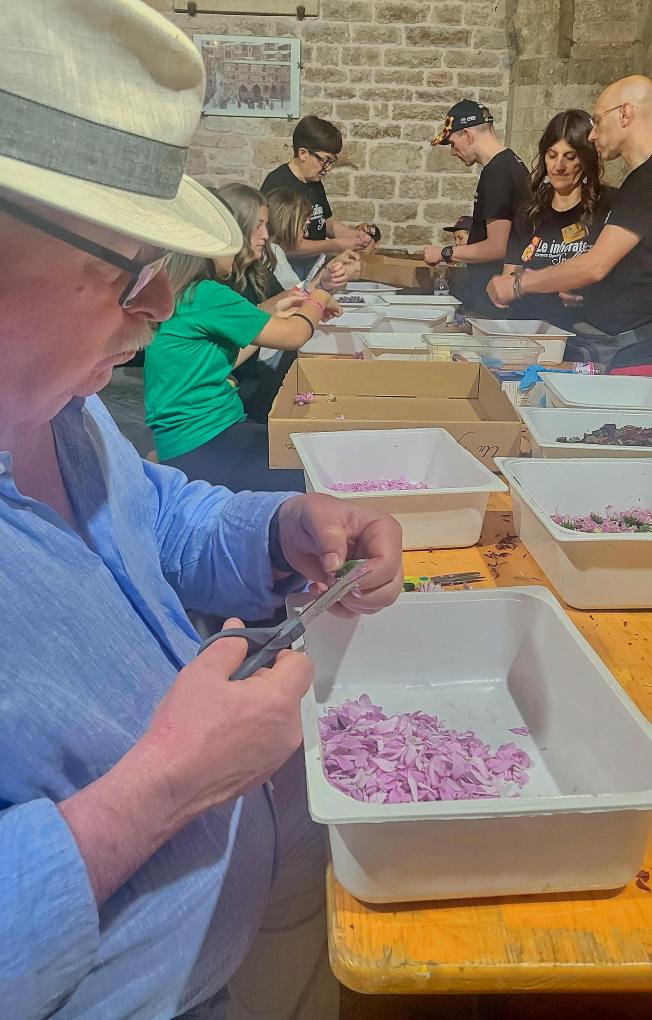
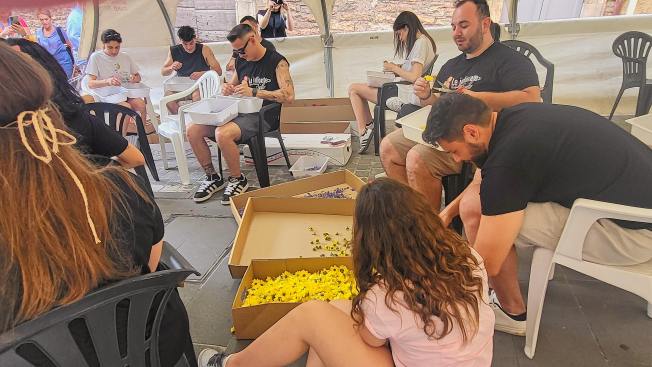
6:00 PM: The group begins preparing the flowers. They use scissors to cut the petals from the flowers.
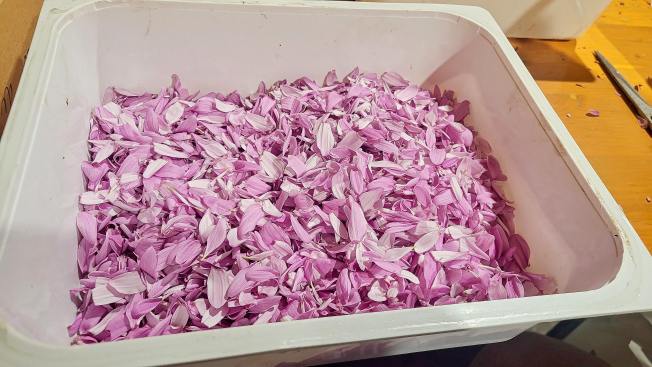
The flowers are ready!
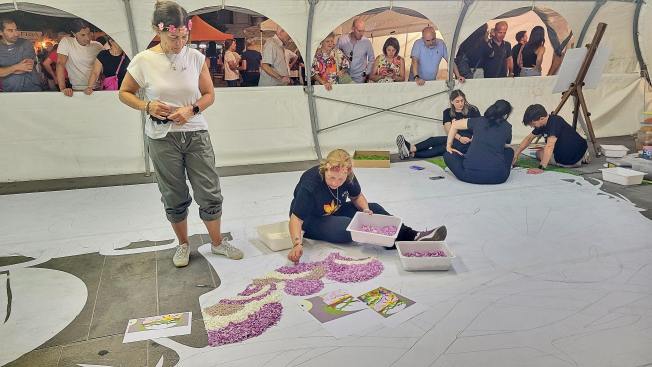
11:00 PM: The group places the flowers on the design. They use their hands, small cards, and tweezers. Many also talk, sing, and eat!
Sunday 6:30 AM: Almost finished. Judging begins at 8:00 AM.
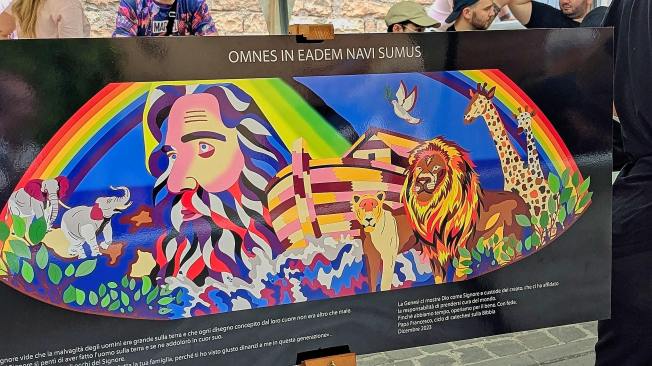
Many groups display signs that explain their design and the message or meaning behind it.
7:30am Final touches!
8am It’s done!
10:15 AM: The carpet is finished! The crowd waits for the procession.
12:00 PM: The procession, which started at 11am and took one hour to reach our appartment.
After the procession, you can see the flowers are all messed up.
5:45 PM: Street cleaners begin clearing the flowers.
There is a tremendous amount of work needed to prepare the flowers, so some groups invite visitors to help. We found one of these groups and helped for about an hour. So much fun to participate in the activity!
Jim, hard at work with the others gathered around the table
We cut all of the petals! And a container full of white petals too!
Here they are using petals like we prepared
The designs are created and judged in four categories:
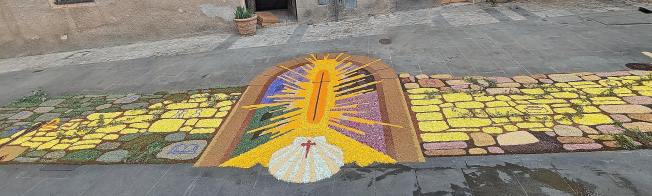
CARPETS / QUADs: flower displays of at least 24 square meters that represent a religious theme in a figurative, abstract, or symbolic manner. These dimensions are reduced for particular narrow streets.
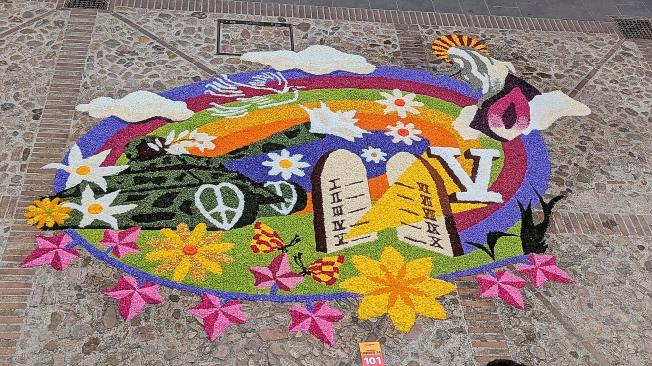
FIGURATIVE CARPETS: flowered carpets measuring at least 12 linear meters or 12 square meters, but less than 24 square meters, in which at least one figurative element is present.
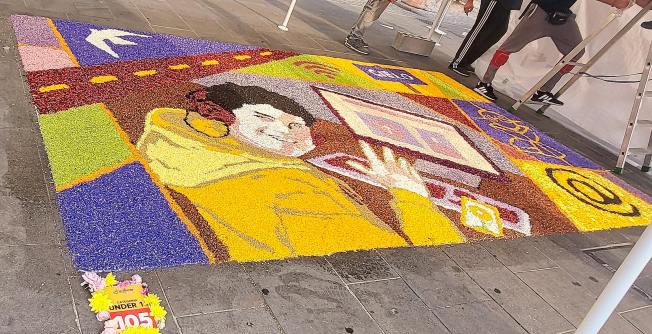
UNDER-14: flowered carpets measuring at least 12 square or linear meters created by groups whose members are under 14 years of age.
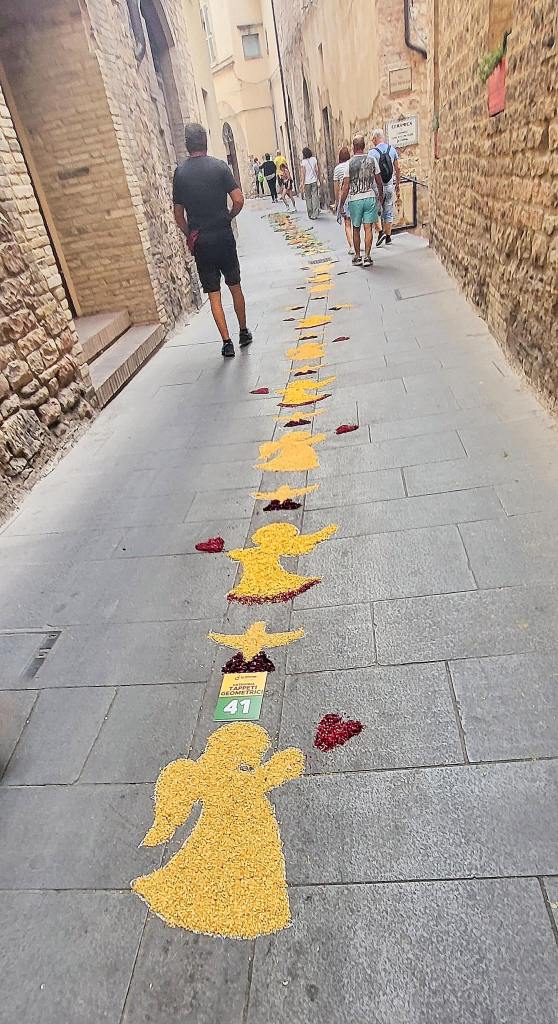
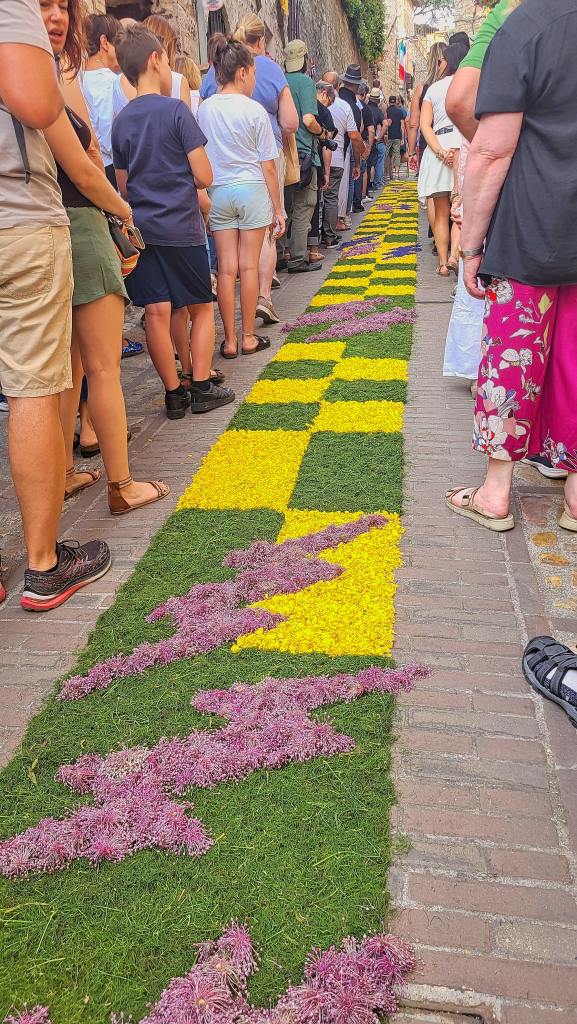
GEOMETRIC CARPETS: flower carpets of at least 12 linear meters, in which the repetitiveness of the shapes prevails.
Here are pictures of designs in each of these categories, along with some street scenes.
Quad category
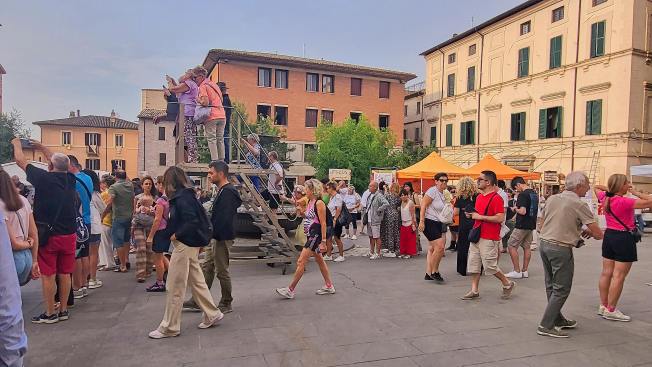
Main piazza, with people checking out one of the carpets with a ladder that gave you a better view.
Figurative category
Under 14 category
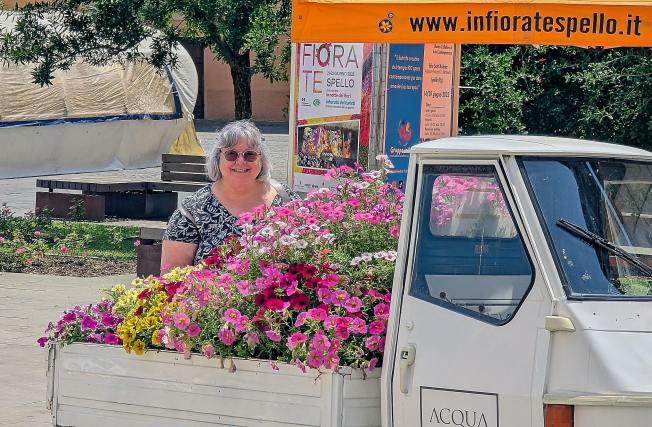
Cute Ape truck filled with flowers
Under 14, Carlo Acutis, an Italian teenager who passed away in 2006, is being called the first Millennial saint.
Geometric category
Geometric category, on a narrow street with too many people!
The streets were one way – even for pedestrians. But our apartment was on the street, so the police let us proceed (very slowly).
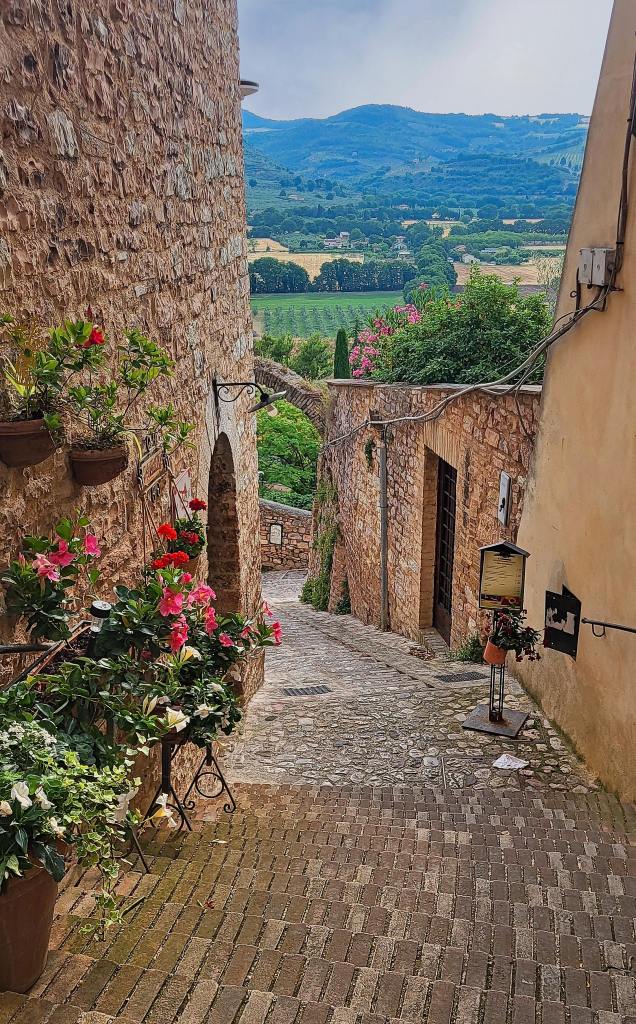
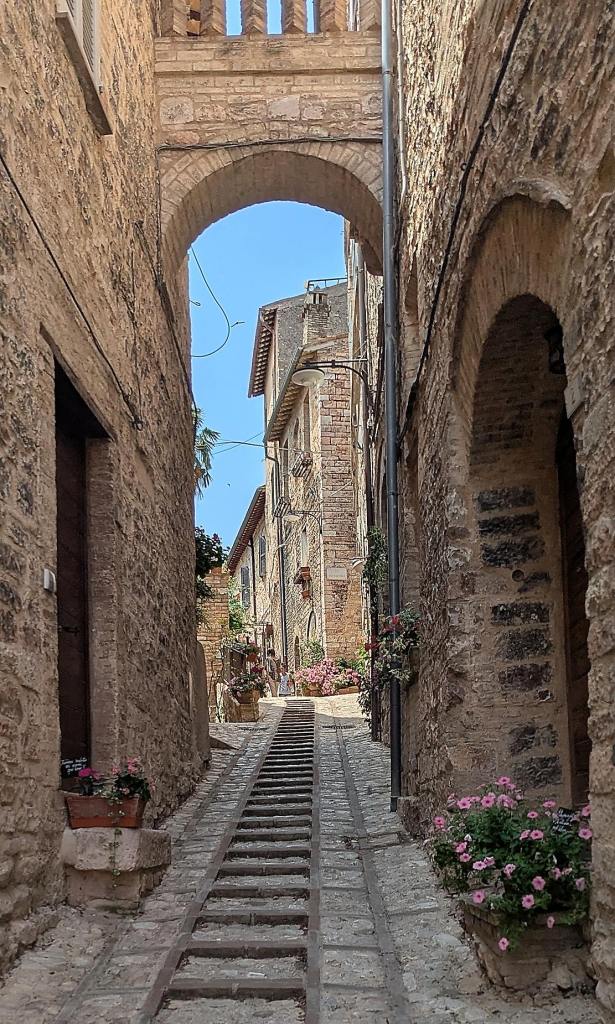
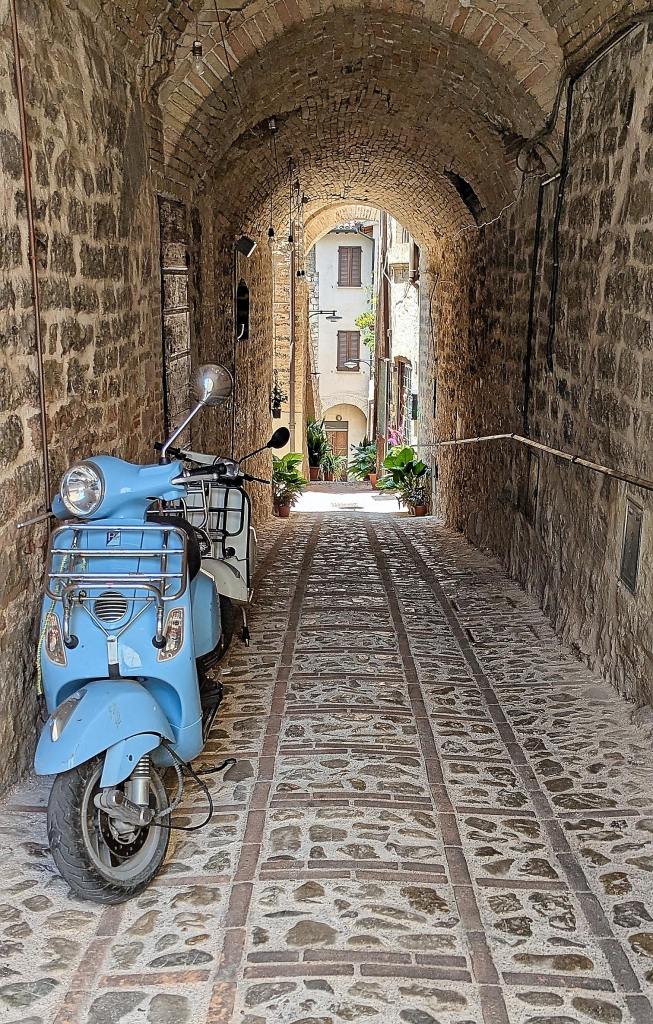
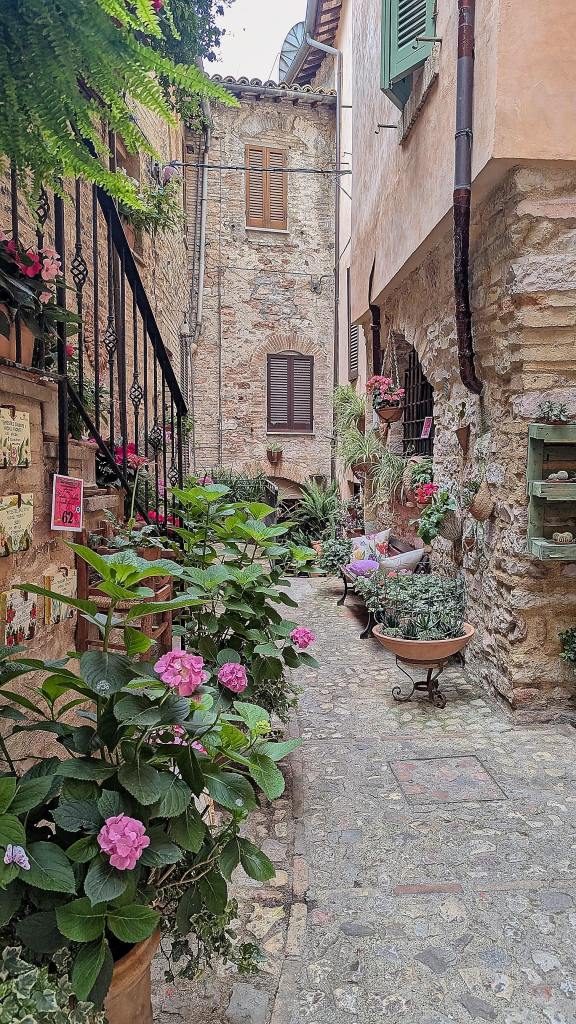
Another flower contest, Finestre, balconi e vicoli fioriti, is also held that brings color and creativity to windows, balconies, and alleyways. Displays are judged on beauty, originality, and how well they highlight the town’s historic architecture. These blooms give Spello a lasting charm. Here are some photos that capture that beauty.
If you are considering visiting Spello for Le Infiorate, here are a few tips for you:
Go! It is worth it!
The 24-hour period from 4pm Saturday to 4pm Sunday gives you an opportunity to watch (and participate!) in the preparation activities, see the completed designs, and watch the procession. If you can only go on Sunday, get there as early as possible, preferably well before 8am.
Stay in the town of Spello if possible. I made reservations six months in advance and there were few rooms available. Plan early, but also check for openings later if that is your only choice.
Reserve a parking space online then walk into the city. We brought only what we would need for the two nights, because the hills are steep!
Be prepared for crowds and focus on the beauty and community spirit instead.
Le Infiorate may last only a single weekend, but the spirit of creativity, community, and beauty lingers all year. Whether you come for the fleeting floral carpets or stroll through flower-filled alleyways in another season, Spello offers something truly special. It’s a town that celebrates art, honors tradition, and welcomes visitors with open arms—and, of course, plenty of petals.
We’re so grateful to have been a small part of it.
When people visit Italy for the first time (or two), the biggest destinations that come to mind are Rome, Florence, and Venice. Each has spectacular and unique sights to see – and also lots and lots of tourists. After a few visits to Italy, people often want to visit locations that feel more authentic without the throngs of tourists. We visited two of these locations recently – the Dolomites of Northern Italy’s Alps and Verona, known as the city of Romeo and Juliet. I also visited Mantua (called Mantova in Italy) which is filled with important art and history and seems to be mostly visited by Italian schoolchildren. This blog post will highlight my visits to these lesser-known but wonderful locations.
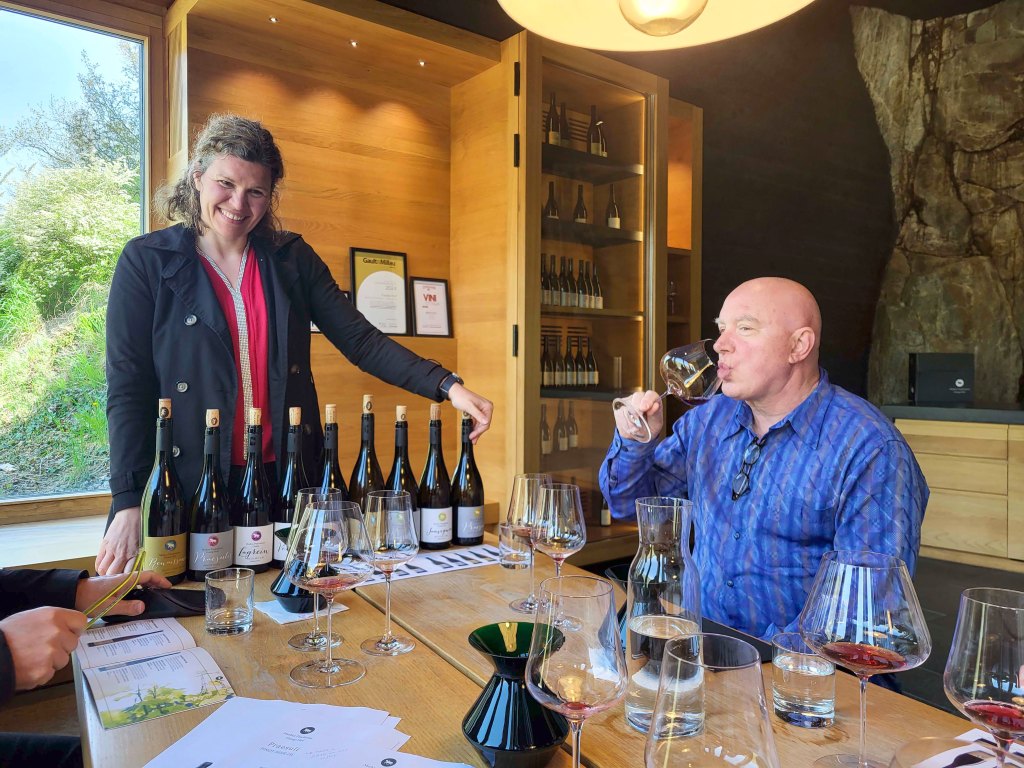
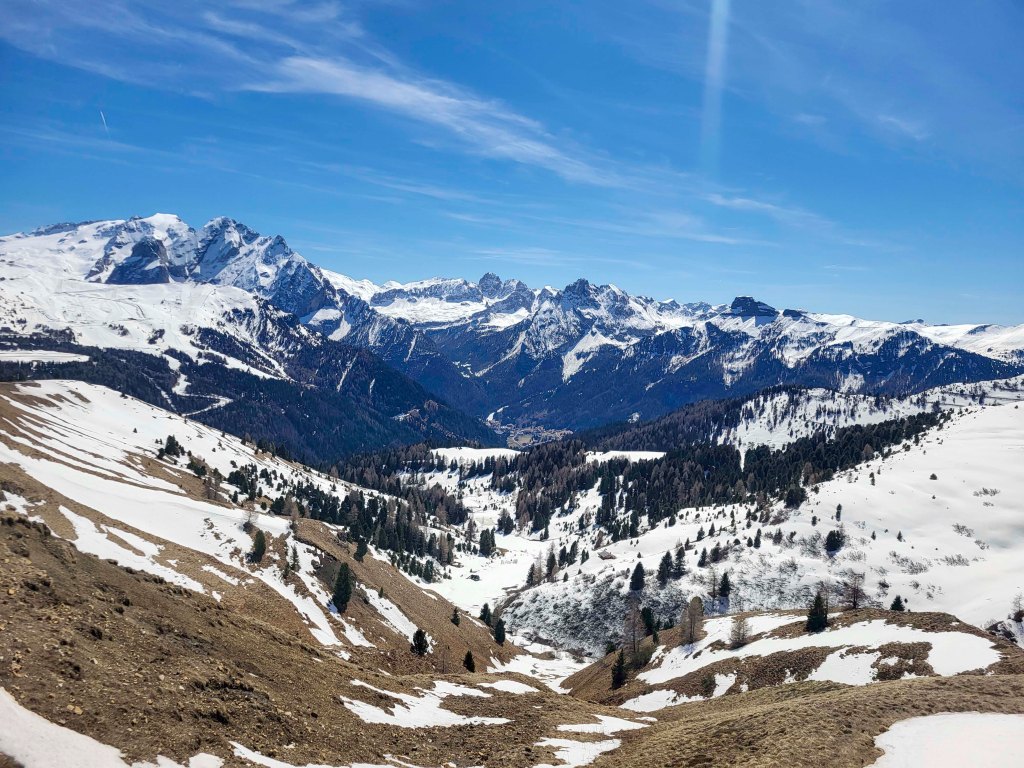
Diana and Jed are friends from Lucca; they recently purchased a condo in the Dolomites so that they could enjoy the winters skiing. And from their property, they are just a few steps from the ski lifts! They invited Pasquale, Jim and I to visit in April, with a special request – that Pasquale set up a few visits to wineries in the area, using his in-depth knowledge of Italian wine producers. This turned out to be a bit of a challenge because many wineries were unavailable due to “out of season” or they were preparing for Italy’s largest wine show in just a few days – more on this later. We visited three:
Weingut Lieselehof – on a beautiful mountainside near a lake. And they have a very interesting “wine museum” that has over 100 different types of grapes growing from all over the world. They study how they grow in this environment and are particular interested in disease-resistant varieties.
Markus Prackwieser Gump Hof – a wonderful family-owned winery that weaved the story of family, local history, and hard work together leading up to a wonderful wine tasting. Our favorite winery of the three.
Kloster Neustift Abbazia di Novacella – a winery and an abbey together! This was quite a large winery that produces LOTS of different wines. The grounds, abbey and library were gorgeous. Too bad the wine wasn’t as good.
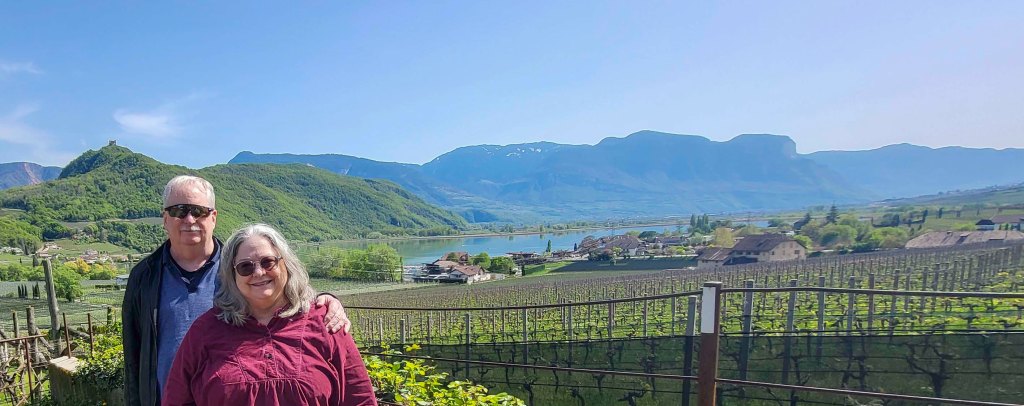
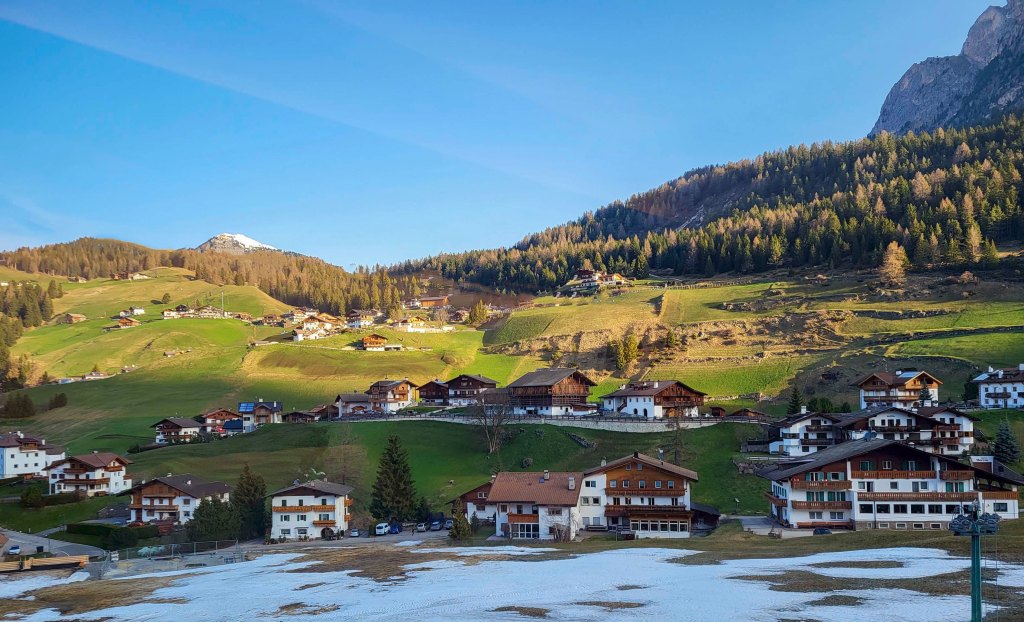
Beautiful and peaceful in the mountains – surrounded by vineyards and a surprise lake!
The vines grow on very steep slopes so all work must be done by hand.
Pasquale enjoying the wine at Markus Prackwieser Gump Hof.
This area looks, sounds and feels more like Germany than Italy! More people speak German than Italian.
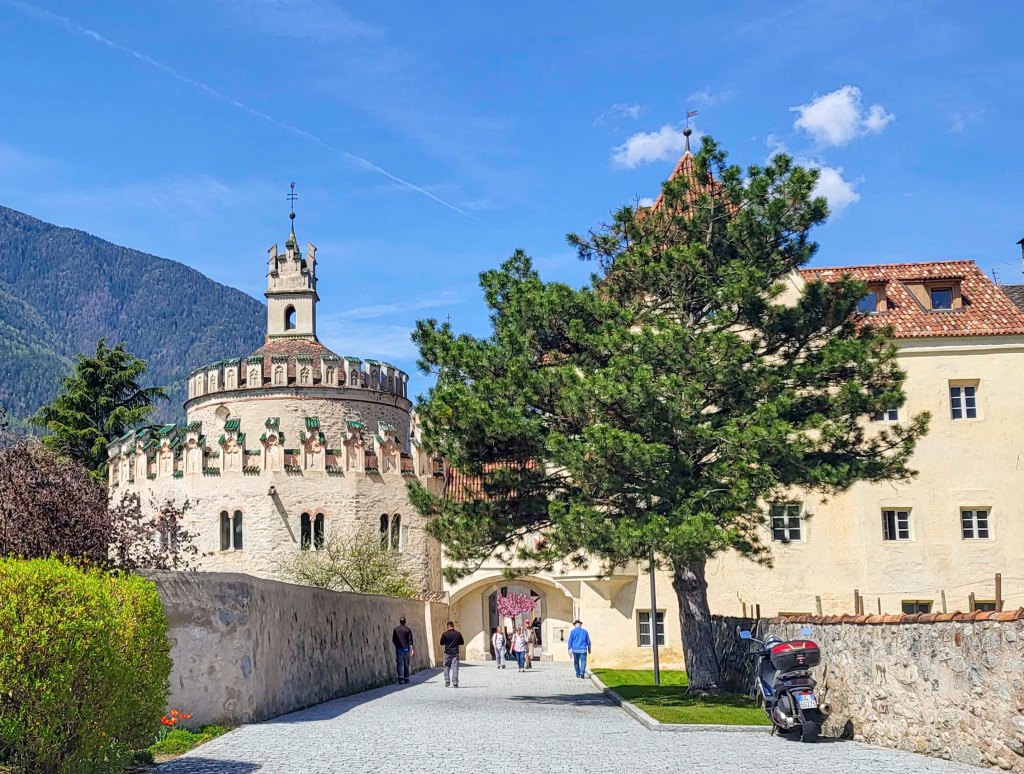
Entrance to the abbey complex. Note the cute round building on the left.
We explored that cute building but then realized that it was closed – the door was only opened for the men working inside. Jim and I exited quickly, but Pasquale and Diana had begun exploring upstairs. The men started locking the door but I tried to explain in Italian that there were two friends still inside. Apparently they spoke only German but they did understand once I got animated!
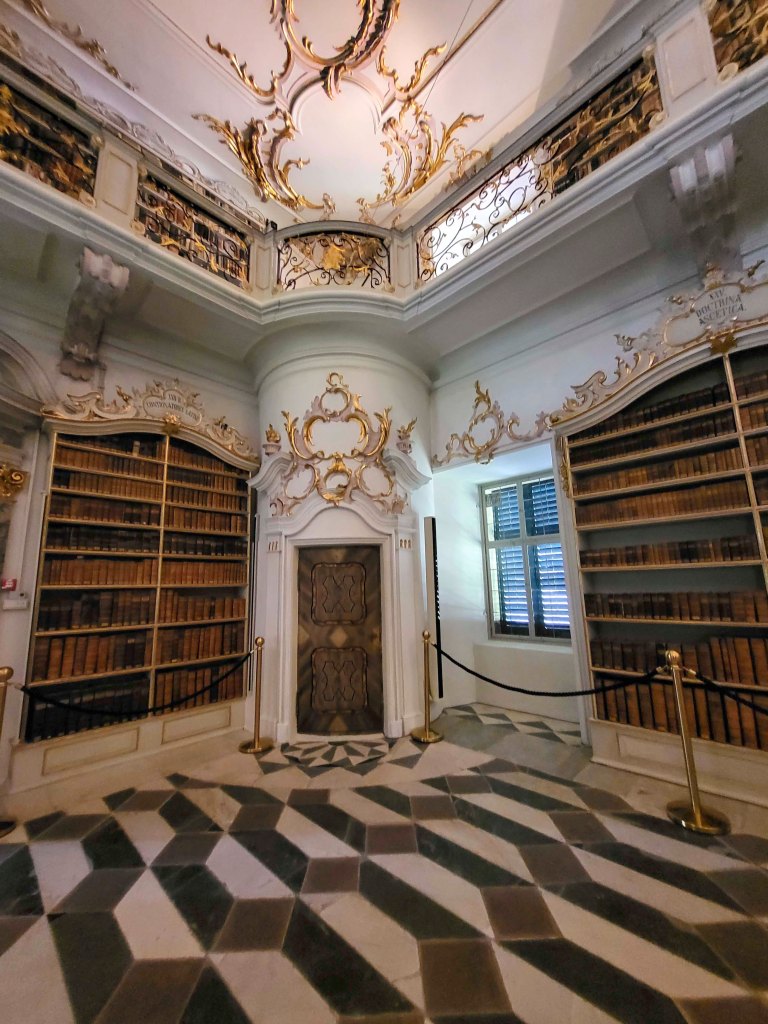
Beautiful baroque library of the abbey!
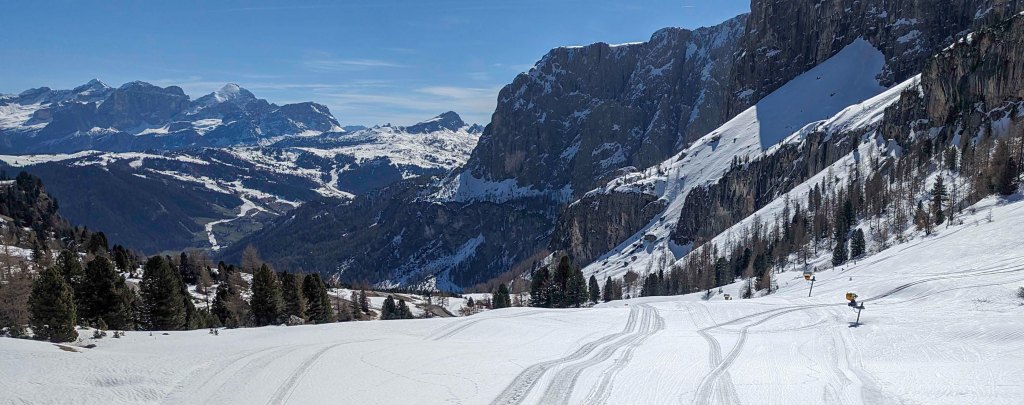
The following day, Jed and Diana took us on a drive around “their mountain”. The views were spectacular and even though it was quite late in the season, we were able to watch people ski. I was surprised to learn that you can ski from town to town and essentially spend all day skiing through the entire area. I was also surprised to learn that the weather could be so warm with snow still blanketed everything. I brought all of the wrong clothes. Diana and Jed are great hosts – they prepared several wonderful meals for us and we even played billiards in their cantina! What a fun visit!
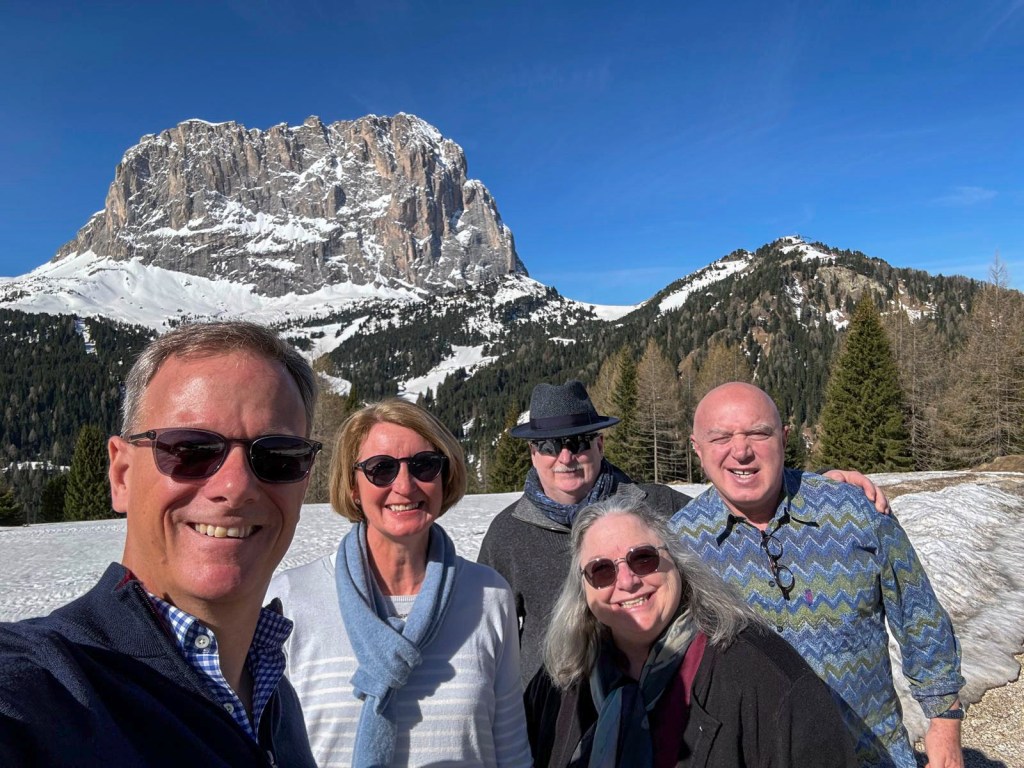
Group selfie! Pasquale, where are your sunglasses???
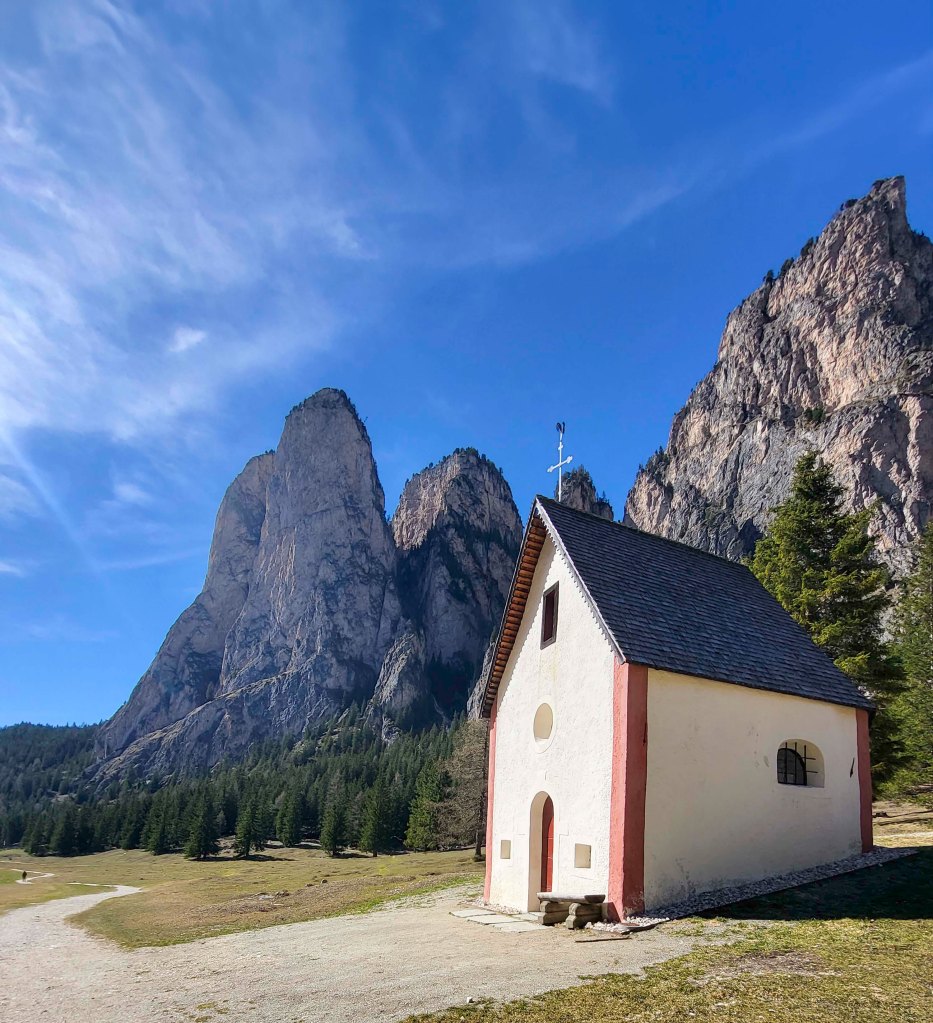
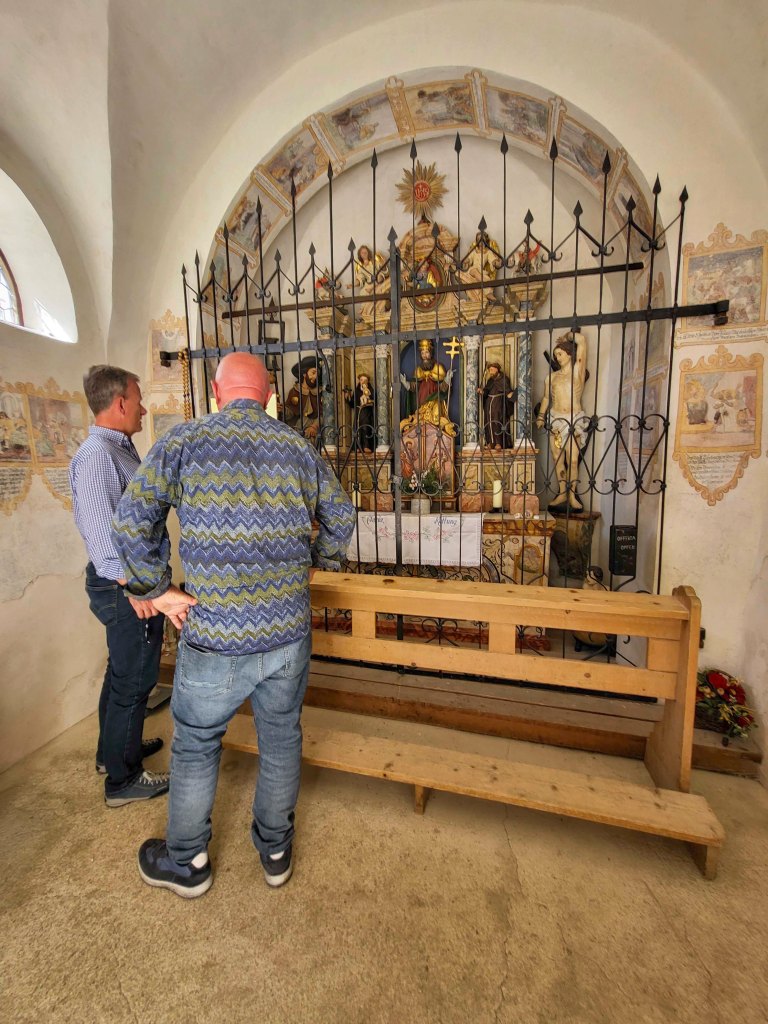
We went to a beautiful field surrounded on three sides by mountains. It was a gathering place for people and animals when invaders were coming. Today there is a beautiful community chapel for remembering locals who have died.
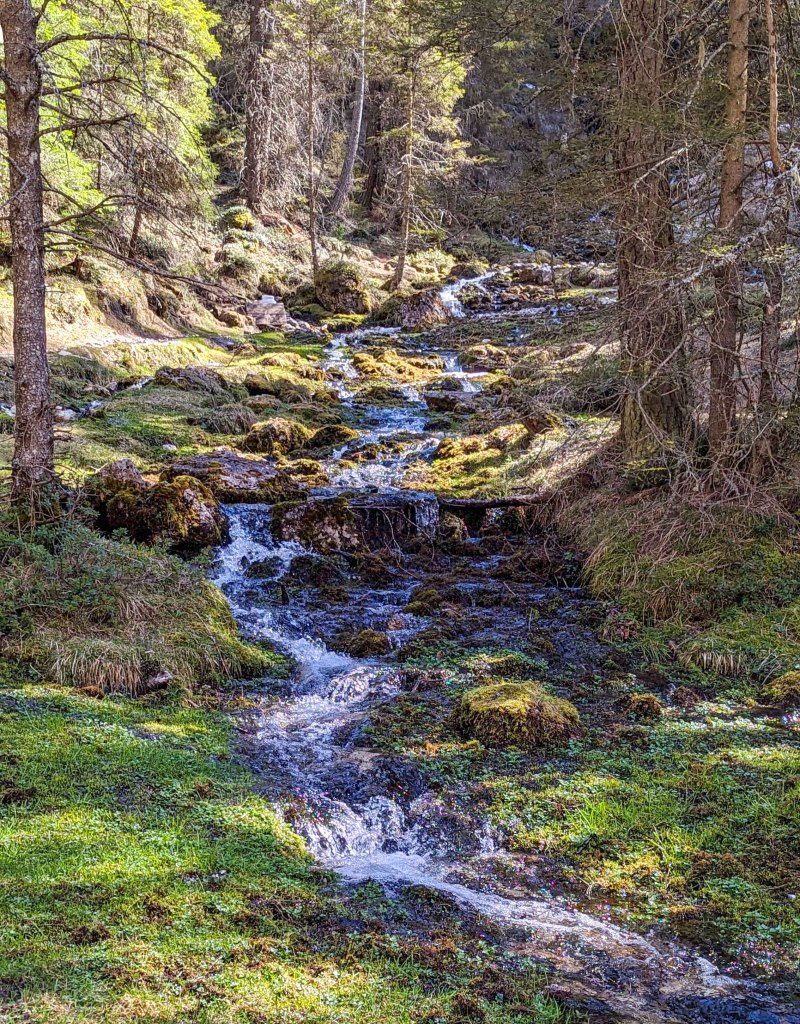
And a lovely mountain stream was flowing through the field.
More slopes!
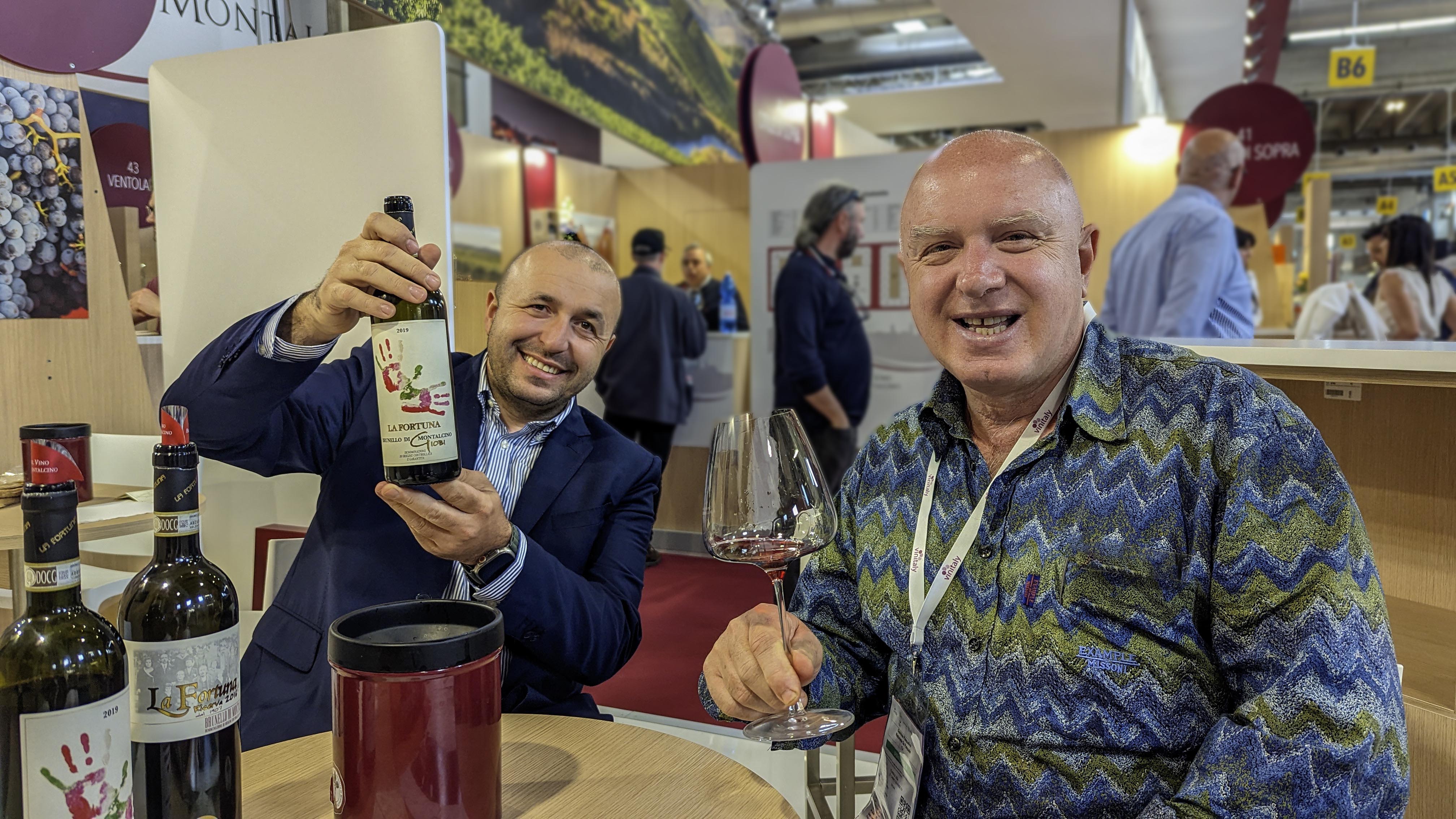
We then headed south to Verona. Jim and Pasquale attended VinItaly, the largest wine event of the year in Italy. It gives them an opportunity to enjoy old favorites, discover hidden gems, and visit with producers and wine lovers. There are thousands of wines to try, and they typically taste (then spit) over 100 wines per day!
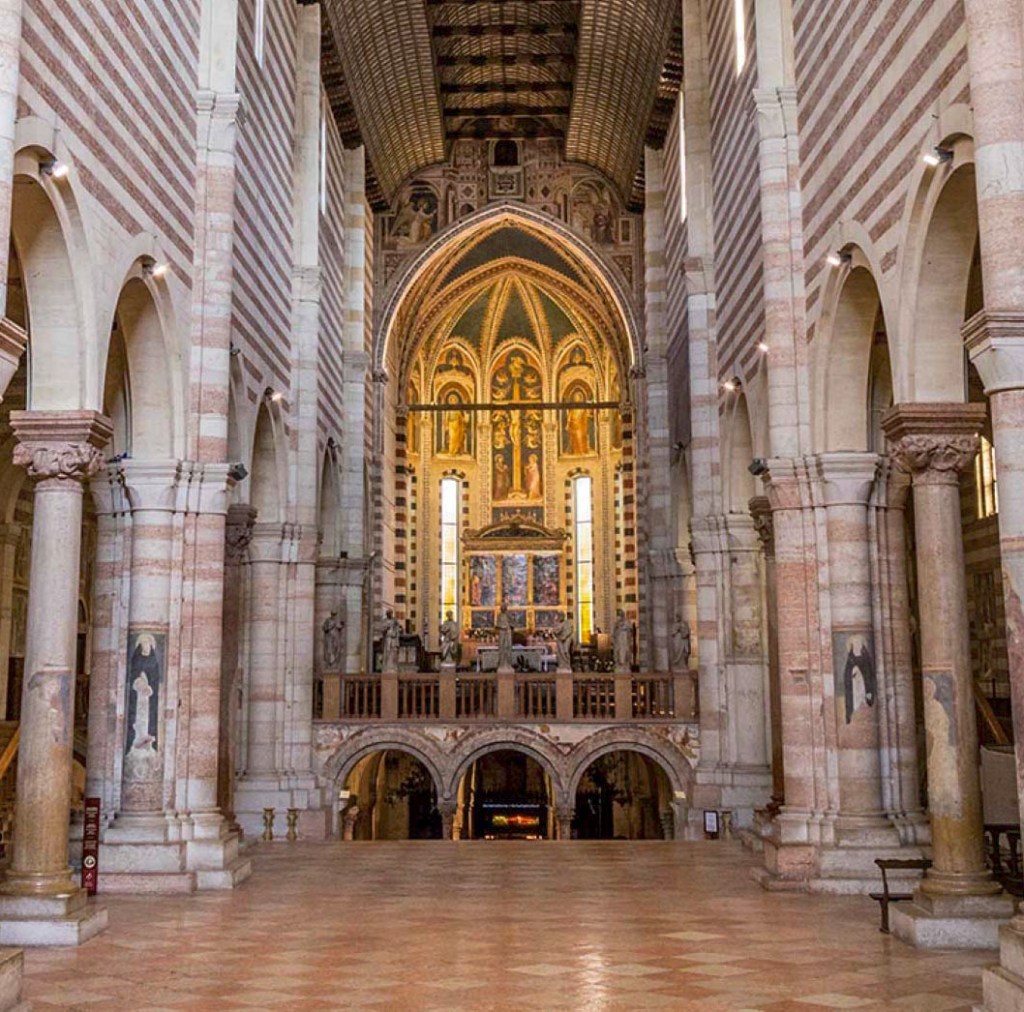
While Jim and Pasquale were tasting and spitting, I explored Verona. We have visited Verona several times, so I have already seen the biggest sights (the spectacular Roman arena that is still used today and the fictitious location of Juliet’s balcony from Shakespeare’s Romeo and Juliet). My objectives during these days were to enjoy the pleasant piazzas and learn more about some of the Veronese artists. I had plenty of time to peek into courtyards, wander the streets, and enjoy a cappuccino at the cafes. And I visited more than a few churches… but I have included pictures of only my favorite: Basilica di San Zeno.
The basilica has a rather unusual layout – there are three different levels: the central church, a raised Presbytery and a lower Crypt.
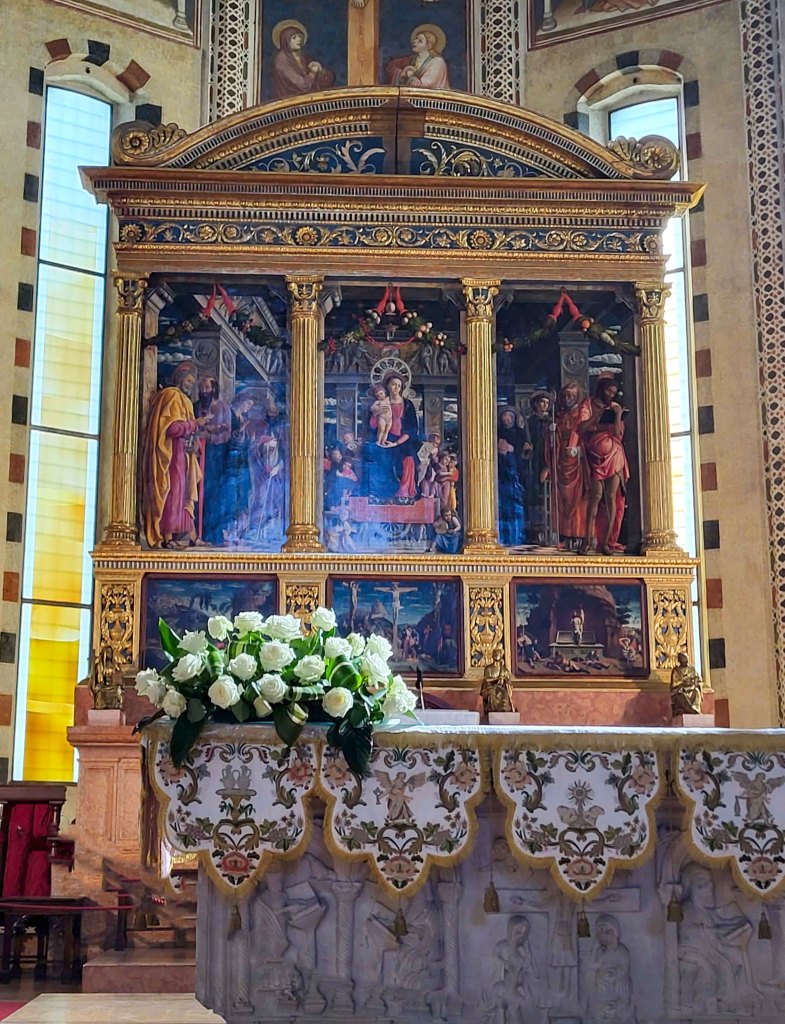
The San Zeno Altarpiece by Andrea Mantegna, an important Renaissance painter from Verona.
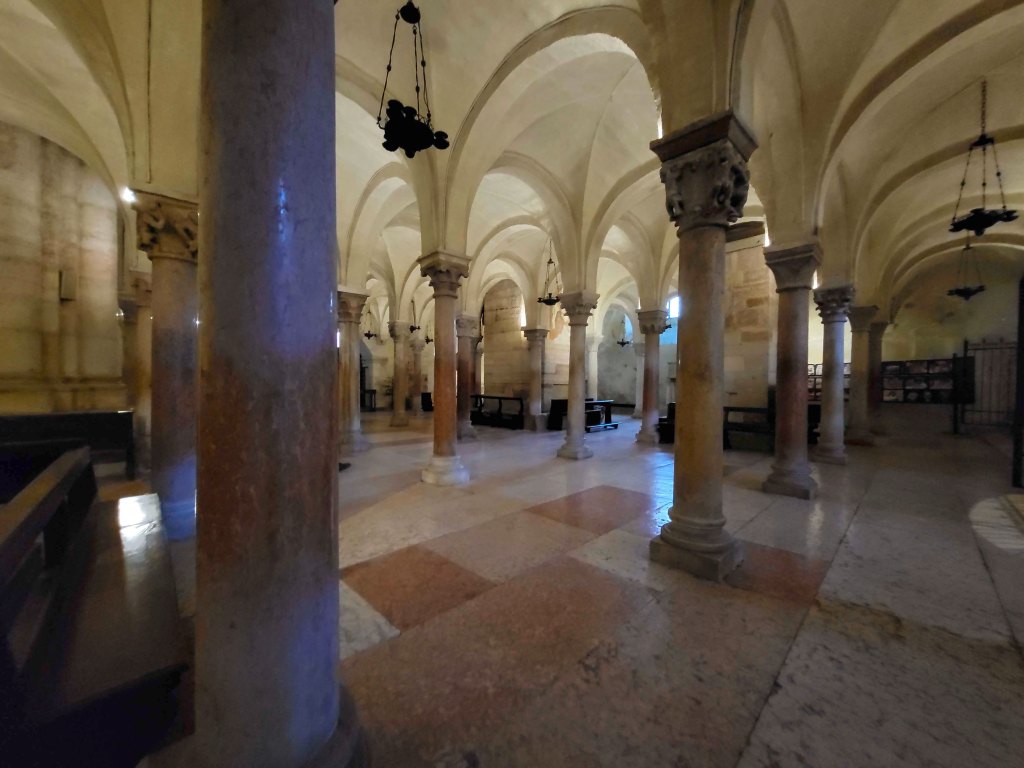
The crypt houses the body of Saint Zeno and has 49 marble columns! You can also see the giant columns from the main part of the basilica. Very cool space!
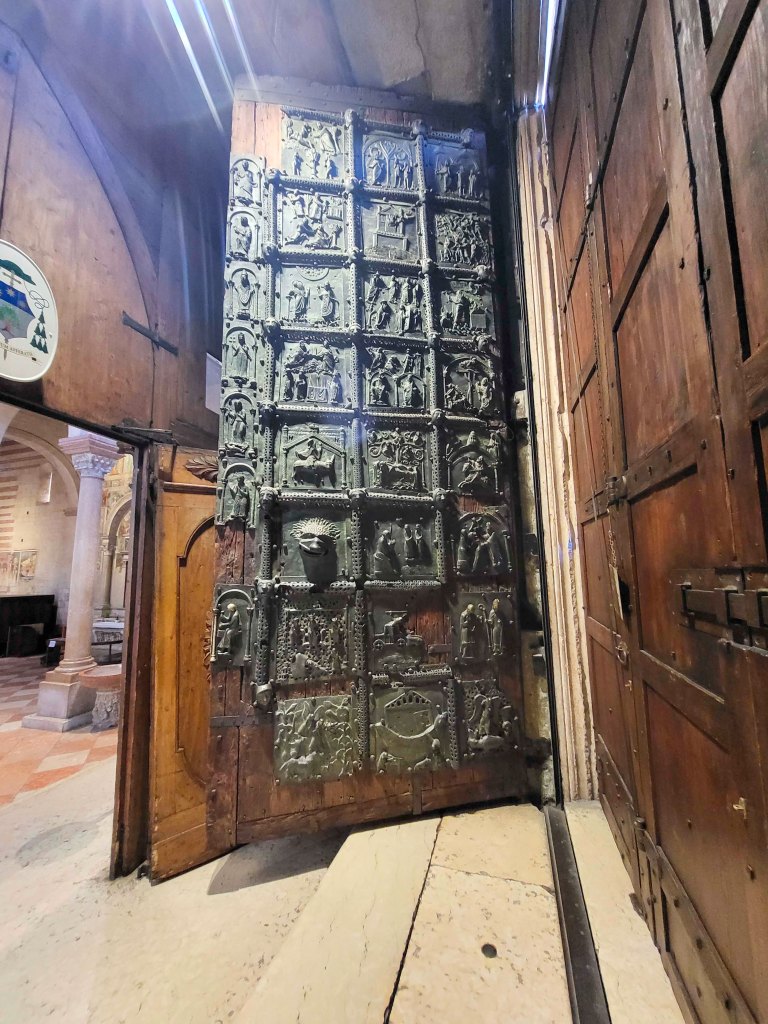
Bronze door from the Medieval times. I’ve never seen anything like this!
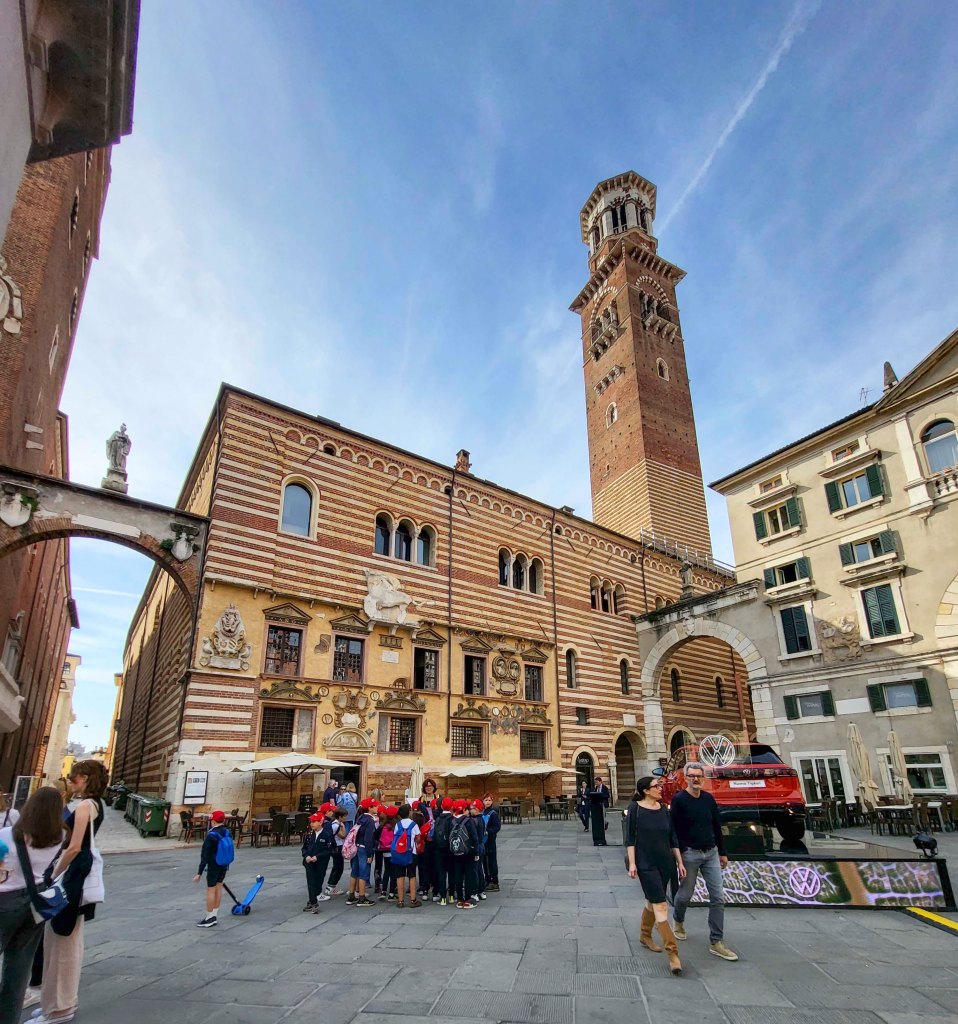
Piazza dei Signori with incredible architecture and art, along with a fancy car for the VinItaly crowd!
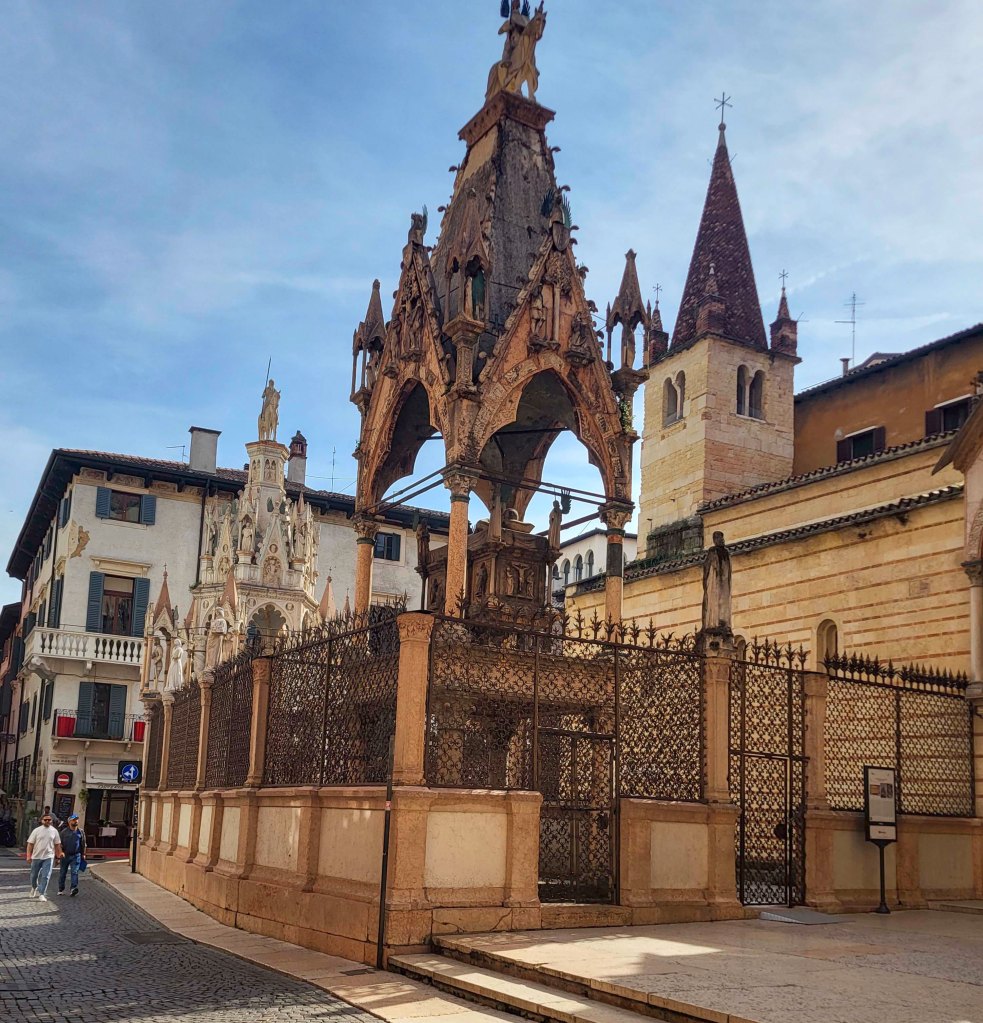
Very elaborate tombs for the Scaligeri family from the 14th century.
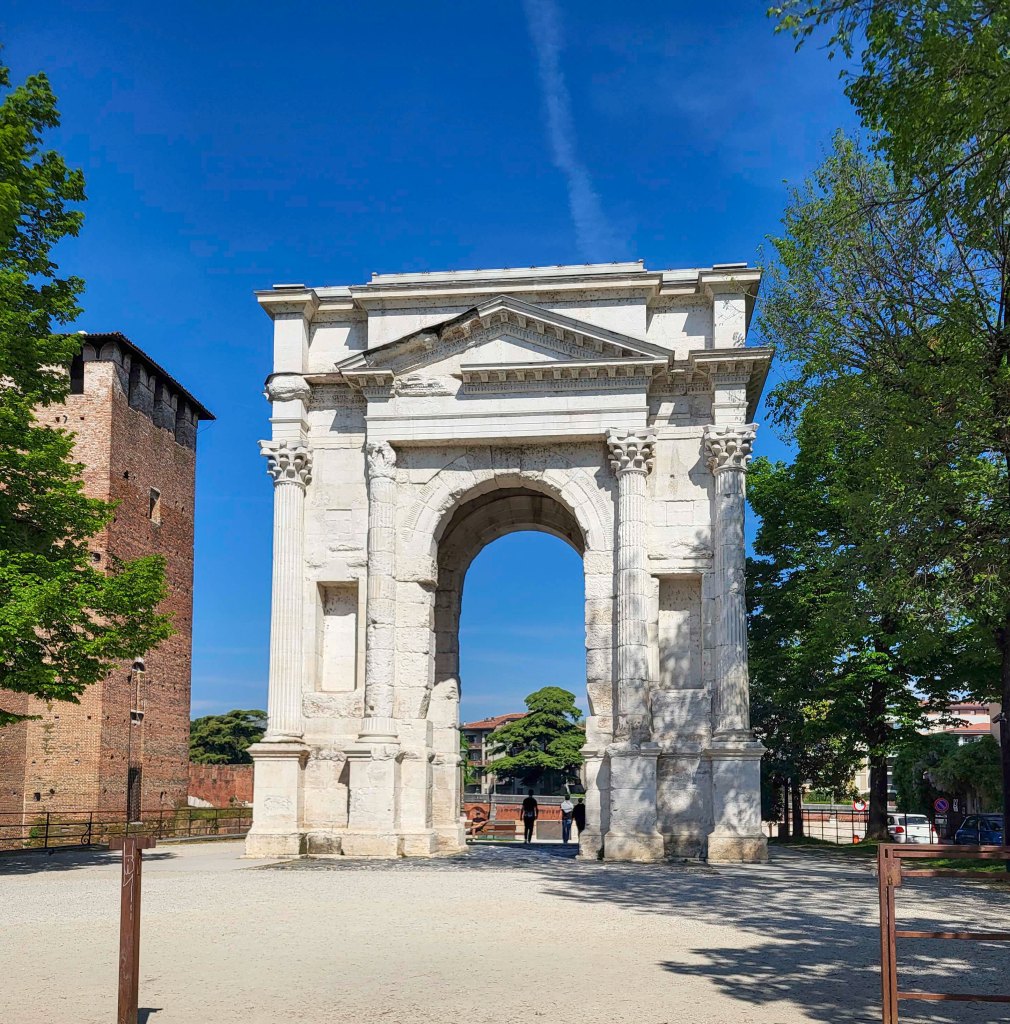
Arco dei Gavi, white marble arch from the Roman times!
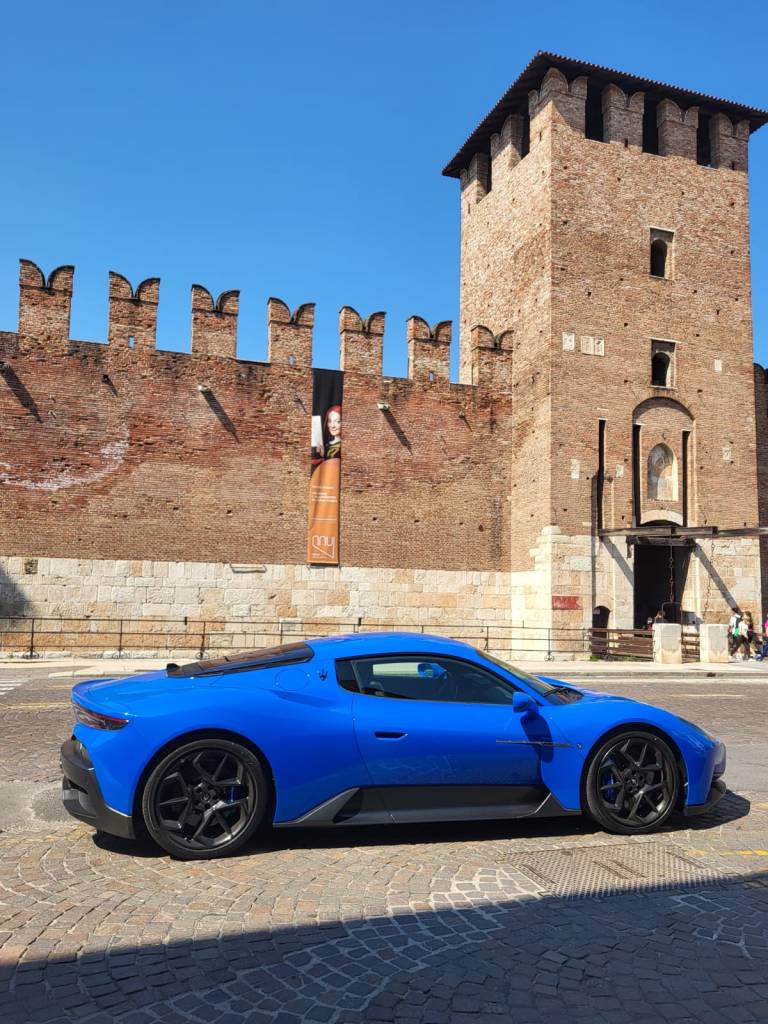
Verona is a very wealthy and elegant city, so I wasn’t too surprised to see this Masserati in front of the castle.
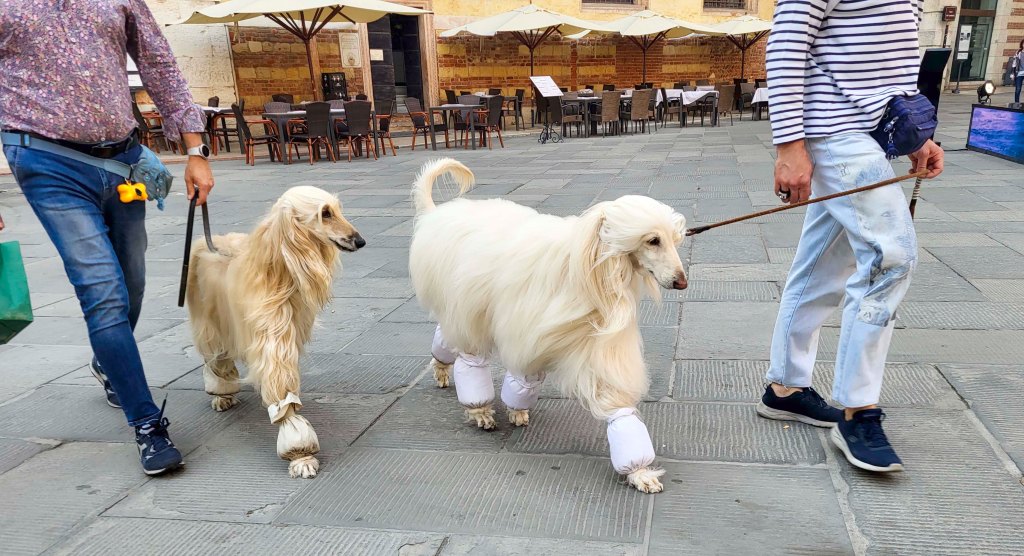
Nor was I surprised to see these elegant Afghan Hounds with their legs carefully protected.
I took a 40-minute train ride south to spend the day in Mantua, “a city surrounded by 3 artificial lakes in the northern Italian region of Lombardy. It’s known for the architectural legacy of the Renaissance Gonzaga rulers, who built the Palazzo Ducale. This imposing building houses the Bridal Chamber, decorated with Andrea Mantegna frescoes.” Unfortunately, no pictures and only 5 minutes were allowed in the Bridal Chamber but I was very pleased with myself for finding a way to visit it for two 5-minute periods!
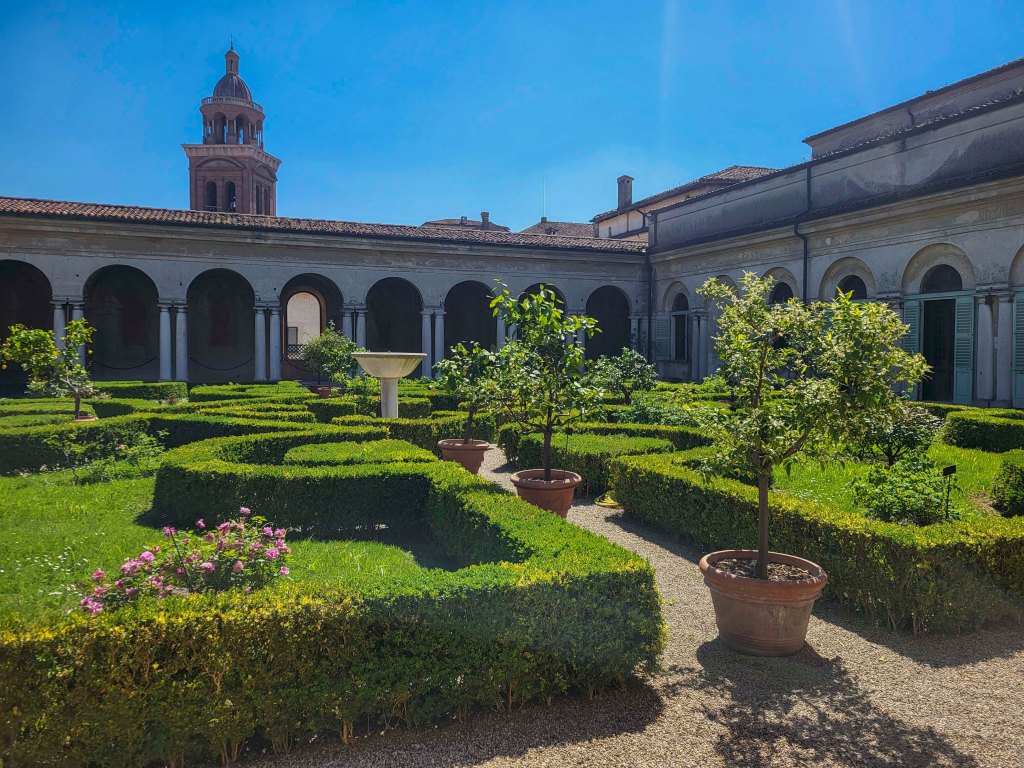
Beautiful and peaceful courtyard of the Palazzo Ducale
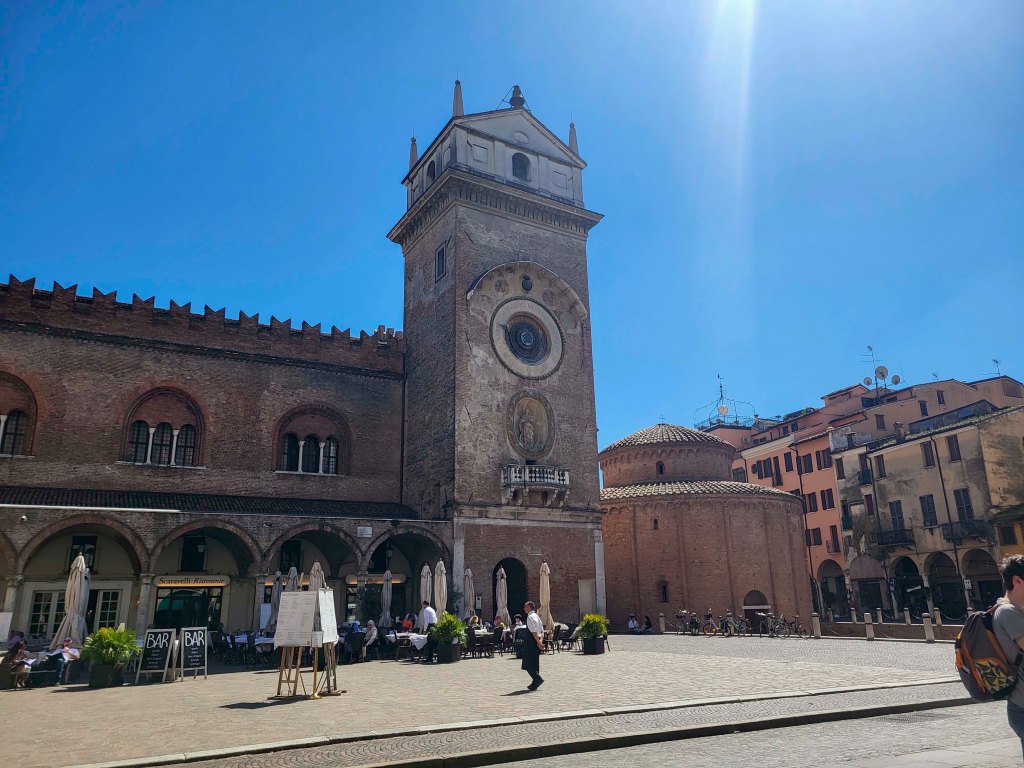
Piazza Erbe and Rotonda di San Lorenzo, a round church from the 11th century
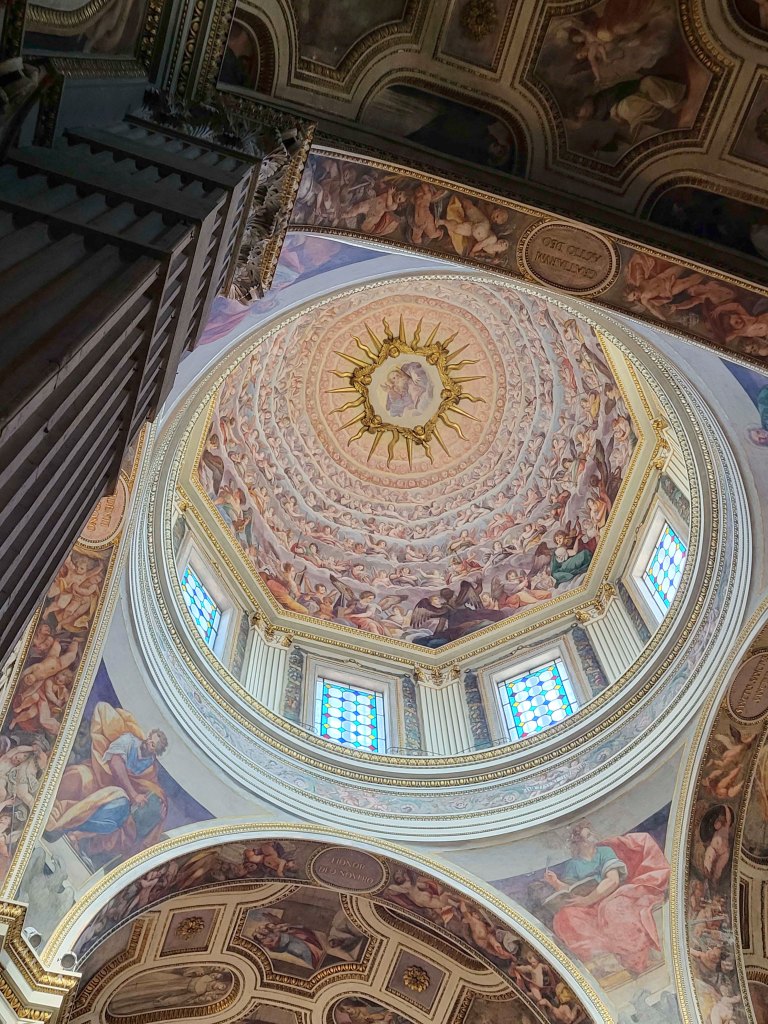
Mantova and Verona are known for their incredible domes, especially with tiers of people, some of which may look like they are reaching down from the dome.
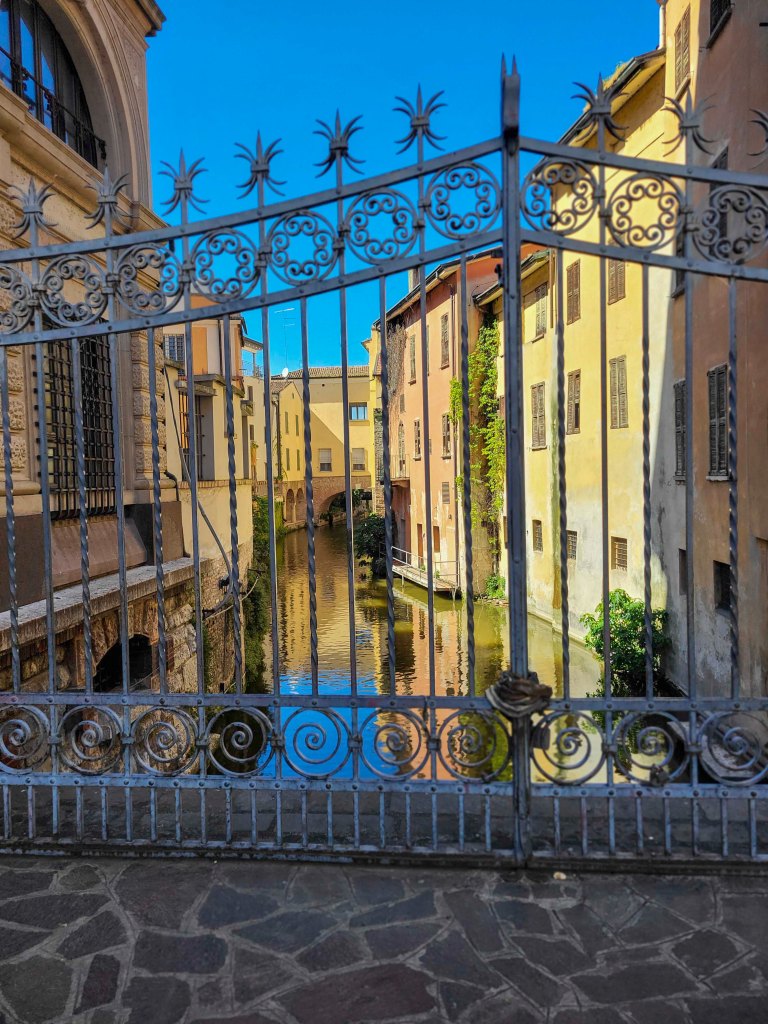
A quiet canal going through Mantova. I could live here!
As I bid farewell to these enchanting places, I carried with me a sense of gratitude for the opportunity to uncover the secrets of this captivating country. Where to next?
Our recent 4-day journey through several cities of northern Italy brought us back to familiar places, each with a unique purpose. In Bologna, our mission was Michelangelo; in Modena, it was all about balsamic vinegar; Parma beckoned us with Leonardo da Vinci, and Milan offered a wine-tasting adventure for Jim and another rendezvous with Michelangelo for me. Our final stop in Alba was a truffle extravaganza.
After the description of each visit, I’ve included photos with captions – most from Bologna and Alba.
Bologna
We have been to Bologna several times for short visits but never stayed long enough to really get to see the city. For this trip I wanted to see three sculptures by Michelangelo. A year or so ago I read “The Agony and the Ecstasy” by Irving Stone, a historical fiction about Michelangelo. It talks about each of the sculptures he made, the challenges, the circumstances, the subjects, etc. At the end of the book there is a list of all the sculptures and other art that he created that are still available to be seen; seeing each of the sculptures that are in Italy has become my objective. When Michelangelo was still fairly young, he created three statues for the Basilica di San Domenico. They are part of a large monument containing the remains of Saint Domenico. It is interesting to see Michelangelo’s statues intermixed with other artists’ work – you can see how Michelangelo’s style and capabilities are so much different than the other artists.
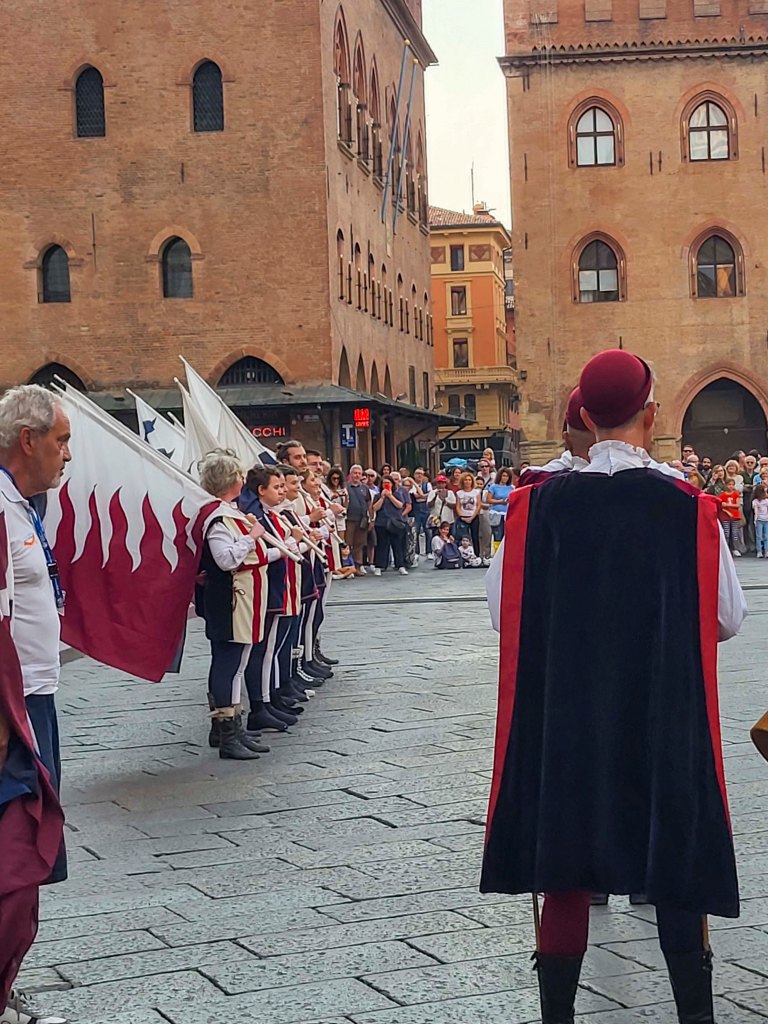
We were surprised to learn that the day that we arrived was the biggest festival day of the year in Bologna. There were many events in Piazza Maggiore in the city center, including music, dancing, drums, flag throwing and even fireworks! We were both quite surprised that they were going to do fireworks in the middle of a historic square but they certainly did; we saw fireworks that were let off from the ground 100 meters from us and on top of a historic building
On our earlier visits to Bologna, we were disappointed in the number of graffiti, the random mix of new and old buildings near the city center, and the general grittiness of the city. We saw too much graffiti, but also saw more beauty during a two-hour walking tour that helped us to understand the history of the city. For example, we learned that Bologna was bombed heavily during World War 2. Today you might see a beautiful old building but it was likely restored after the war and then next to it is a new building because the earlier building was totally destroyed.
I have a much better sense of Bologna and look forward to returning in the future.
Bologna has beautiful porticos throughout the city. Great on rainy days!
The Arca di San Domenico where remains of Saint Domenica, founder of the Dominican Order. Can you spot the Michelangelos?
The Michelangelo statues: St. Petronius (the patron saint of Bologna), an angel holding a candle and St. Proclus. (St Proclus is on the back of the monument.)
The door of Basilica of San Petronio, in the main piazza of Bologna. The carvings are by Jacopo della Quercia who also created a lot of art in Lucca.
Cassini created a meridian line in the church in 1655. From this, he was able to calculate the duration of the tropical year, the timing of equinoxes and solstices, and the tilt of the earth.
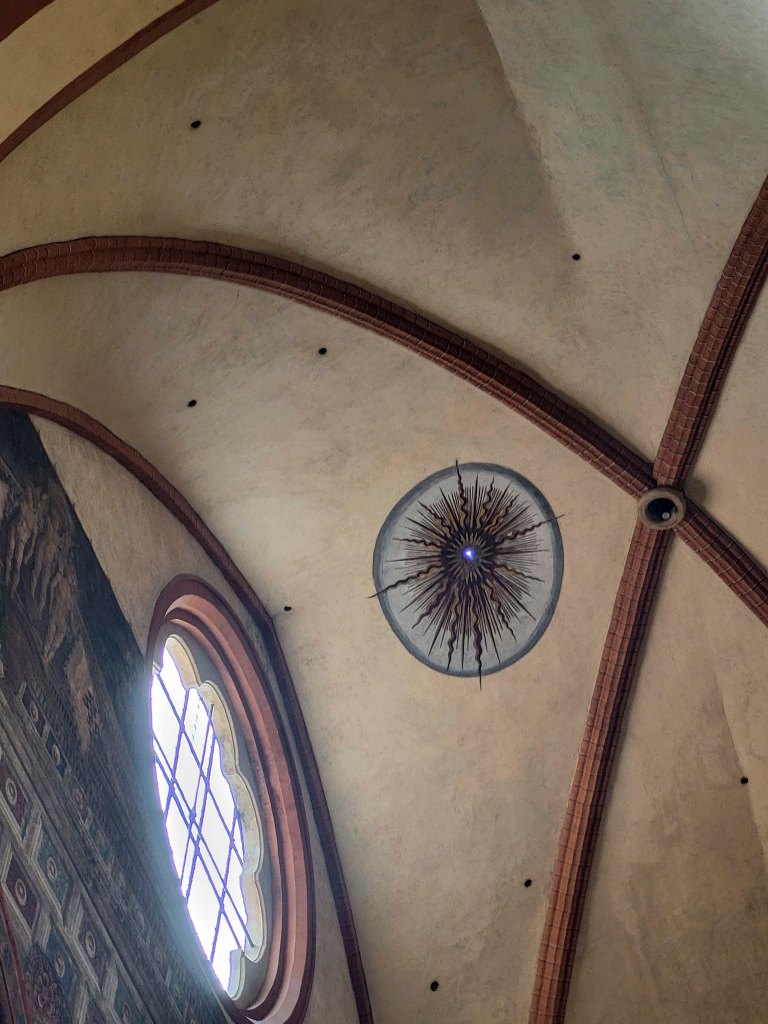
This small hole projects an elliptical image of the sun, which at local noon falls exactly on the meridian line and every day is different as to position and size.
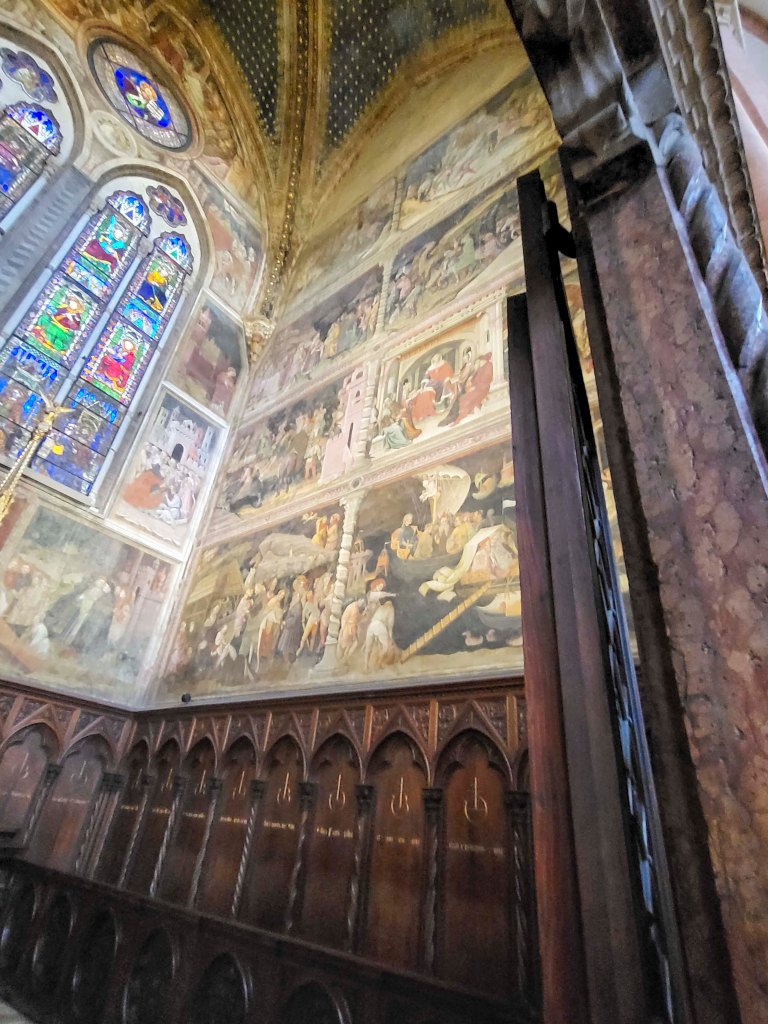
The beautiful Chapel of the Magi, with stained glass window, frescos and beautifully carved choir seats.
We unexpectedly arrived on the Festival Day for Saint Petronio. Lots of activity in the piazza!
What would an Italian festival be without flag throwers?
Very energetic choir performing in front of the basilica!
Later on, a pop group with lots of Italians dancing in the piazza. I’m not sure what Quercia would have thought about that lighting on his beautiful carved exterior…
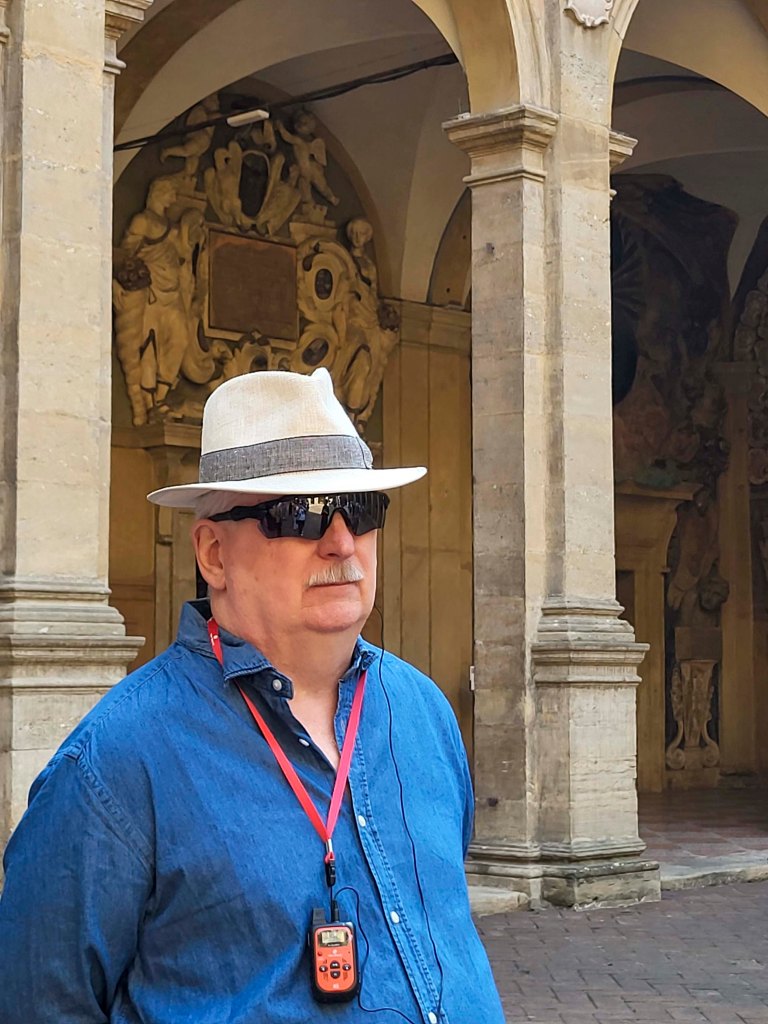
We took a two hour walking tour and learned a lot about the history of Bologna. Our turn to be tourists!
We weren’t able to enter this library, but we did get a peek through an open door. Wow!
We loved their market street, especially in the morning when the locals were buying their food for the day.
Lots of tourists in the afternoon checking out the fish in the marketplace
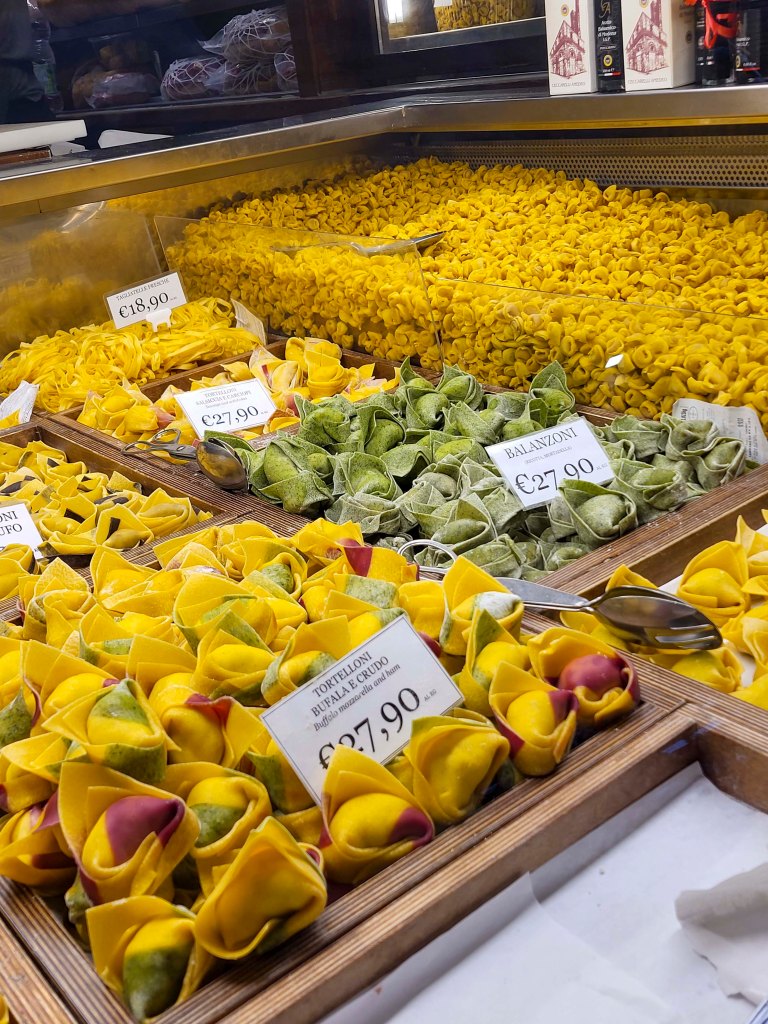
Bologna is very serious about their pasta!
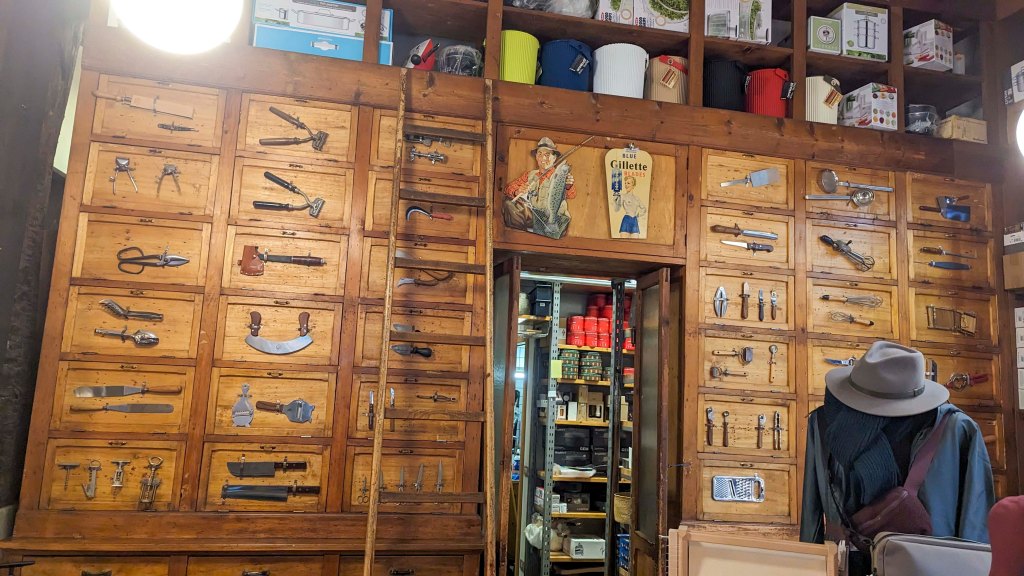
We bought a vegetable peeler at this great kitchen store on the marketplace street.
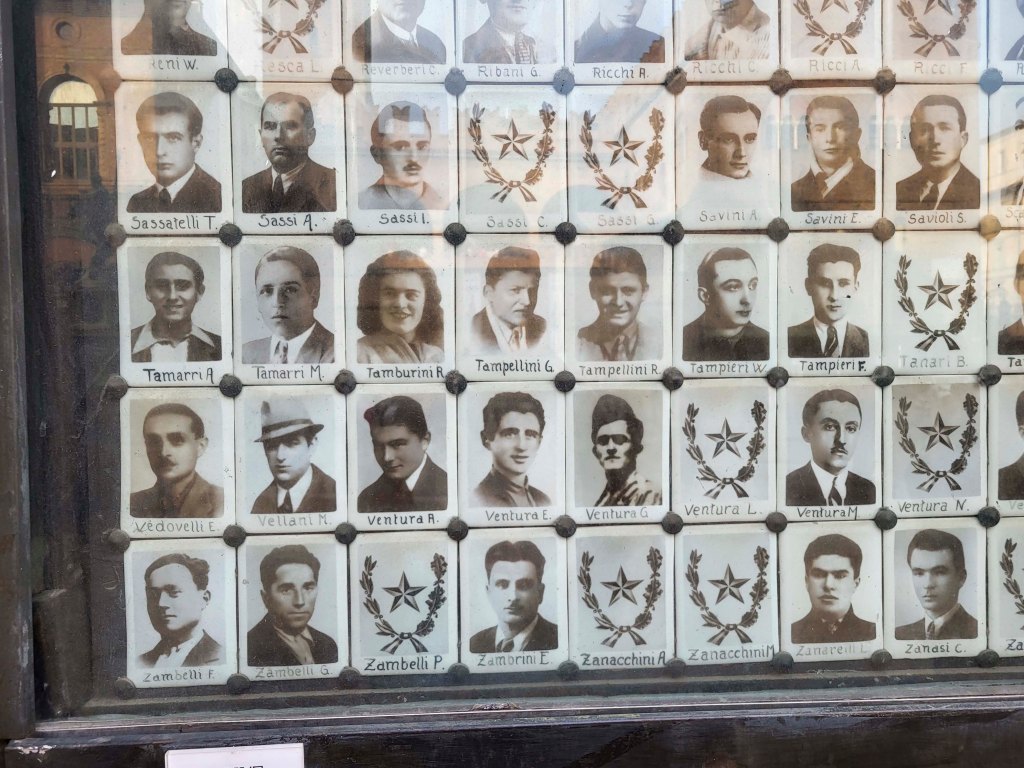
A striking memorial recalls thousands of Bolognese men and women killed fighting fascists in World War II.
Closeup of the Memorial
Modena
Next, we headed to Modena, a small town about an hour from Bologna with one simple objective: visit Acetaia Cavedoni, a small farm that we’ve visited several times before. They make balsamic vinegar and we have been on their tour several times (see my friends’ blog post that describes the tour and how balsamic is made. Fascinating!) Today our goal was simply to buy some balsamic for ourselves and for our friends and to catch up with the owners. A bonus was the beautiful grapevines that are turning color for autumn.
Beautiful grapes still on the grapevines
Parma
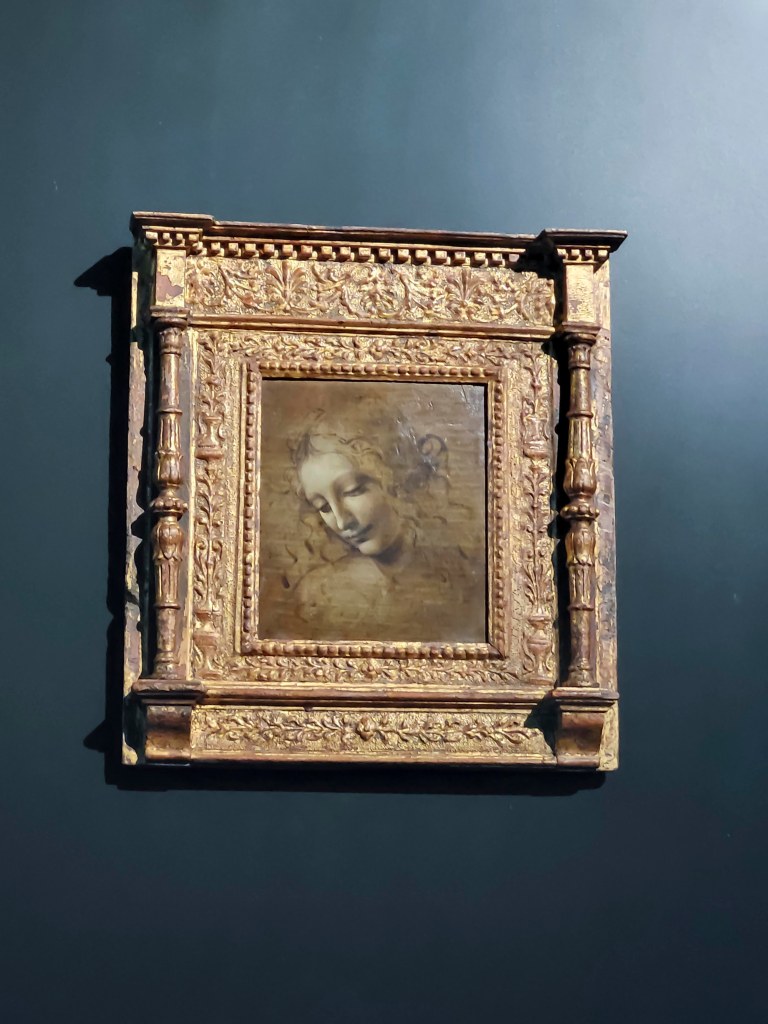
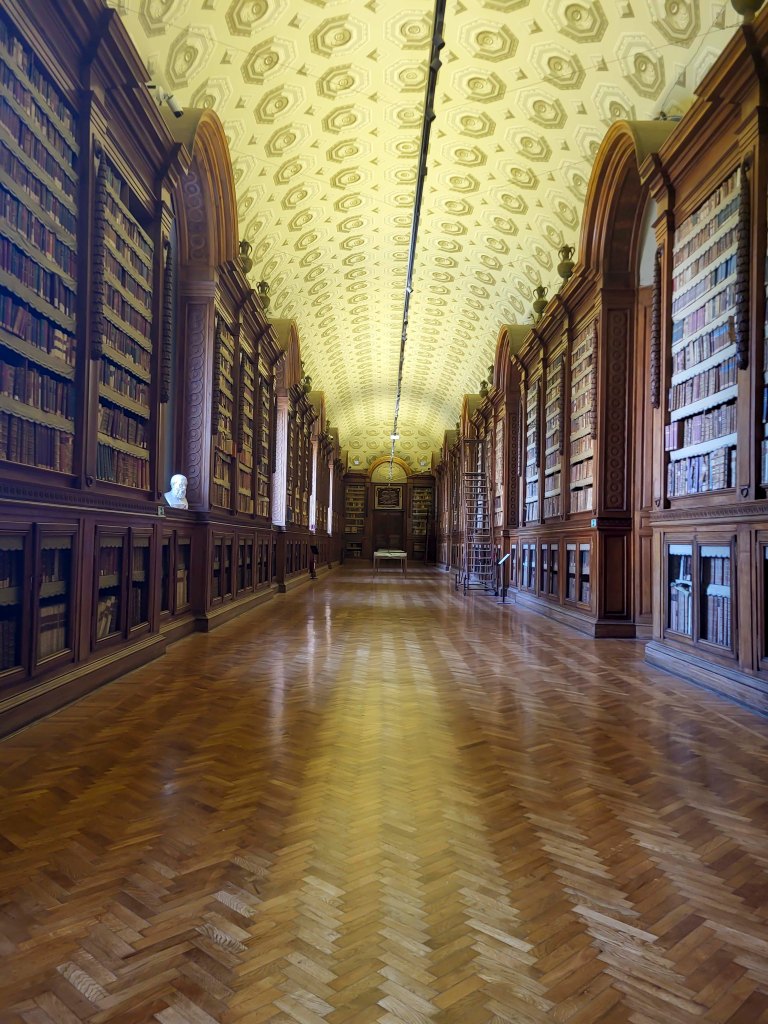
You may not have recognized the name of Parma but you certainly know its primary product – Parmigiano Reggiano cheese, which is very different than “Parmesan” cheese. Parmigiano Reggiano DOP can only be made in the province of Parma. Today we were not visiting to learn about the cheese or even buy some, but to see a particular painting by Leonardo da Vinci. As I was planning this trip, this painting popped up and I was transfixed. The painting is called “La Scapigliata” and I love the precise detailing of the face and the use of shadow, next to the sketch-like hair and torso. How does this work together? No idea, but it does! The painting was in one of several museums located in a huge palazzo (palace) that was owned by the Farnese family. The surprises were the incredible wooden theater, built for a visit of Cosimo de Medici, and an incredible library that is still used by students of the University of Parma and others.
“La Scapigliata” by Leonardo da Vinci
Another gorgeous library! This one is still used today by the community and the college students. (They also have new books.)
Wouldn’t you love to read each one???
Milan
Our next destination was Milan. Jim would be meeting two friends from Lucca at a wine tasting. They tasted about 100 wines in four hours. How do they do that? Well, they don’t drink each of the tastes, but rather take a small amount then spit it out. Then they talk about it (a lot)!
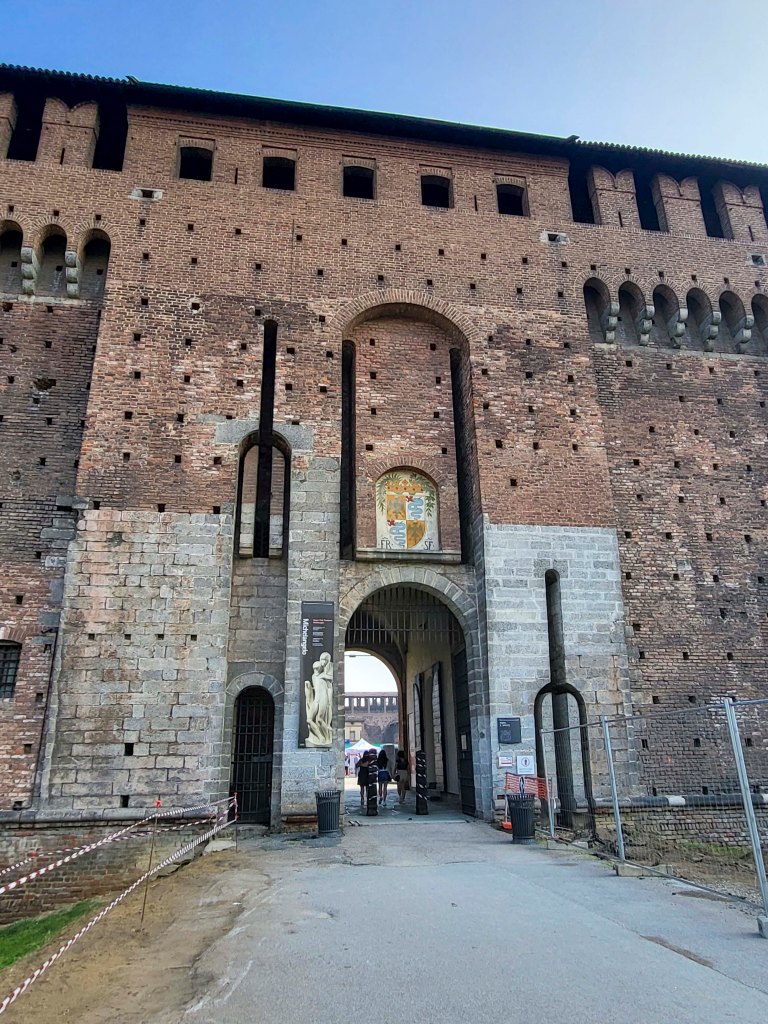
My objective was to see a Michelangelo statue at Castello Sforzesco called Pietà Rondanini. A Pietà (Italian meaning “pity” or “compassion”) is a subject in Christian art depicting the Virgin Mary cradling the body of Jesus Christ after his descent from the cross. Michelangelo created three different Pietàs… one at the beginning of his career (in the Vatican), one mid-career (now in Florence) and one unfinished as he was working on it when he died (now in Milan). Each shows Mary’s sorrows as a mother grieving the loss of her son while also understanding the special spiritual nature of His life. Each is profound, but I have to say that the one in Florence is my favorite.
BTW, there are 33 statues by Michaelangelo in Italy; I’ve now seen 27 of them!
There was also lots of other museums within Castello Sforzesco. My plan was to see the Pietà, check out the Castello for a while, then walk to the Duomo (Cathedral). I spent way too much time at the Castello, so just headed back to the hotel. I met Jim after his wine tasting and then we headed to our final destination for this trip.
Jim’s destination – The Slow Wine tasting!
JoAn’s destination – Castello Sforzesco
The Pietà Rondanini
yep, Michelangelo made it!
Alba
We stayed between Milan and Alba at Il Cascinalenuovo that they describe as a “restaurant with rooms.” This is a Michelin-starred restaurant with a few rooms that allow you to stay on property so that you don’t need to drive after a lengthy meal with wine. It met our needs perfectly. This is white truffle season and we splurged for a multi-course meal that included white truffles as a part of each course. Still, my favorite was the simple pasta with those wonderful truffles on top. The most interesting was a small piece of Robiola cheese, a bit of pepper and olive oil, and truffles – how can something so simple be SOOOO good?
So, what is a truffle? Truffles are edible fungi that grow underground near the roots of certain oak trees. They have a very distinct look—that sort of resembles a dark, small, lumpy rock or potato—and a flavor that’s savory, earthy, and completely unique. Some describe the aroma and flavor as a cross between honey and garlic. Actually, the aroma is much stronger than the taste and is the driving aspect of the experience. There are different types grown in various locations in the world, but most people would agree that the White Truffles from Alba are the best in the world. I do need to add that they are quite costly, so eating truffle shavings is truly a special experience!
Alba has a Truffle Fair each October where they sell these truffles to people who come from across the world. This is our third time visiting the Truffle Fair and we planned to buy two truffles – one for us and one for a friend. We found our truffles (36 and 41 grams, respectively), enjoyed the fair, then headed for home. We enjoyed several meals with our truffle and I was even able to duplicate the cheese dish for some friends that visited a few days later.
Truffles, truffles, truffles!
Here are the five courses
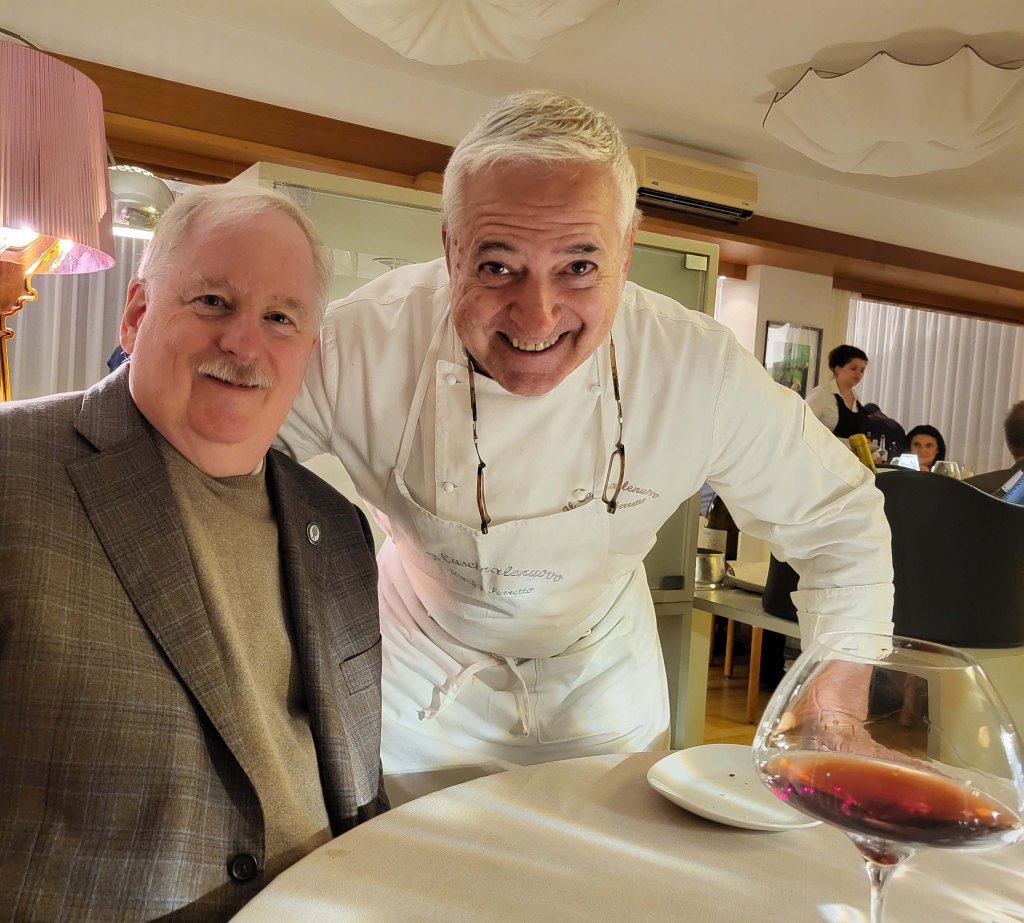
Jim and Chef!
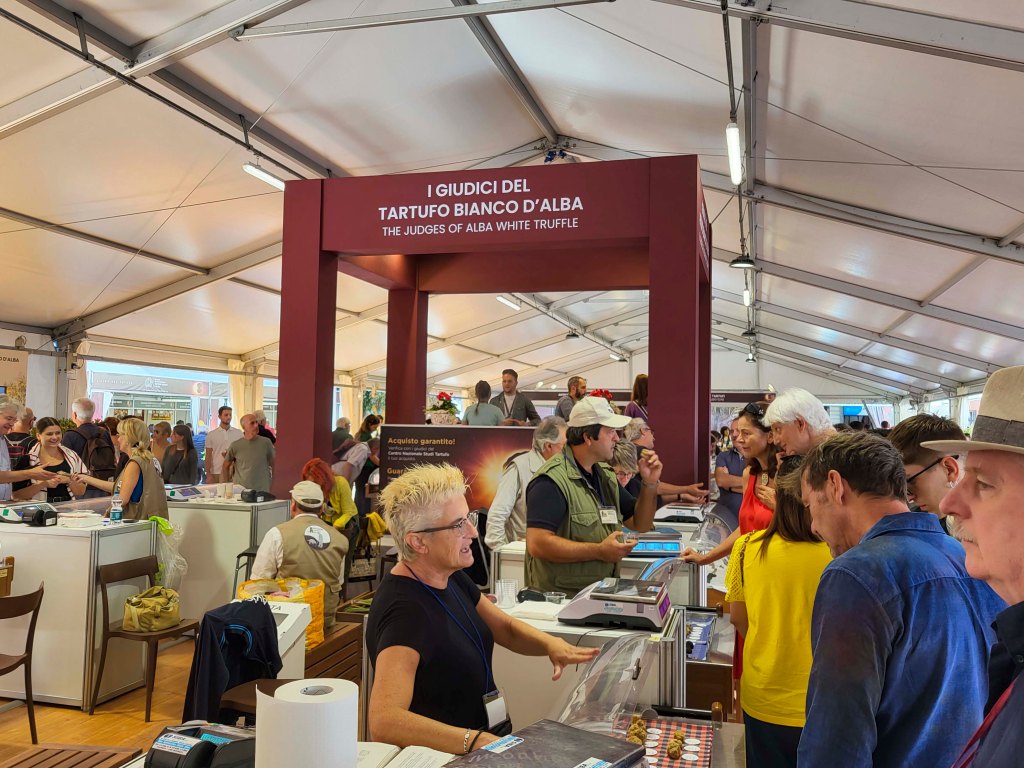
Alba’s Truffle Fair
Here’s a typical display of white truffles on the left and black truffles on the right. The white ones are the best!
The happy sellers of our two truffles
Truffles and pasta with the simplest butter sauce at home. We ate truffles for 4 meals and shared some with friends with cheese.
Retiring in Italy has allowed us to embark on numerous adventures throughout Italy and Europe. It has been a joy to revisiting our some of our favorite cities, uncovering new layers of history and experiences with each return.
After we arrived to Lucca in 2020 and the lockdowns started to be lifted, we began to recognize our “neighbors” on the streets. We live near one of the main entrances to Lucca and on the busiest shopping street of the city. So, we see visitors, tourists, Lucchesi, and our neighbors on a regular basis. Our neighbors include people that live close by, those that work in the businesses, and a variety of interesting characters. Some are well loved characters, such as Mario, who wanders the streets of Lucca singing, greeting the locals, and begging from others.
We also noticed a guy outside our palazzo that kneeled on a pad most evenings while begging. How could he kneel for so long without being in terrible pain??? We call him “Kneeling Guy”. Very creative, eh? He doesn’t really beg, but holds up a sign that says “Un Po di Aiuto” which roughly translates to “Some Help?”. I also noticed that many the locals stopped and chatted with him; he stands up and engages with them in lively conversations, just like many other groups on the streets. He often talked to the shopkeeper across the street. After a while, I greeted him with a friendly “Buono Sera” or “Good Evening”. He seemed like a healthy man in his late 40’s and Jim and I wondered what his story was.
One evening I was sitting on the step waiting for someone to arrive and we acknowledged each other. A person then left the B&B across the street and left the front door open. You don’t do that on our street – too busy! “Kneeling Guy” and I both looked at the door and exchanged puzzled looks. He got up, closed the door and I acknowledged his neighborly action. Our first interaction beyond simple greetings. I never gave him any money and he never asked for any or even seemed to expect it from me.
Over time we chatted briefly. He spoke Italian and was quite difficult for me to understand. For Christmas 2021 I made American-style muffins and gave them to many of our acquaintances. I gave him some muffins and a monetary gift. He was very appreciative and there were many “Buon Natale” greetings exchanged.
Through 2022 we continued to chat. I asked his name at one point but didn’t really understand what he said. I learned that he had a heart condition and was not allowed to work. One day Jim and I were walking down our street for the Italian tradition of an evening stroll called “passegiate”. I was shocked to see him in a different place – he was always right outside our door. Not every evening but several times I week. He saw my shocked looked and explained that it was just too busy at his usual location so he decided to move. Funny how we react when things unexpectedly change in our world.
The week before Christmas I saw him on the street, still in his “new” location. I gave him the gift and again he seemed quite pleased. He even mentioned the muffins that I gave him last year – I was touched that he remembered the gift! We chatted for a few minutes and he mentioned something about getting a new job, but I didn’t fully understand what he said.
For Christmas this year, I didn’t plan to bake but I wanted to give him a gift. I want it to be appropriate and useful, but more like a gift than a handout. I discussed this with my Italian tutor and she suggested socks or a hat, common gifts in Italy. There is a family that has sells socks from a stand on our street; I also consider them neighbors. They helped me select some warm socks and they even put them in a festive red bag with a bow. Perfetto! I included a Christmas card with a monetary gift and now I just need to carry it each evening when we out until I saw him again.
The next evening, we saw him again and he stopped us to chat. Again, he thanked us for the gifts and then shared his good news with us. That day he had succeeded in finalizing a contract for a new job. It sounded like he would be delivering the vehicles and then taking the train back. But that could be wrong… my comprehension with him is pretty low. The contract part is key; in Italy, with a work contract you have many protections and it is assumed to be a long-term position. He said that he would start at four days a week, but that it would increase. He would be starting on January 2nd and would need to buy some new clothes (which I assumed would be purchased with our monetary gift).
He also said that he would be here this evening and the next, but then no more. That is, no more kneeling on the street and he pointed to his sign. And he told us this with such gratefulness but not with a sense of shame either. He said that he hoped in the future to see us on the street but not kneeling, instead he would be walking on the street, greeting those that he knows. And he would greet us. We stood on the street celebrating his news and congratulating him. He remained kneeling, but not for much longer…
When Jim and I moved to Lucca, we set a goal for ourselves to “become part of the community” which includes learning the language, developing friends (both expats and Italians) and eventually to volunteer in the community. But that evening on our street, while celebrating with “Kneeling Guy,” I truly felt like a member of my community and especially my special neighborhood.
And none of my blog posts can be complete without some pretty pictures, so here are a few pictures that I took of my “neighborhood” – within a minute’s walk of our front door.
The front door to our palazzo
Closeup of the ironwork by our front door
The door to the Bed and Breakfast across the street
Beautiful marble sculpture above a store’s door
Former church, now a clothe store
Closeup of former church
Beautiful carved brickwork about the gelato store’s door
Sign outside of our neighborhood bar
Epilogue… 22 April 2023
What a wonderful morning! Jim and I met a friend for coffee and breakfast this morning. An older Italian woman came in… one that I see there often. A few weeks ago we started chatting beyond the standard “Buon giorno”. Today we had a good 10 minute chat including exchanging names. Paola is my new Italian friend! As we were leaving, the man formerly known as “Kneeling Guy” steps in. I asked him how he was and he said “Molto bene! Tutto bene” – very well, everything is good. Work is going well and he is enjoying a few days off because of the national holiday on 25 April. His posture has changed. His face has changed. He is a proud man.
This is also the start of our local Festival of Santa Zita that fills up our oval piazza with flower vendors. What a glorious morning!