Saturday we reached a big milestone — we now have our permanent carta di soggiorno, or permission to stay in Italy indefinitely.
How We Got Here
2017–2019: What began as a dream of moving to Italy slowly turned into a rough idea, then a sketch of a plan, and eventually into a detailed, deliberate decision.
2019: We applied for Elective Residency visas while still living in the U.S.
2020–2022: After moving to Italy, we began the bureaucratic marathon:
Annual permesso di soggiorno
Official residency
Carta d’identità (national ID card)
Tessera sanitaria (health card) All of this took from March 2020 to January 2022.
Driver’s Licenses: After one year in Italy, you must get an Italian driver’s license. The written test is notoriously difficult — even for Italians. After lots of studying, we both passed. Jim even passed the motorcycle exam, so a Ducati may be in our future.
Annual Renewals: Every year we had to apply for a new permesso di soggiorno and tessera sanitaria. The permesso expires after one year but sometimes takes longer than that to receive, so you pick it up already expired and start all over again. A never-ending loop.
Year Five: After five years of residency, we became eligible for a permanent carta di soggiorno — and we applied right away.
Each application required piles of documents. I’ve lost count of how many times I’ve submitted our 14-page lease (always printed double-sided!).
The Stressful Part: The Suitability Certification
To apply for the permanent carta di soggiorno, we needed:
Everything required for a regular permesso, plus:
Italian language certificate (A2 level)
Criminal record in Italy
Certification that our home is “suitable for habitation”
We provided all documents except the last one. The last one was the hardest. Our apartment easily meets the standards, but the city wanted a properly scaled floor plan and additional documents we didn’t originally know were required. We asked the owners, the building association, a neighbor, even the building’s architect (who we know personally). Still — we could not get the last document.
Then, out of the blue, Tony (our Italian fixer for all things bureaucratic) told us our permanent carta di soggiorno had been approved and was ready to pick up. We still don’t know how or why, but we are so grateful. Truly an answered prayer.
What’s Next?
Our lease expires in two- and one-half years. Rent will probably increase after eight years at the same rate — which is fair — or the owners may decide to sell. If that happens, we don’t know what we’ll do. Long-term rentals in Lucca are currently scarce because of the conversion to short-term rentals. Maybe things will change in two years. Maybe we’ll compromise. Maybe we’ll move to another city. Buying isn’t likely — the tax implications and housing market are complicated and very different from the U.S.
Mostly, we’ll continue our retired life in Lucca. We usually have a major trip or event about once a month. In between, we plan for those adventures, study Italian, enjoy our hobbies, spend time with friends, and appreciate the simple rhythms of daily life.
After ten years of residency, we’ll be eligible to apply for Italian citizenship. That requires a B1-level language certification. I’ve already passed mine; Jim is studying for his now. We decided it’s easier to take the test at age 66 than at 71, and we’d prefer not to do it under pressure.
Reflections
I often say Italy “dares” you to live here. The bureaucracy can be slow, confusing, and sometimes absurd. Expats usually respond in one of two ways: frustration or acceptance. We realized we had officially joined the second group the day we waited 45 minutes for new tessere sanitarie, only to be told (in very polite Italian) that the computer was down and nobody knew when it would be fixed. Jim suggested we try again tomorrow; I suggested we give it a week. There wasn’t much point stressing; an expired health card doesn’t really change anything.
People often ask if we like living in Italy better than in America. The truth is, two big life changes happened at the same time: we retired and we moved to Italy. I can’t compare working life in America to retired life in Italy. What I can say is this: even knowing everything we know now — every document, every line, every impossible requirement — we would still do it again.
In my blog posts I’ve been showing and talking about the beauty that surrounds us during these early days of retirement in Lucca, Italy. But the last few weeks, Jim and I have been exploring and learning about the local World War II activities. Within an hour from our home, there were many battles fought and much sorrow. We’ve taken two trips to nearby villages to see and understand more:
The Gothic Line at Borgo a Mozzano
Between 1943 and the summer of 1944, the commanders of the Nazi forces constructed a 32K kilometer (20K miles) defensive line from the Adriatic Sea to the Tyrrhenian Sea, as a last stronghold against the invasion of Northern Italy. The defensive line was known as the Gothic Line or Green Line. At Borgo a Mozzano (about 30 minutes from our home), bunkers, anti-aircraft emplacements, communication trenches, and antitank ditches are still well-preserved. We visited a museum and two bunkers during our tour that was led by a very informative and engaging guide.
The museum was stuffed full of artifacts and interesting documents.
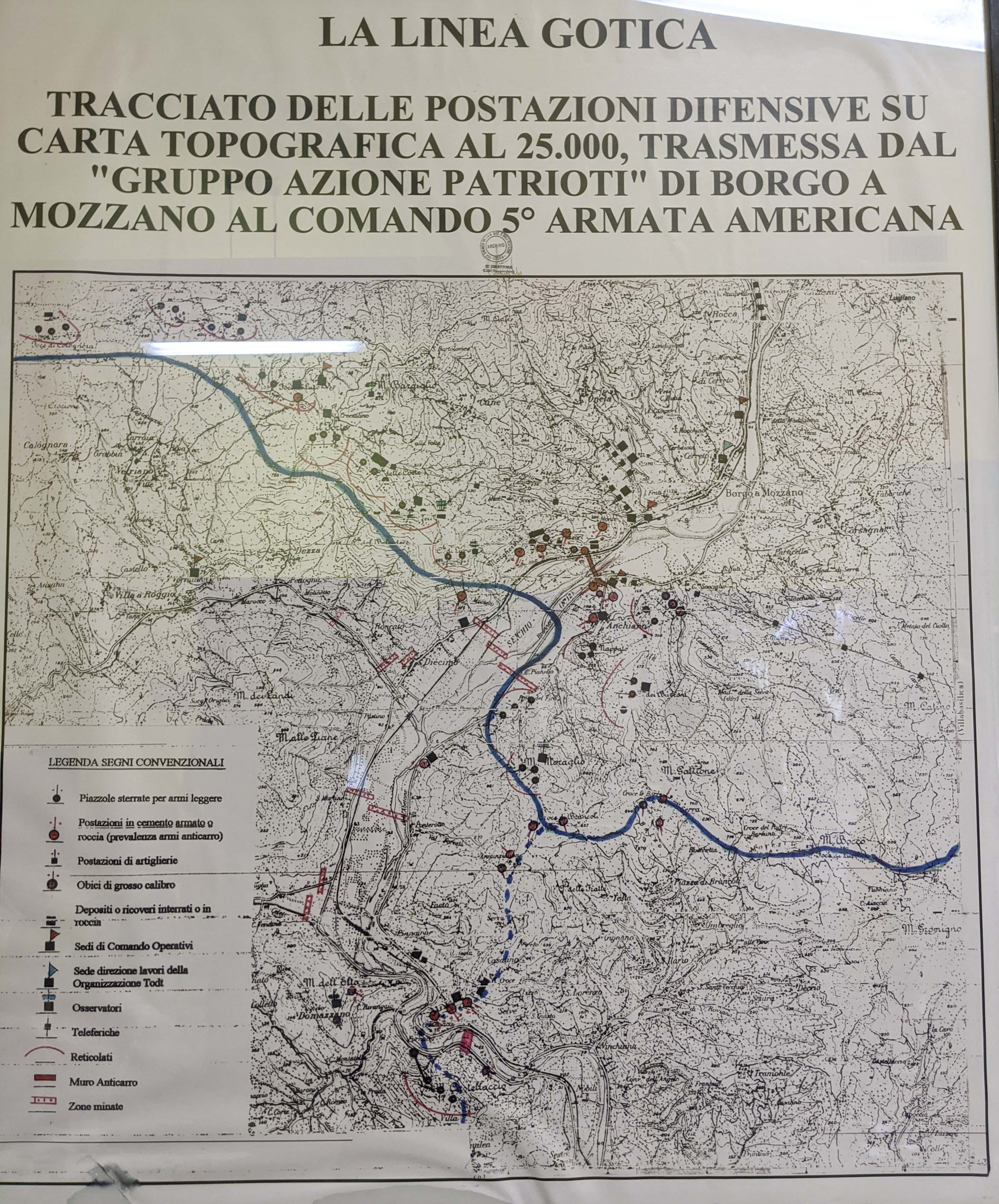
This map was copied from the Nazi commanders and taken to the Italian partisan fighters and Allied troops. The dots show locations of bunkers. Without this map, the Allied forces would have been in a very weak position. With it, they broke through the line.
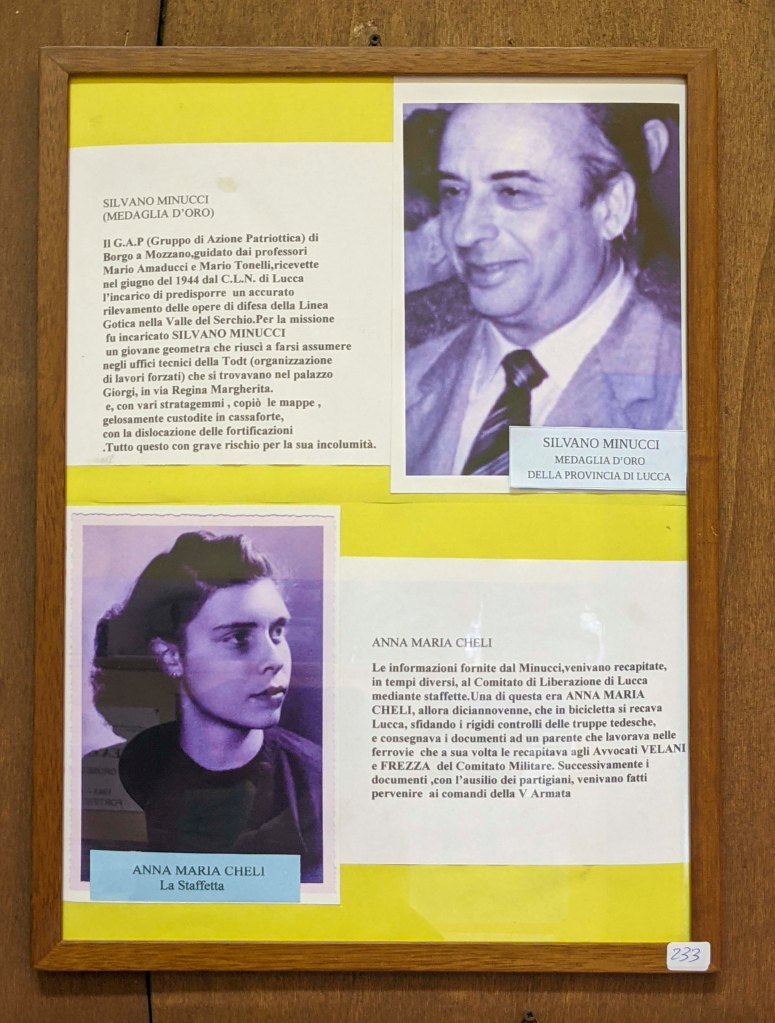
Our guide told us stories about many of the local individuals that lived through WWII, including several that he had interviewed for a book. Anna Maria was the person that brought the map from the Nazis to the partisans, risking her life. She was 18 years old at the time.
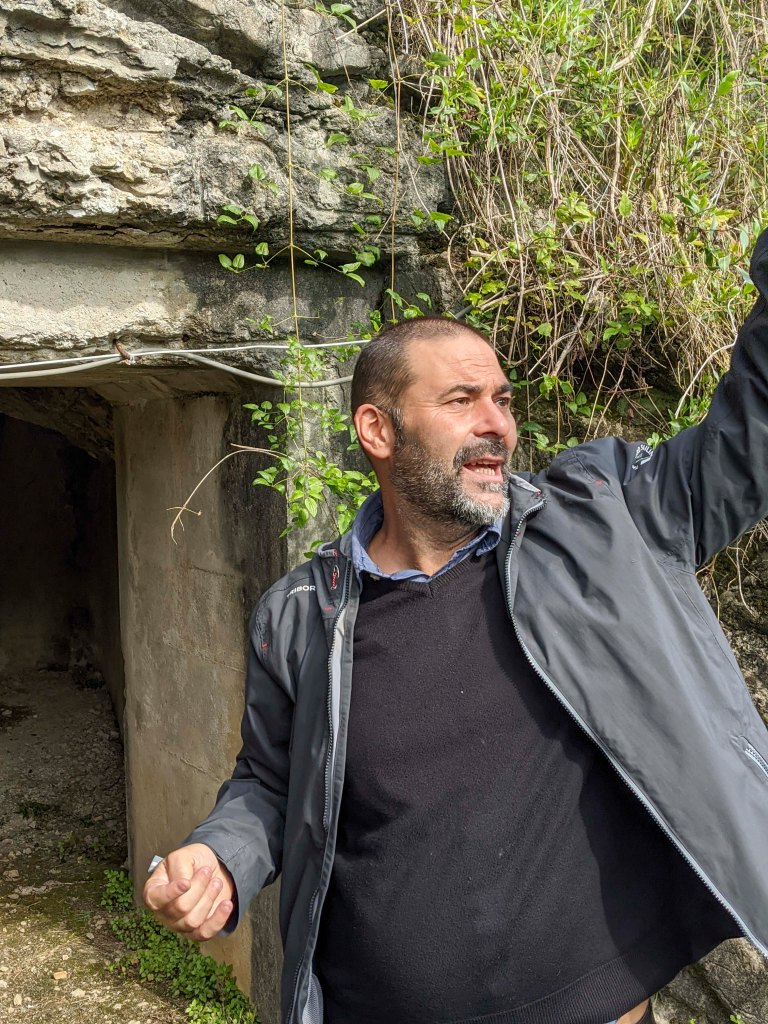
Here is our guide in front of one of the bunkers, explaining how they were built, hidden, and used during the war. We went through two of the bunkers. Most of the bunkers are not opened to the public. These two are available only through guided tours.
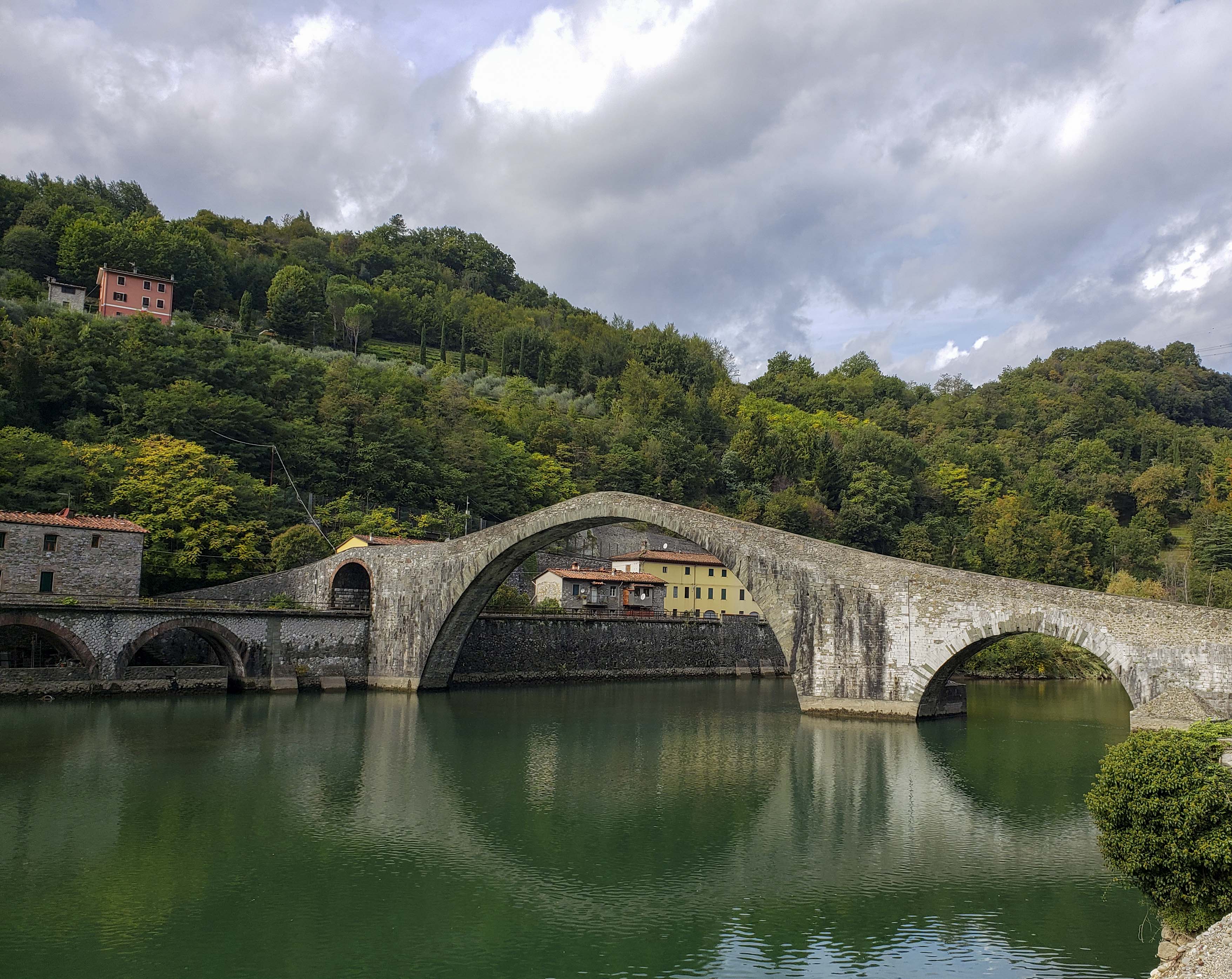
A beautiful medieval bridge located in Borgo a Mozzano. You can read the legend of the bridge here.
Sant’Anna di Stazzema
In 1944, Nazi officers were given orders to round up Italian partisans in the Tuscan region. On August 12, about 300 Nazi troops surrounded Sant’Anna di Stazzema, a small village in the Apuan Alps. This remote village had been flooded with refugees that were gathered here to hide from the Nazis. The Nazis found them, rounded them up and shot them. Some people were herded into basements and killed with hand grenades. Before burning the village to the ground, the Nazi soldiers murdered hundreds of women and elderly and 116 children, the youngest of which was just 20 days old. The precise number killed is uncertain, but the most commonly cited number is 560 people.
The massacre, perhaps the most egregious war crime committed by the Nazis on Italian soil, took place as the Nazis were retreating up the Italian peninsula. Some historians say the killings were in retaliation against Italian partisans resisting German occupation; others maintain it was an unwarranted act of intimidation.
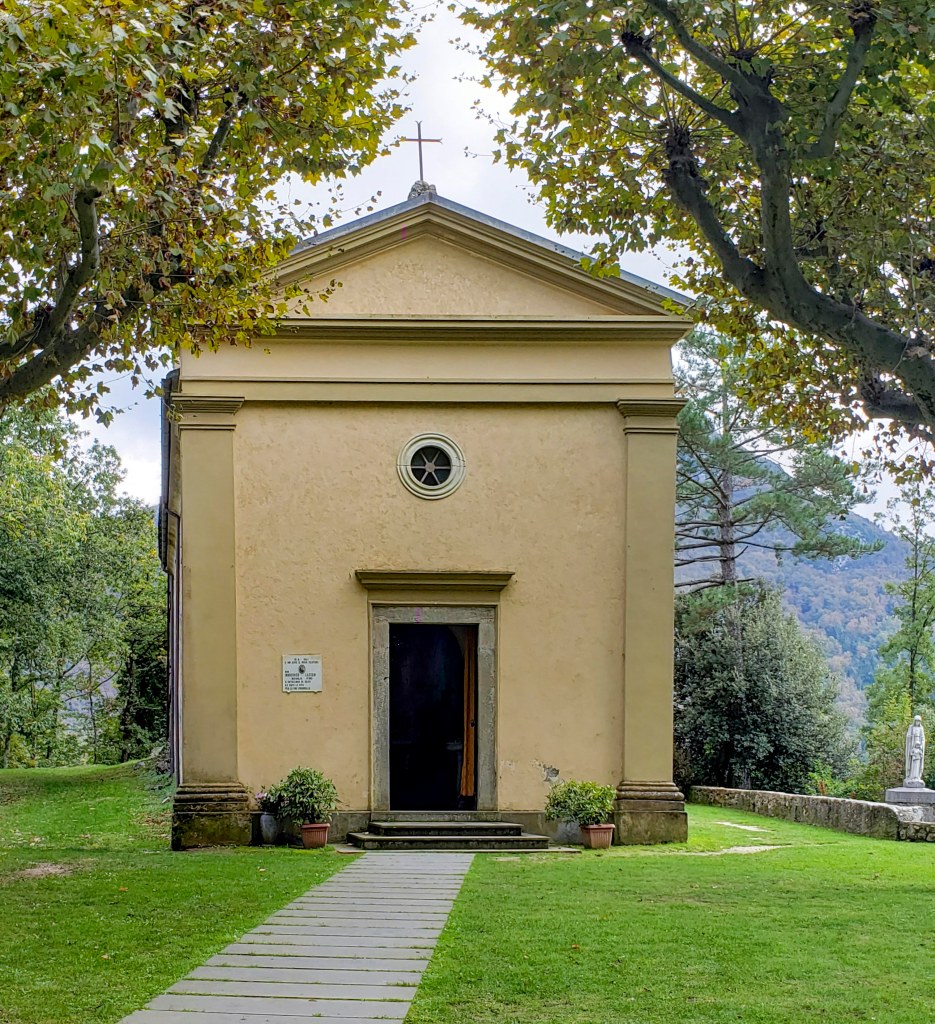
The Nazis burned all of the buildings in the town, but the church has been rebuilt.
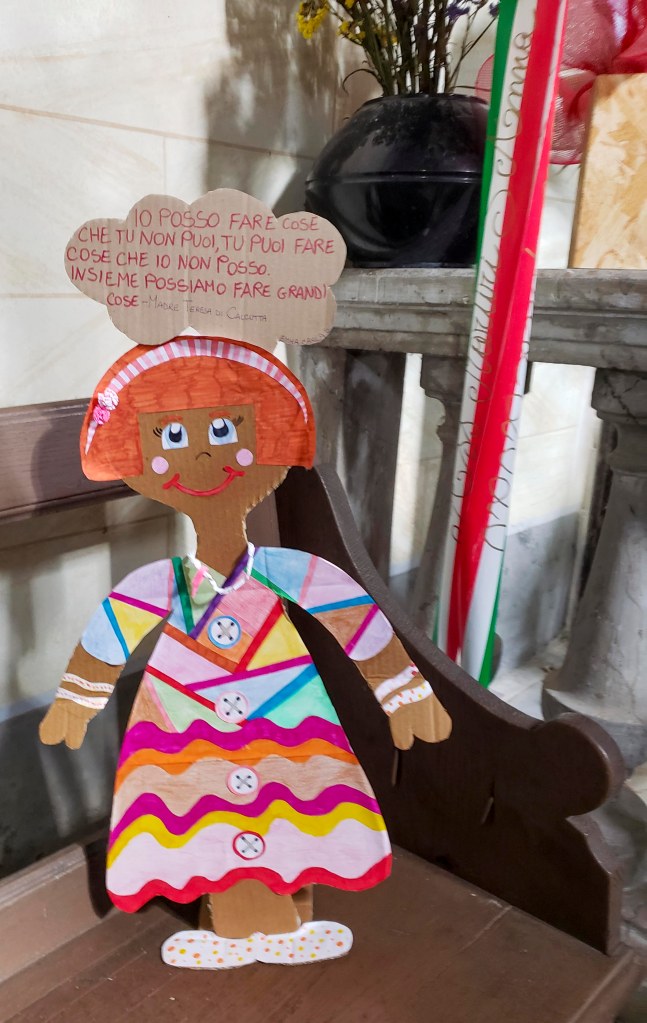
A child’s artwork in the church says “I can do some things that you can not. You can do some things that I can not. Together we can do big things.” (my translation) Maria Teresa in Calcutta
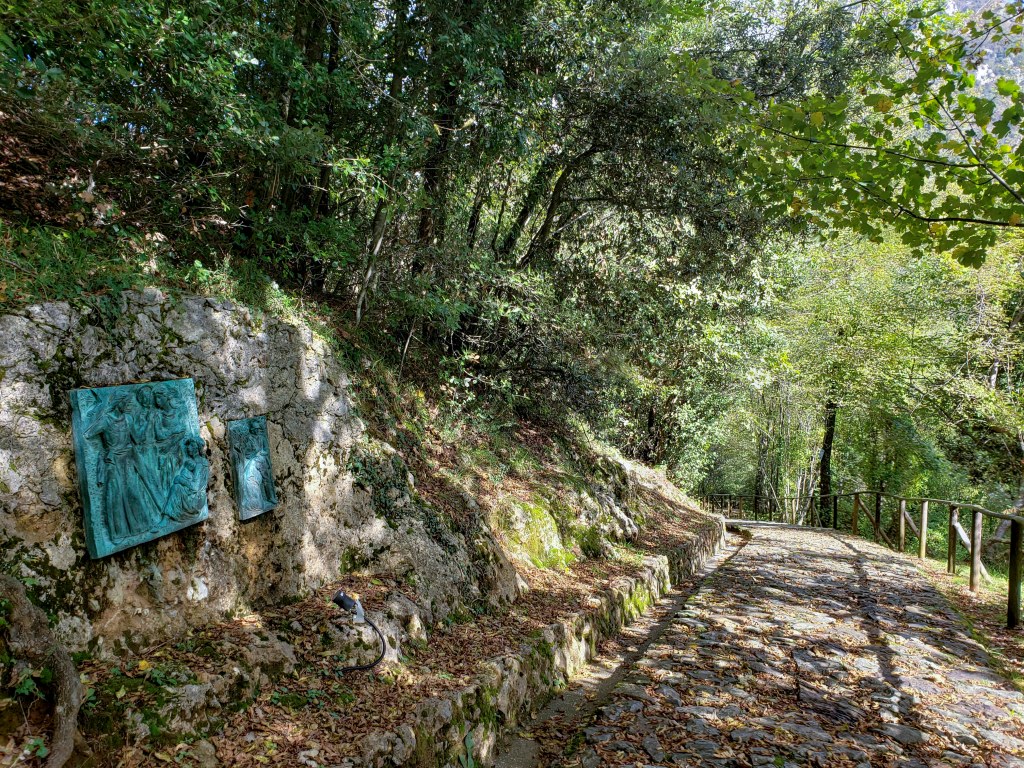
A steep and long (for me!) path leads to a memorial. Along the way there are plaques showing the story of the Passion of Christ and corresponding depictions of the massacre. Very powerful…
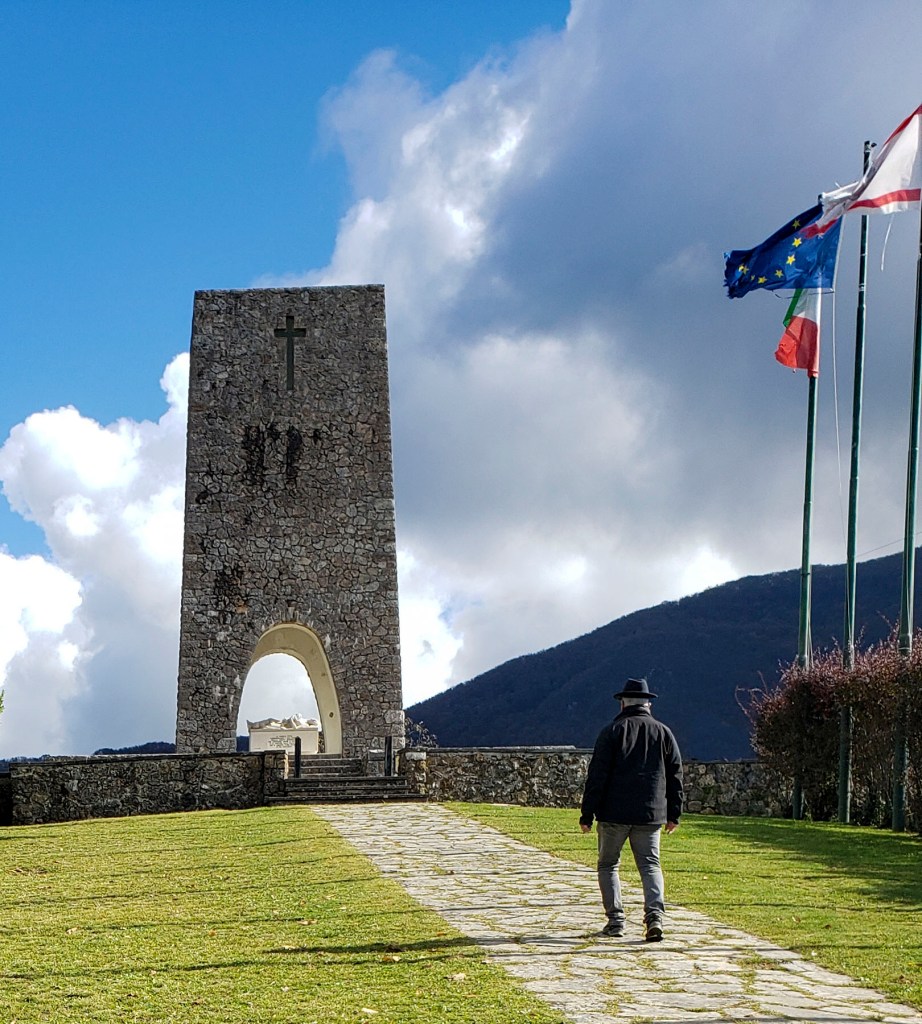
At the end of the path is an Ossuary Monument in memory of the victims of the massacre. The monument is a large tower 12 meters tall with four arches, a tombstone holds the names of the dead that have been identified, and many other features to help us remember.
This lists the names of all known victims. There were entire families killed, so many of the victims had the same last names. There were also signs in the church and museum that showed pictures of the children and pregnant women who were killed that day.
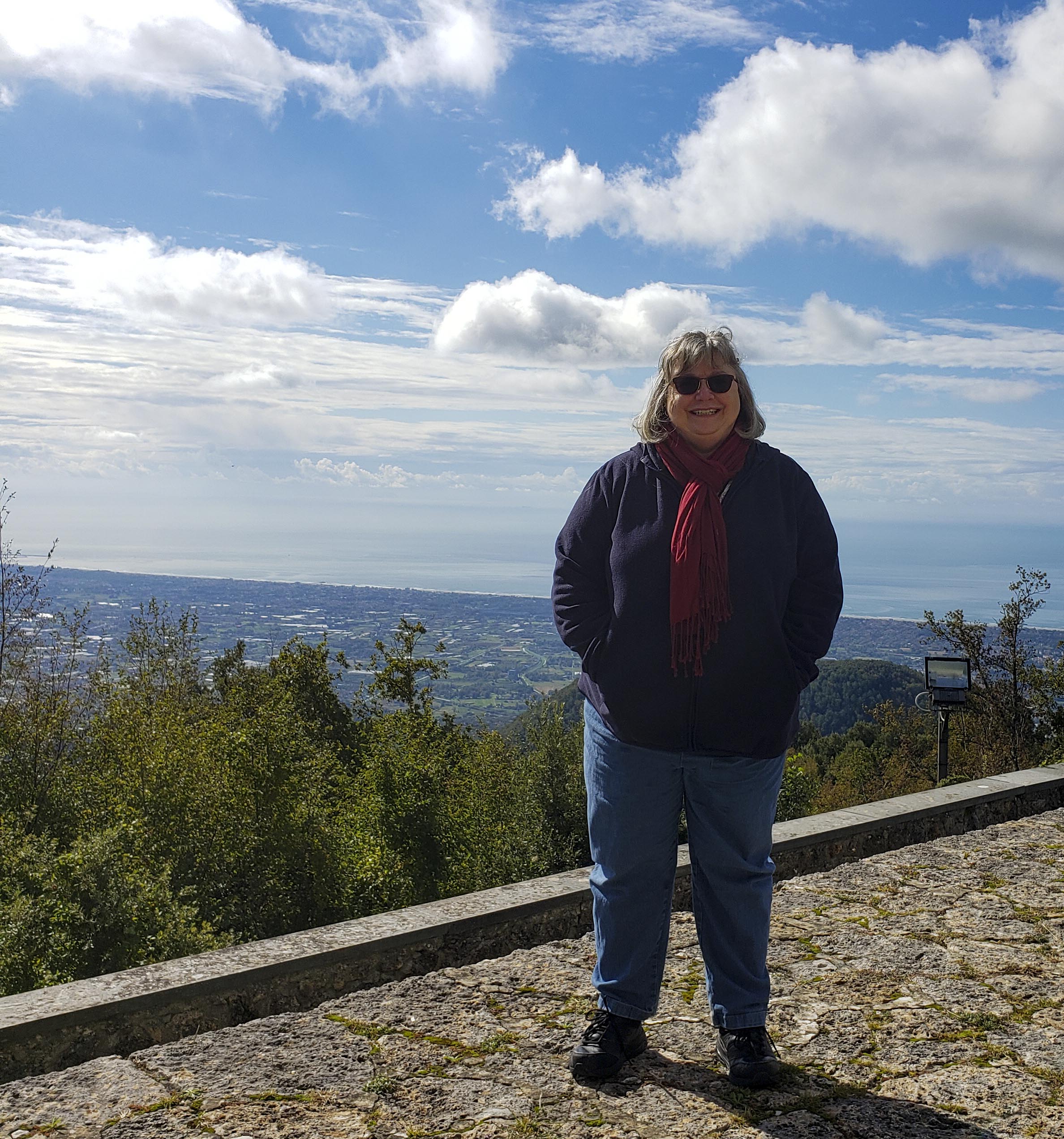
The view from the memorial was gorgeous. You can see the Tyrrhenian Sea, seaside towns, beautiful mountains and forests.
And some updates on life…
We are still working through the process of becoming residents. Jim has an appointment next week that will bring him very close. My next appointment is in December.
Once Jim gets the card showing that he is a resident, we can buy a car. We can drive for one year with our International Driver’s License after becoming a resident. Then we need to get an Italian Driver’s License, which is very challenging, especially because the test is in Italian. And for the first year, it is considered a Provisional license with extra restrictions, like you can only drive a car with a very small engine. So… we plan to buy a car, but a small one. For example, my Mini Cooper had an engine that is much larger than we are allowed here!
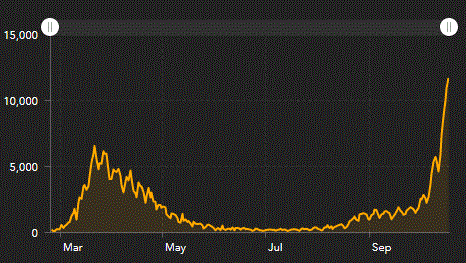
The government changed the rules to control the coronavirus last week, including requiring everyone to wear a mask whenever in public – inside or outside – with just a few exceptions. But then the number of new coronavirus cases started to rise very quickly. We are expecting new rules again today or tomorrow. Rumors include online school only, closing restaurants, 10pm curfews, etc. I don’t like it, but I fully support taking whatever actions are needed to get it under control. The number of new cases per day:
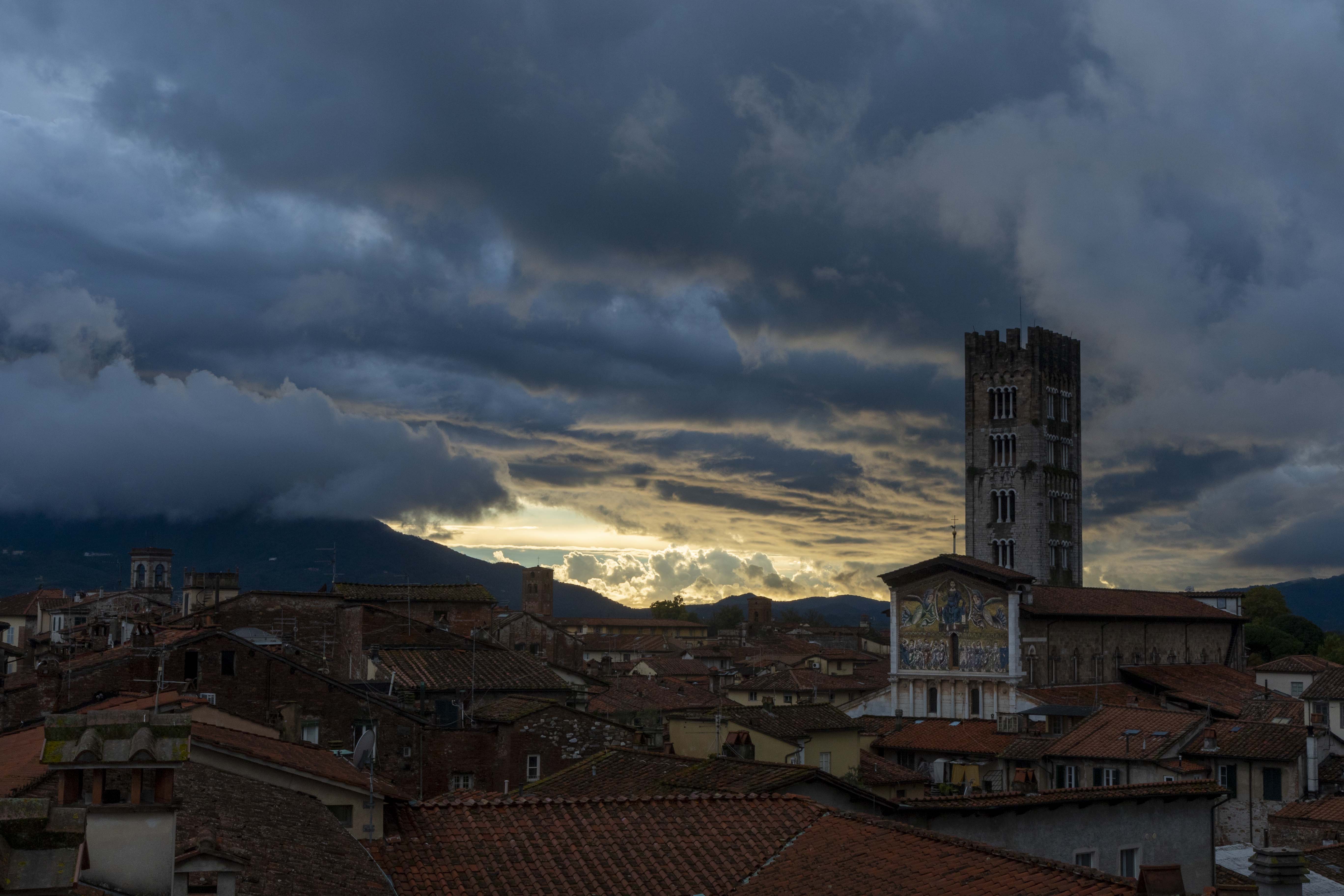
The weather has changed here. So far, October has been usually cold and wet. The last few days (and this coming week) have been gorgeous. I’ve been posting early fall foliage pictures on Facebook, although the trees are still mostly green. And I’ll end this blog post with a picture taken one evening last week, after a storm when the sun burst through the clouds.
I am touched that you take the time to read my blog posts. If you have things that you’d like me to write about, please let me know! JoAn
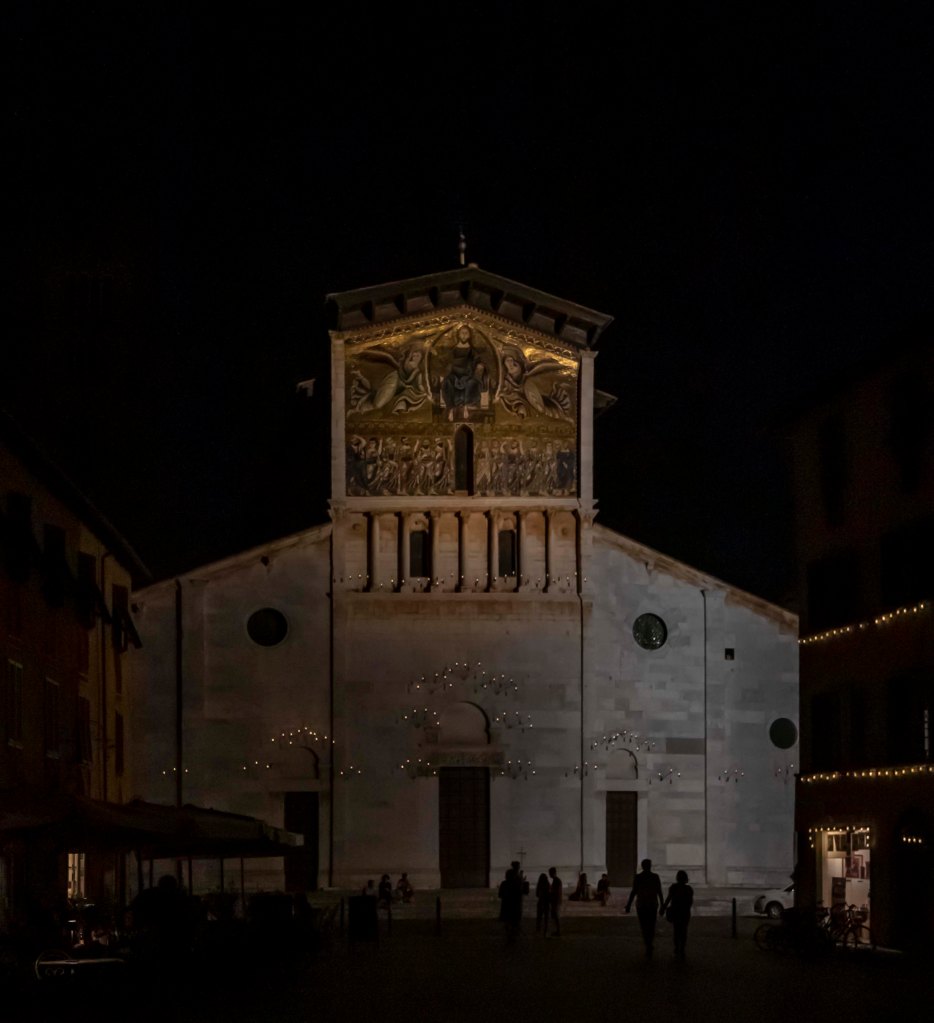
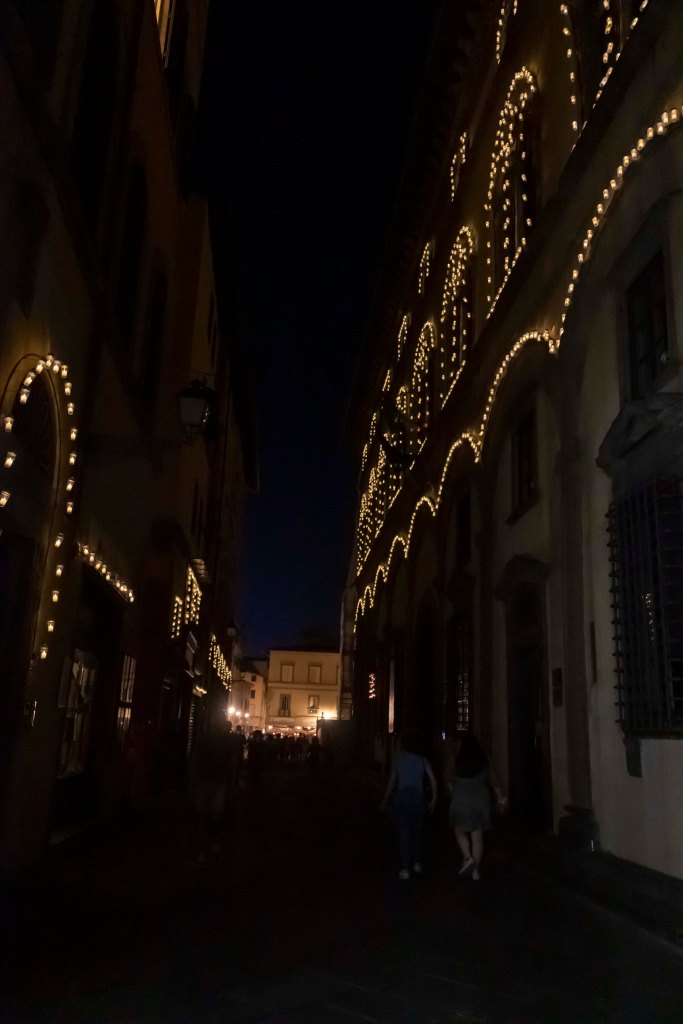
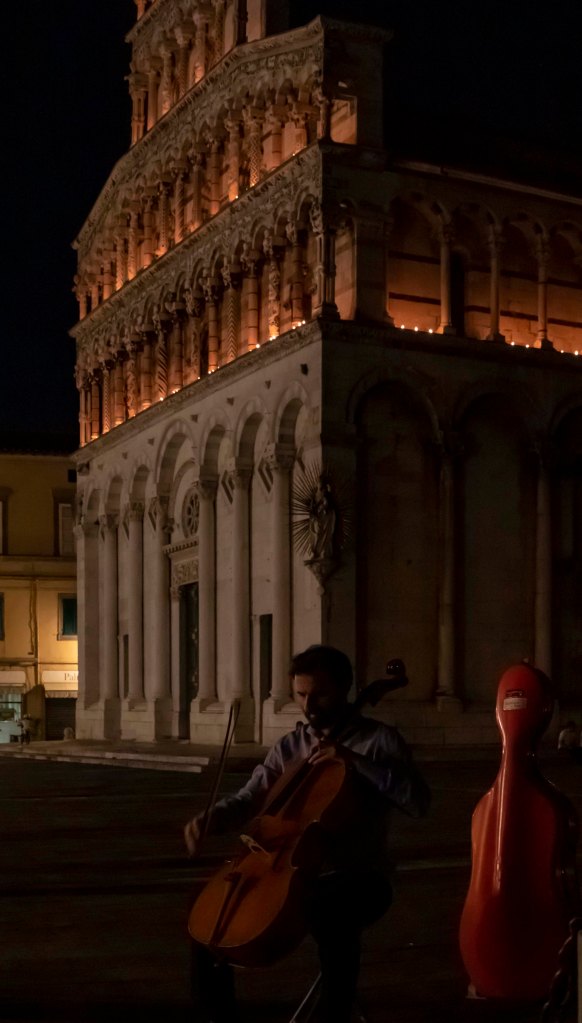
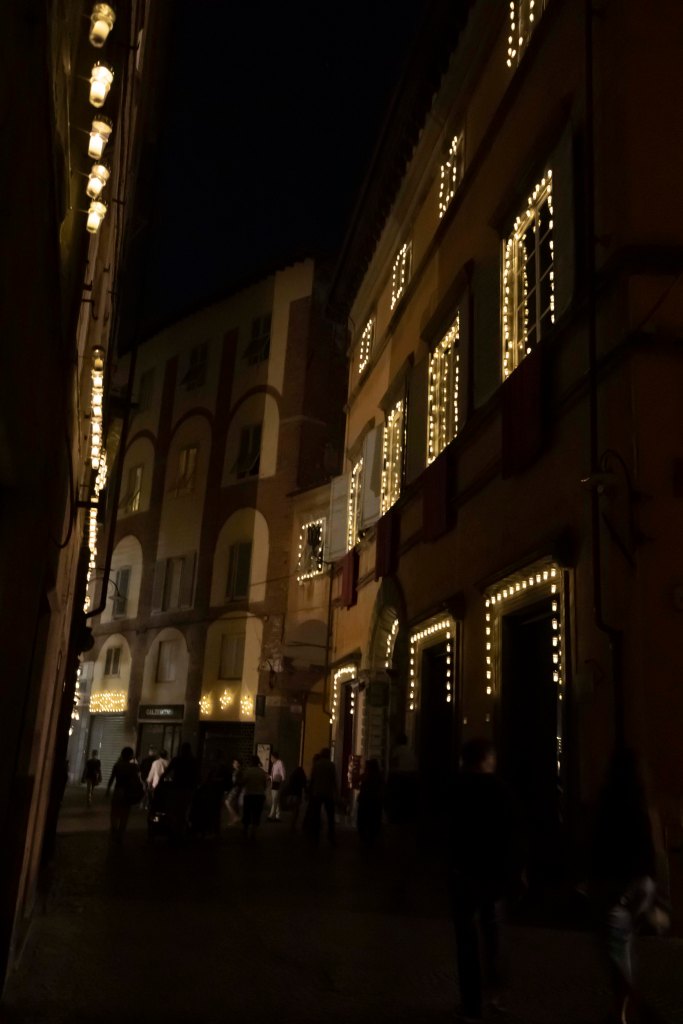
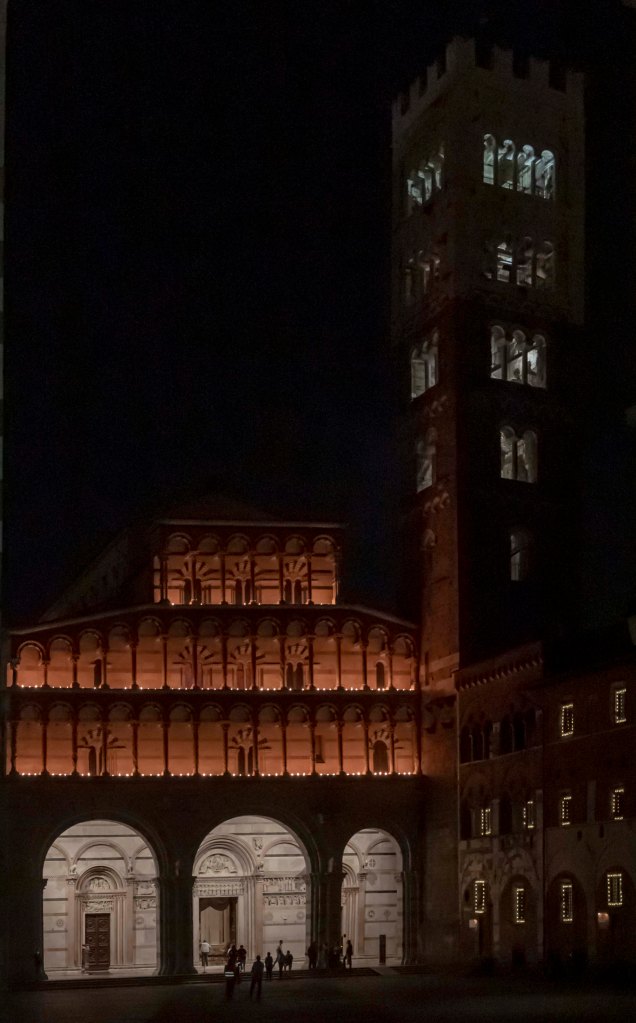
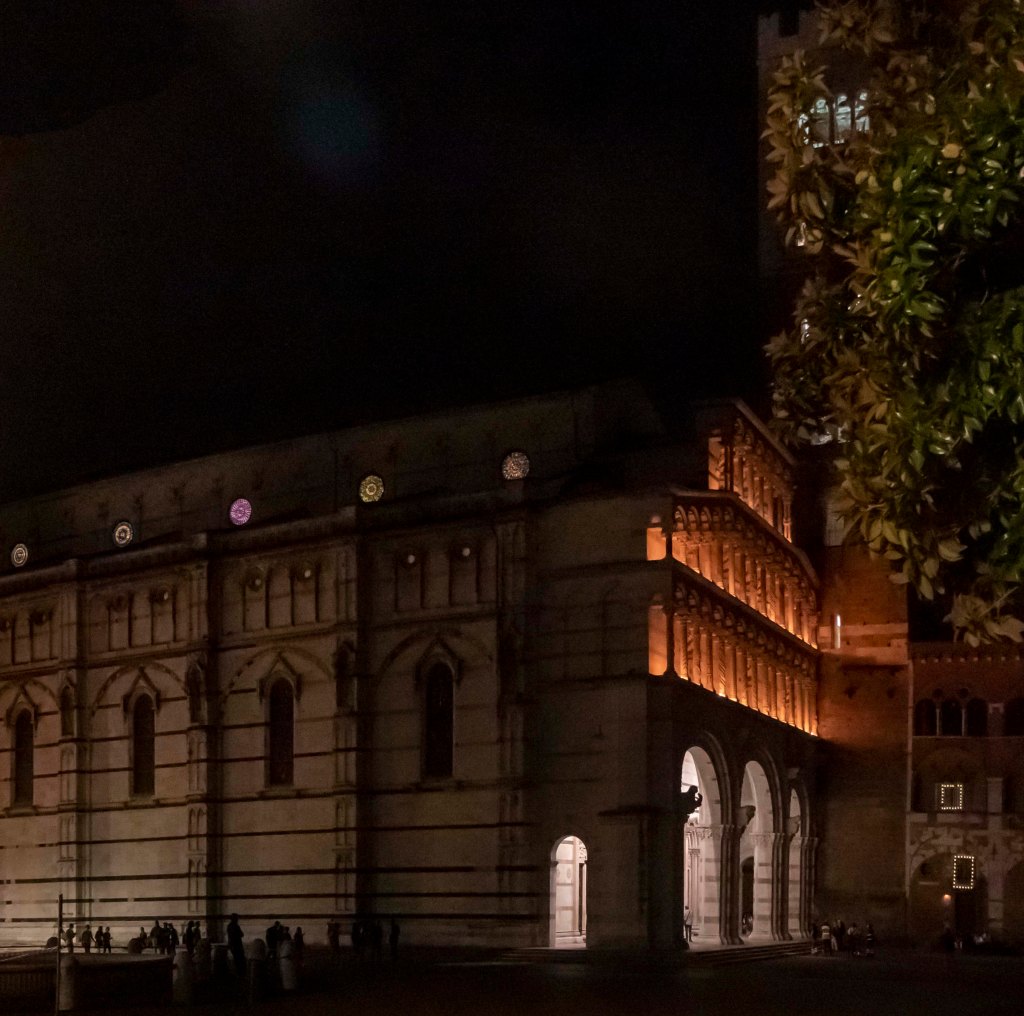
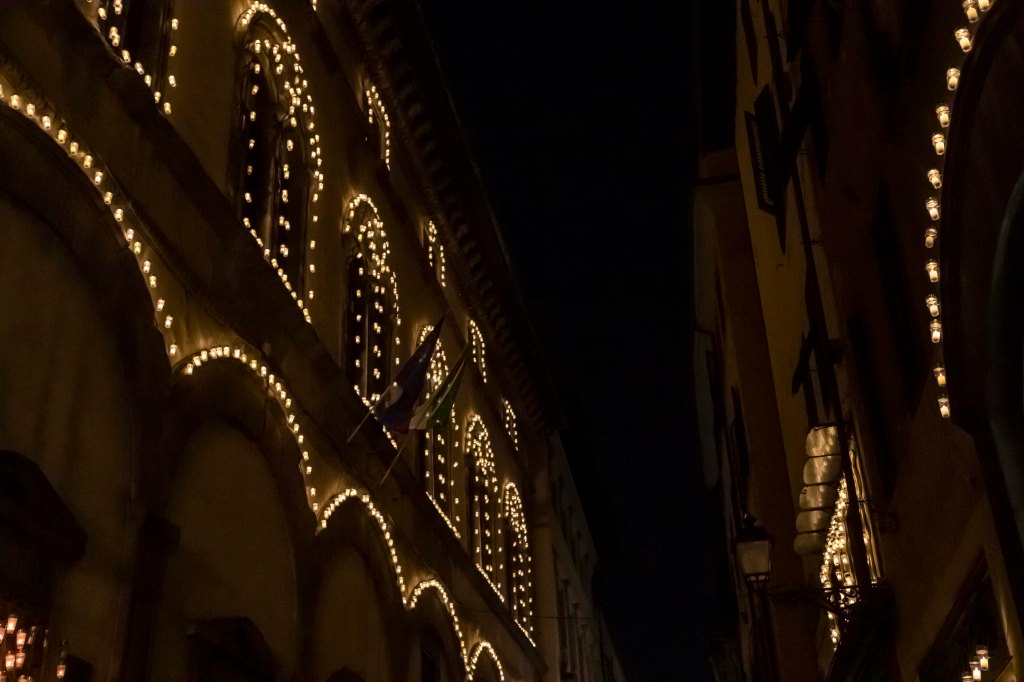
But first a few pictures of the churches and streets illuminated for the Santa Croce festa on 13 September. Normally there is a long procession with people in medieval costumes, religious artifacts, and many local groups. Due to the coronavirus, much of the festival was cancelled or scaled back, but I loved wandering through the streets.
We arrived in Lucca on March 9th, so have now been here for more than six months. It feels the time has flown by, yet this now feels like home. While walking the familiar streets, I recognize many locals and even occasionally run into friends or acquaintances. But I still discover new streets, piazzas and stores. I’m now able to communicate as needed, although my pronunciation and grammar have lots of room for improvement. Phone calls are still tough. We are planning to buy a car within the next month or so and I now feel comfortable driving here.
But things aren’t exactly perfect here. We’ve run into a few glitches recently and both can give you a sense of the crazy bureaucracy here:
Permesso di siggornio: Getting our visa was challenging and took a long time, but it only gave us permission to enter the country. To stay, we need to get our permesso di siggornio (PDS). We applied in March, shortly after our arrival. We got the forms but of course all of the directions were in Italian. I googled and found some instructions on how to complete the non-intuitive forms, lists of documents to include, and tax stamps to attached. We turned them in and waited until the end of August for our appointment at the Questura (immigration office) to get our fingerprints. In the meantime, a local American friend introduced us to Tony, who helps expats and others through the crazy bureaucracy. A day before our appointment he checked on the status of our applications and that is when he discovered that I had made a mistake. A big mistake. I filled out one form because I had convinced myself that the form covered both of us. Nope… I was supposed to complete one form for each of us. Bottom line, I had only applied for Jim. So, Tony helped me fill out MY form, we submitted all of the documentation again, bought new tax stamps and now I wait until December for my Questura appointment. My visa is valid until the end of February, so I should be OK. Ugh!
For Jim’s appointment at the Questura, we arrived before they opened per Tony’s instructions. There were about 20 people waiting for it to open, all wearing masks and maintaining social distancing. Then the door opened and everyone rushed to the front. Tony was there to maintain our spot and got Jim in for his appointment. That alone was worth the prices we paid for his services!
And no, the Questura appointment is not the end of the process. There are more appointments to finalize the PDS, get the identification card, and sign up for the national health insurance. And a slightly easier version of this is completed annually.
We also need to do several activities as part of an integration plan that we commit to. We are required to take training about the Italian government (a few hours of boring recorded training at a Government training location). Then take a test about the content a few years from now. Why wait two years, you ask? Because that’s how it work. We also need to take a test to show that we can speak and understand basic Italian. There are other activities as well, but those are the key ones.
The medical system: One of my goals for this year is to gain an understanding of the medical system. What better way to do that than needing some out-patient surgery!
It turns out that Jim had a hernia… We aren’t yet on the National Health Insurance so we have private insurance for at least the first year. We went to a local general physician who speaks English. He confirmed that Jim had a hernia, ordered some blood tests, and referred Jim to a surgeon. He is a doctor in the National Health system, so he doesn’t have a way to accept money from us. The doctors are paid a salary; they aren’t paid by the visit or the patient. Bottom line, the doctor appointment will cost us a nice bottle of wine. The doctors don’t have nurses or staffs. Before the coronavirus if you needed to see the doctor, you went to the office and waited for your turn. Now, you need an appointment. So you call or text the doctor to get an appointment – and they tell you when to come in. No nurse, no staff, just communicate directly with the doctor. To give the doctor the blood test results, Jim put them in an envelope and took them to the pharmacy by the doctor’s office. The doctor picks up results there and leaves info for patients there too.
Getting Jim an appointment with the surgeon was a challenge for two reasons – I really struggle with speaking on the phone and it was August. Nearly everyone takes vacation in August: some for the entire month, most for a few weeks, but at least for a few days. I got the contact info of someone who could help me get the appointment and we communicated via WhatsApp. We had an appointment for several weeks later. Once we found the location for the appointment, we were pleased to find that the surgeon spoke decent English. He examined Jim and confirmed that he needed surgery, which would be done at the large hospital in Pisa. This would be out patient surgery, likely done via just a few small incisions. Next step is to meet with the anesthesiologist and do some pre-operative tests.
When someone says Pisa, you likely immediately think of that leaning tower. I think of IKEA, Pisa University, and Cisanello Hospital (one of the best in Italy!).
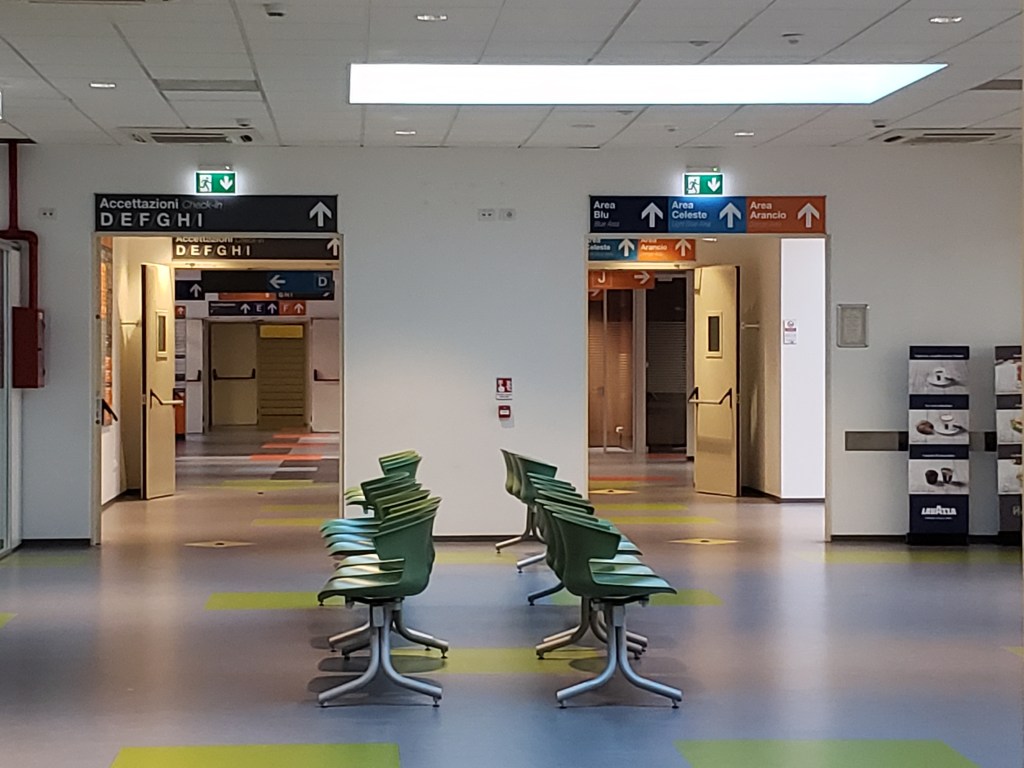
We arrived at the hospital for the pre-operative testing and followed the directions to Building 10, the Orange area, followed the G route, then went down a floor to search for area 14. There was a long line outside of the pre-operative testing room and I tried to ask a question. They quickly realized that we couldn’t speak Italian well, whisked Jim inside and told me to stay out of the room. After about 3 hours, Jim came out to say that he needed a chest Xray and someone would lead us there. It was so confusing getting around that the “guide” asked 3 people for directions! Jim said most of the people spoke decent English. After about 4 hours total, we left. We walked around the city of Pisa and found a wonderful place for lunch. We got a glance at the tower; it’s still leaning.
More directional signs than an international airport!
The next day, the surgeon called me. (No, not his assistant or nurse… the surgeon). He said that surgery would be Monday and we were to arrive by 10am. He gave us directions to the place to come for surgery and asked Jim to take a COVID-19 test on Sunday at 9:55am and asked that we pre-pay before the surgery. We had talked to our insurance agent and they will cover 80% of the cost, but we needed to pay up-front and they will reimburse us for 80% of the total.
We decided to pre-pay for the surgery on Friday so that we wouldn’t need to worry about it the day of the surgery. Boy, am I glad that we did that! After going to a few different buildings, we found someone who could help us. Because we aren’t using the National Insurance, no one seems to know how to deal with us. At one point, there were three people helping us and two people were called. After about an hour, they finally took our credit card.
Next step… the COVID test. We were told to go the hospital, parking lot A1, and look for an orange building with a tent next to it. Jim didn’t wait too long to have a swab in the throat and one in the nose. He also learned that we were essentially quarantined until he went to the hospital the next day. They said that they would call if it was positive, otherwise we were to come to the hospital the next morning.
Surgery day! Next problem… because we had paid on the Friday before, the date on some of the paperwork showed surgery on that Friday. Yikes! After lots of phone calls and a 1.5 hour wait, we were brought to Jim’s hospital room. The nurse showed us the room, including the bathroom and two beds. They said that I could sleep in the other bed. For outpatient surgery??? Surgery was scheduled for 1pm, but nothing seemed to be happening. Then they asked me if I wanted lunch and dinner. Of course, I was confused because I’m not the patient and Jim can’t eat. They ended up bringing me a decent lunch and dinner will come for Jim and I. They finally said that the surgery would be later than planned, probably around 2pm. Piano, piano… This “out-patient” surgery was going to include a night in the hospital.
After a few hours, Jim was returned to the room. The surgery was a success and his recovery has been very quick.
Bottom line, the medical care received was top notch. The administration and bureaucracy was very challenging!!!
Lots of words in this blog post, but I wanted to convey the complexity of life in Italy when dealing with organizations and government. Be sure to consider that very few of the people that we deal with regarding medical care, immigration, home repair, car purchasing, etc. speak much English. These conversations are typically a mix of Italian and English, with use of Google Translate when needed. But it is all worth it!
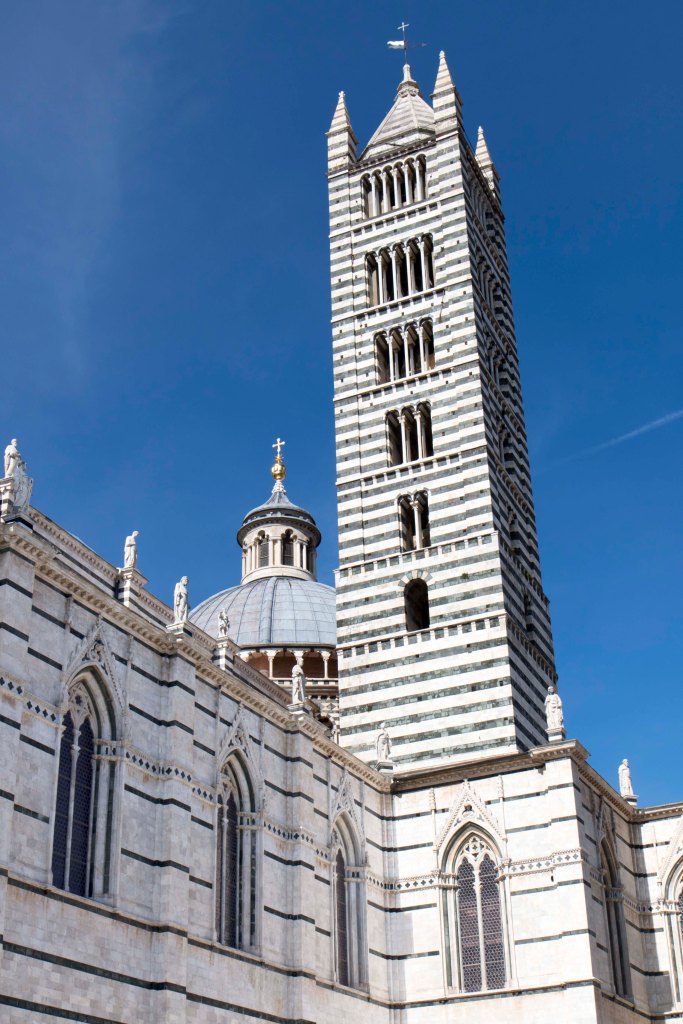
We took a day trip to Siena a few weeks ago with Brian and Victoria, an American couple that lives in Lucca. All of us had been there before, but Siena is such a lovely town we all wanted to return! There were some tourists in town, but not nearly as crowded as our earlier trips. My favorite church in all of Italy is the Siena Duomo (Cathedral) so I’ve included pictures from this trip and earlier ones. Here are a few pics of the exterior taken in pre-COVID 19 days:
Siena Duomo
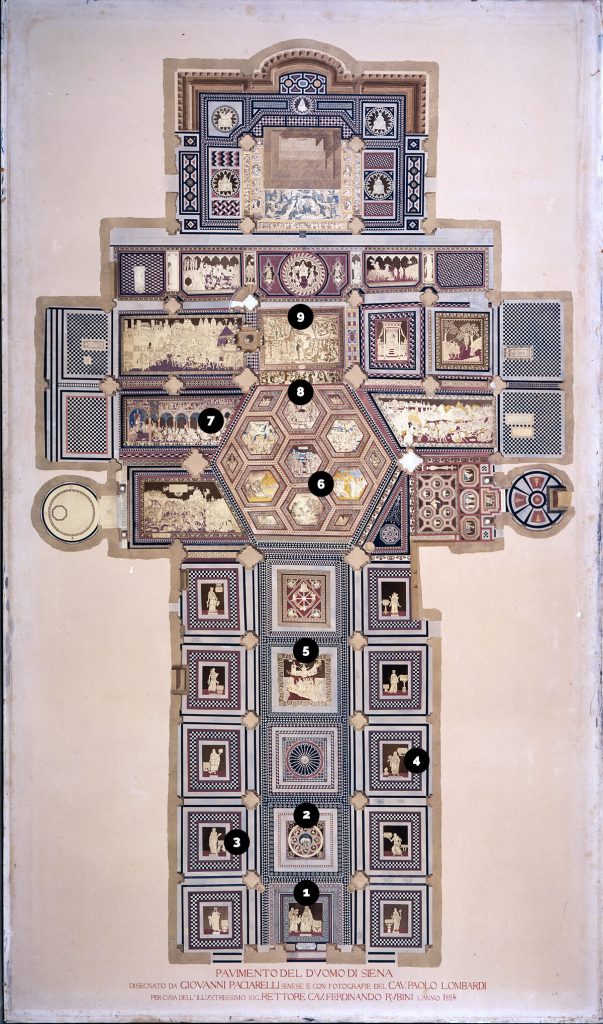
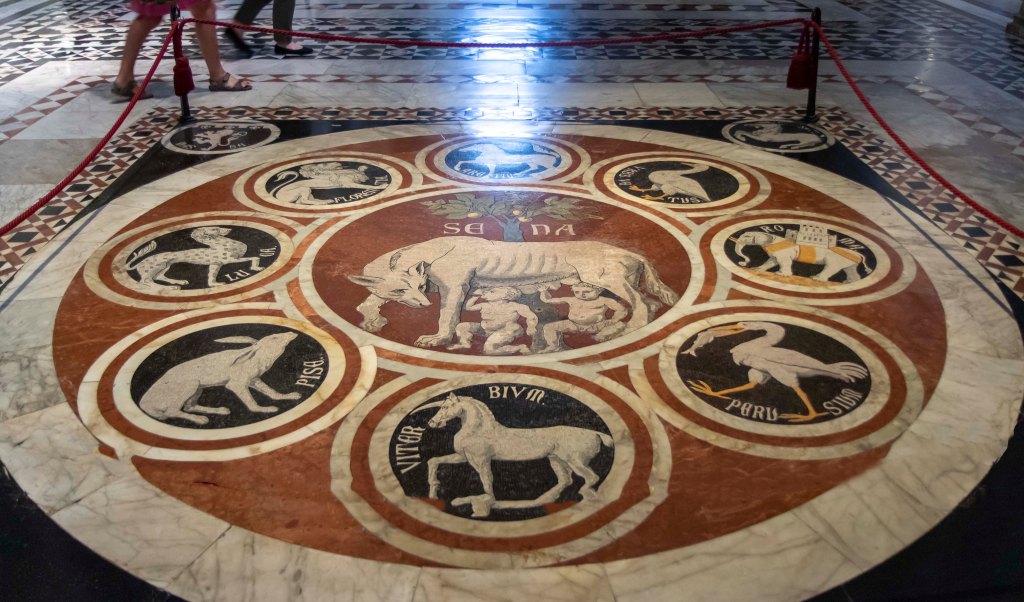
It’s sounds rather odd, but one of the most striking elements of the Duomo is the floors. The floors consists of 56 individual panels, fit together like a jigsaw puzzle. This picture shows how the original designers planned out this masterpiece:
I took pictures of the earliest panel – number 2 in the above diagram. The She-Wolf of Siena (center) with the emblems of the confederate cities probably dates from 1373 (then restored in 1864). And one of those confederate cities is Lucca!
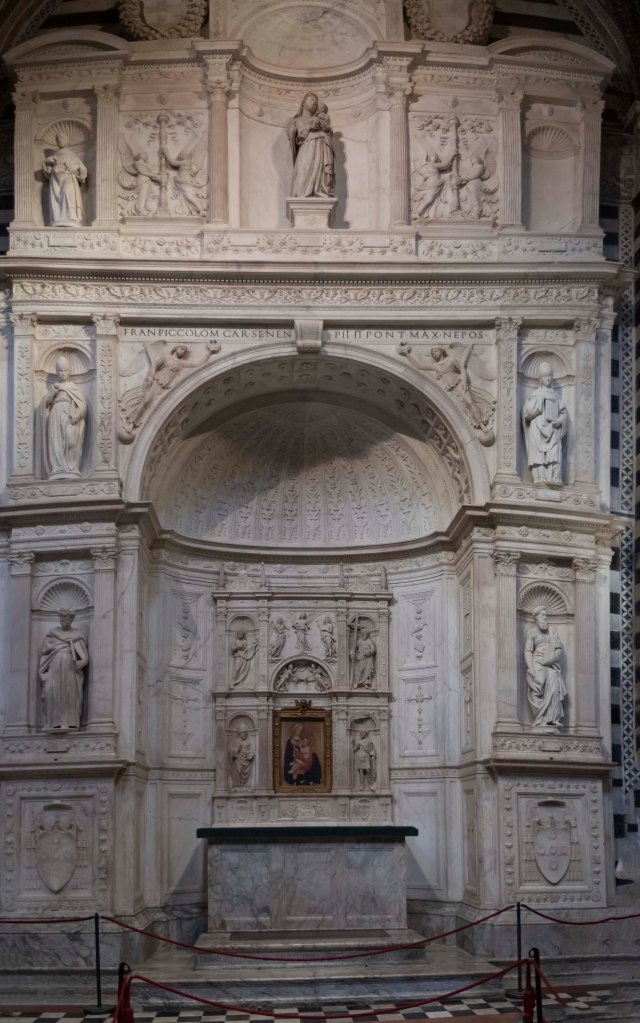
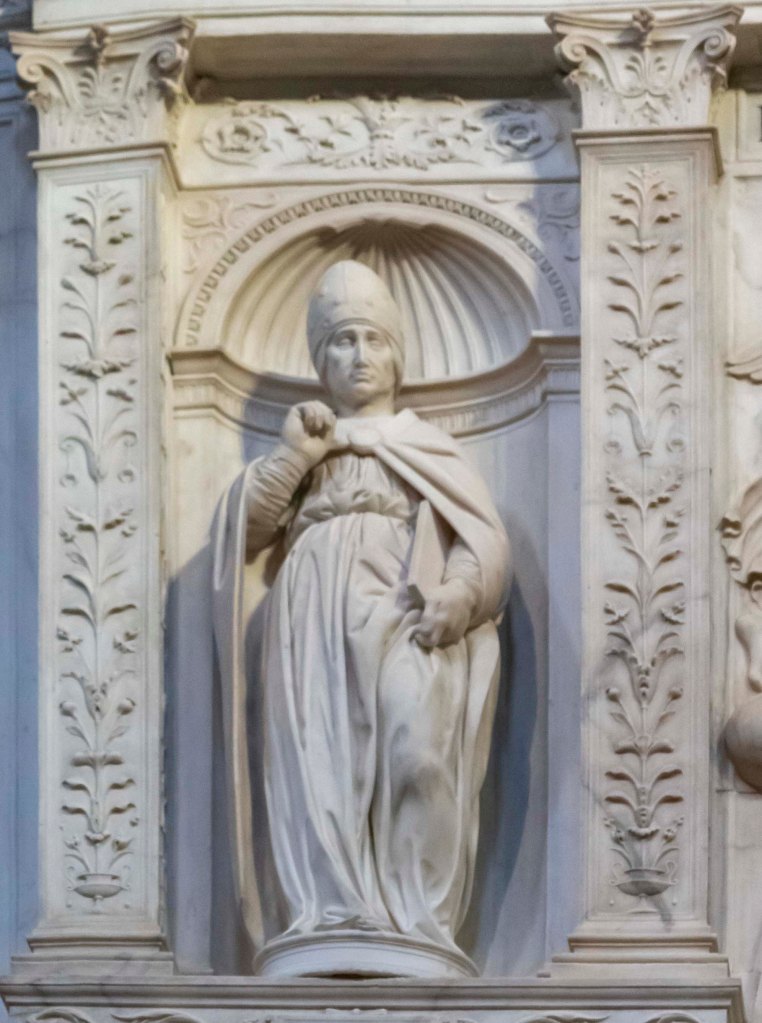
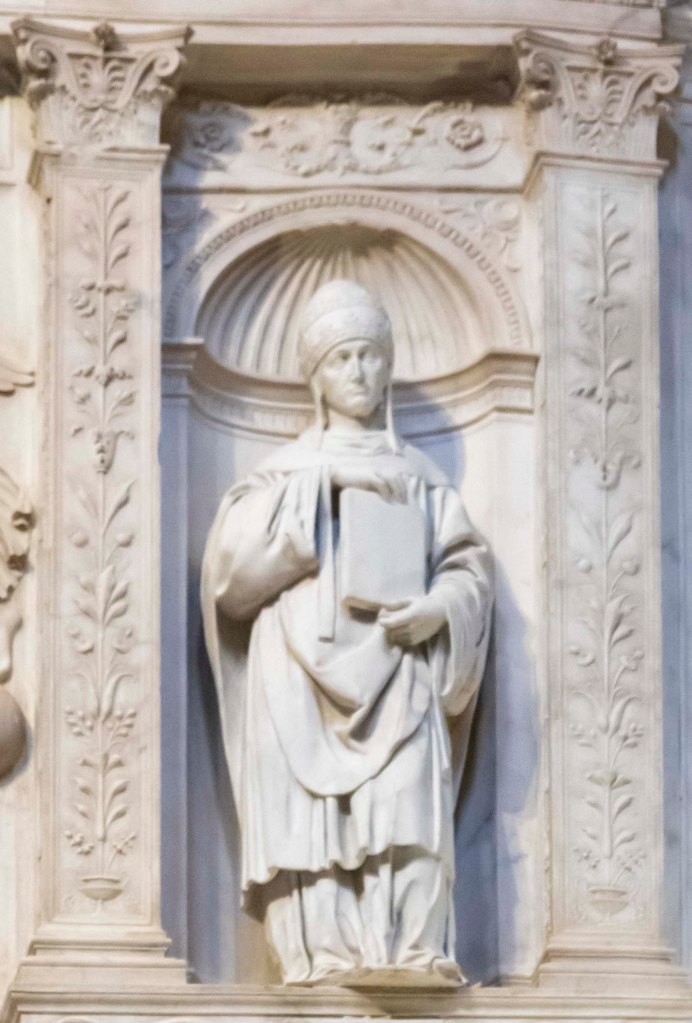
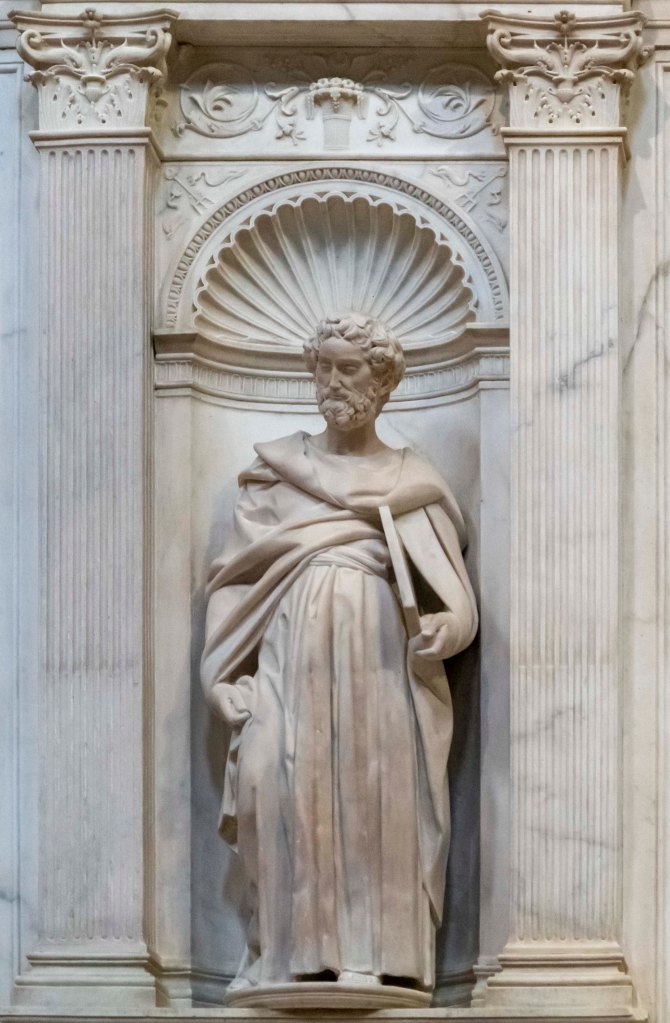
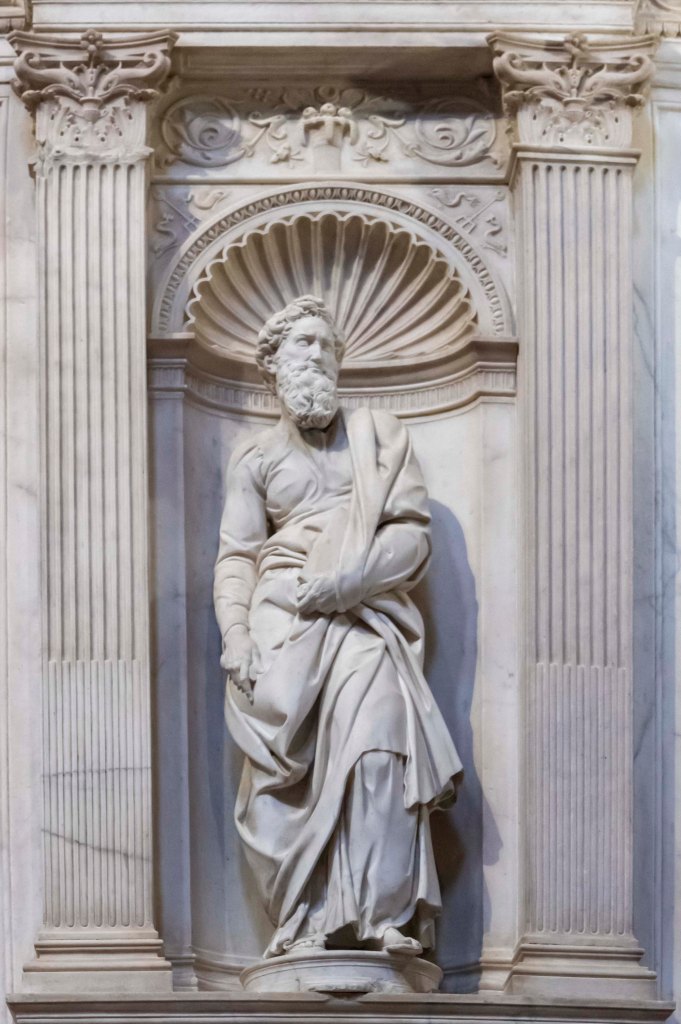
The pictures below are of the Piccolomini Altar. Piccolomini was a very wealthy patron of the church, born in Siena in 1439. The original intent of this altar was to serve as his tomb. But by the time that he died in 1503, he had become Pope Pius III (for less than a month!) and was buried in the Vatican. When the altar was being built, Michelangelo was a rising star, so was contracted to do 15 statues for it. However, he then received much better offers (including sculpting the David), so was only involved in the 4 larger statues at the bottom. And, out of the four, he only completed one of them himself. I’ve included closeups of all four statues. Which one do you think that he completed himself? (The others were completed by his students.)
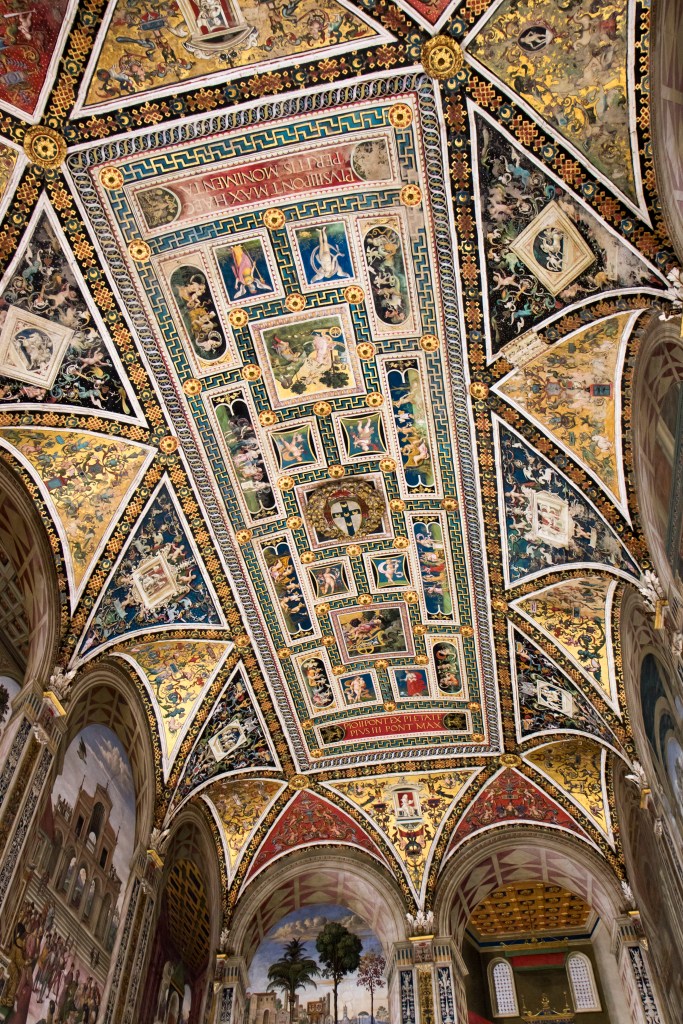
Unfortunately the most beautiful room of the Duomo was closed during this visit due to coronavirus. It is the Piccolomini library which was built in memory of him and to conserve the rich collection of manuscripts he had lovingly collected. The “books” in the library are illuminated choir books, but it’s hard to notice those books with the brilliant frescoes on the walls and ceiling. Here is a picture I took from an earlier trip:
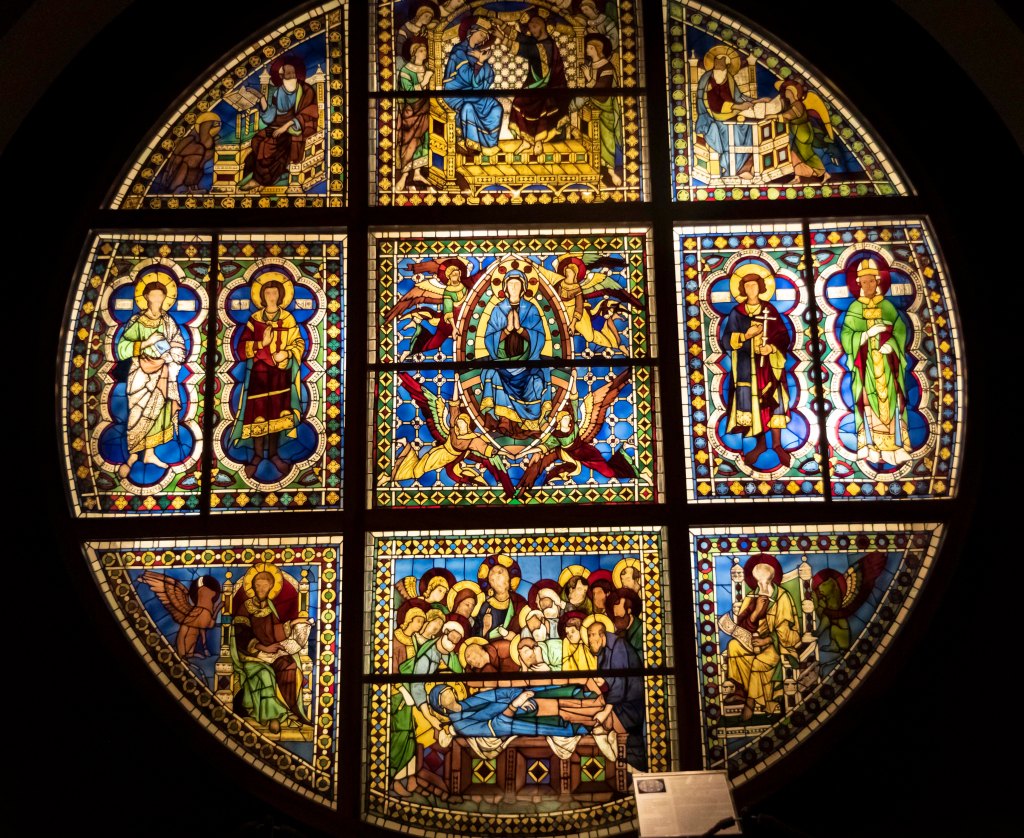
One of the original stained glass windows is now in the museum next door, where you can see the detail close up. The window was made between 1287 and 1288 by Duccio di Buoninsegna and in considered one of the most important windows in Italy. “The stained glass window depicts the Death of the Virgin (bottom), her Assumption (center) and Coronation (top). On the two sides of the Virgin of the Assumption , the 4 patron saints of the city of Siena are depicted , namely San Bartolomeo and Sant’Ansano on the left and San Crescenzio and San Savino on the right. The 4 corners of the stained glass window depict the 4 evangelists seated on the throne and their symbols (the eagle for Saint John, the winged bull for Saint Luke, the winged lion for Saint Mark and the angel for Saint Matthew ).” Only 4-6% of the glass has been replaced over the centuries, so this really is THE original!
So that was a lot of info on one church, but I did say that it is my favorite in all of Italy. And I didn’t even talk about the incredible pulpit and the artwork of Donatello!
Everyday life in Lucca… learning the language
Both Jim and I are working hard at learning to read, talk, and understand Italian. Understanding the spoken language is the hardest. I started studying the language in 2017 but started and stopped multiple times since then. I took a 12-week adult education class in America, used the Memrise app for vocabulary building, had several weeks of full-time classes at the Lucca Italian School and have used several tutors via Verbling and now in person. This patchwork of methods and starts/stops has brought me to a point where I can communicate with shopkeepers, ask simple questions to people on the street, and have casual conversations with friends from our local church. However, I still have a lonnngggg way to go.
We watch one show on TV several times a week called “4 Ristoranti“. The host takes the owner/chef of four restaurants to visit each of their restaurants, they all judge each others’ restaurants and then select a winner. VERY formulaic. Perfect for learning the language. I know when the host will describe how the restaurants will be judged and try to understand more of it each time. I know when they will all guess the amount of the check and I listen for the amounts. And we get to see restaurants all over Italy. 🙂
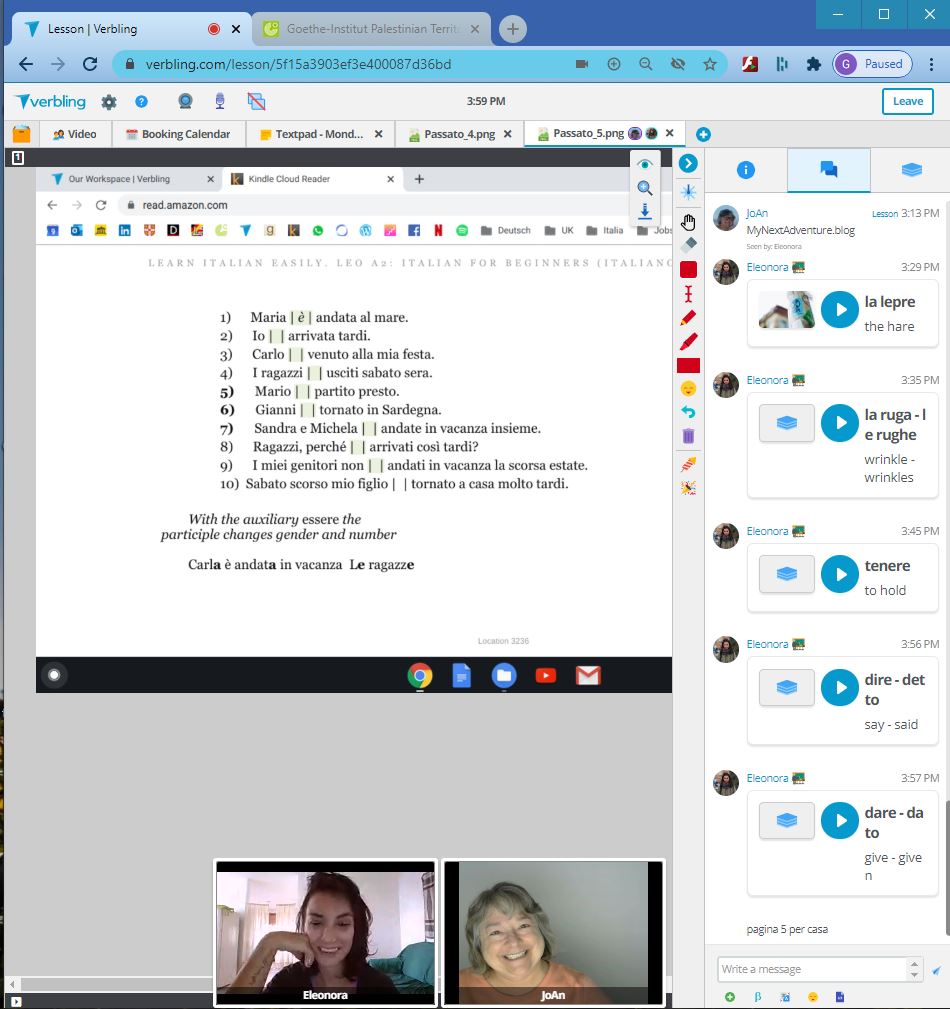
Our primary studying method is using online tutors. We started during the lock down because that was the only available option. Eleonora, my tutor, is Italian but now lives north of Jerusalem in the Palestine State. She teaches German there! I meet with her twice a week for an hour each time. We are reviewing some of the grammar that I studied earlier, but it sticks with me more the second time – and when I have opportunities to use it on a daily basis. I’ve also started meeting with a local tutor for an hour a week for more conversation practice in person. So to prove that I can speak a bit of Italian, here is the request that I made to my tutor to get the photo below: “Scrivo nel mio blog sullo sto imparando dell’italiano. Posso fare uno screenshot della nostra lezione?”
Jim studied for a few weeks at Lucca Italian School and then quickly forgot much of what he learned. He now studies with an online tutor three times per week and is making a lot of progress quickly. His tutor is Italian but currently lives in Helsinki.
Within a few years of becoming a resident, we will need to take a test to demonstrate that we can speak basic Italian. But we want to be ready much earlier than that… in order to really become part of the community, we need to be read, talk, and understand Italian!
The Beauty of Tuscany… gardens, sunflowers and beaches
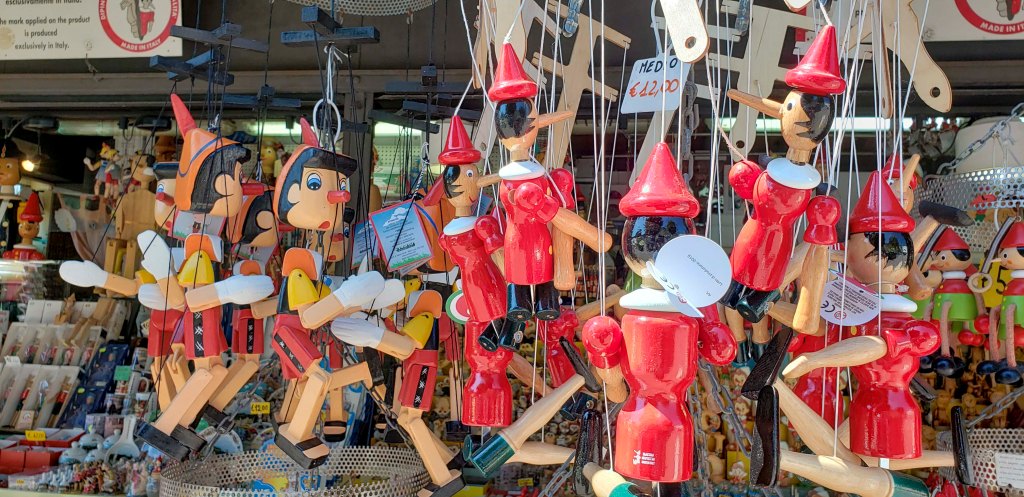
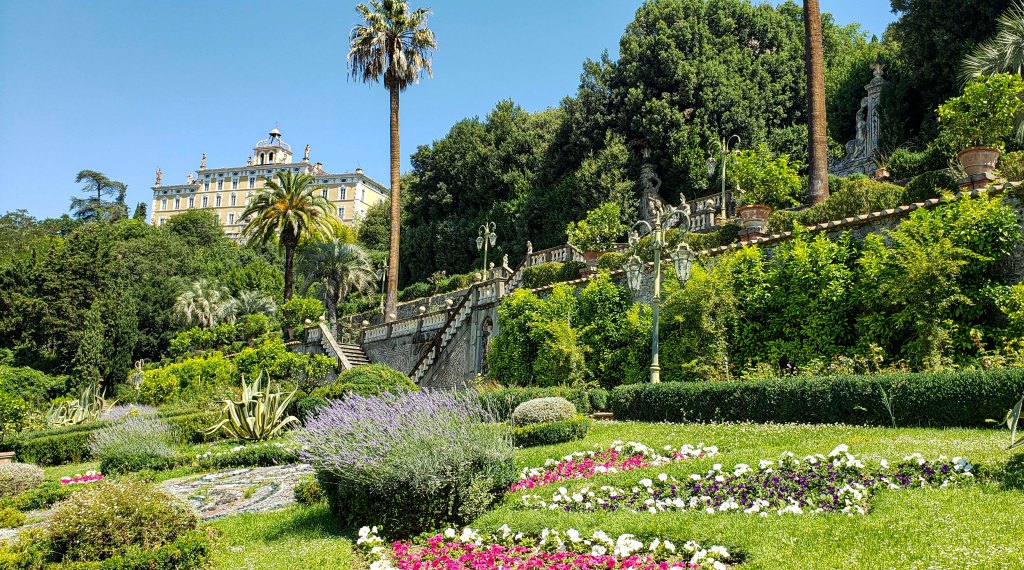
Yes, we made a few more day trips from Lucca. 30 minutes from Lucca is a town called Collodi. Carlo Lorenzini, author of The Adventures of Pinocchio, is from Collodi, so there are LOTS of Pinocchios in the shops, restaurants, streets, and even a Pinocchio amusement park for the kiddos. This kiosk sells two different Pinocchio designs: Italian and Disney!
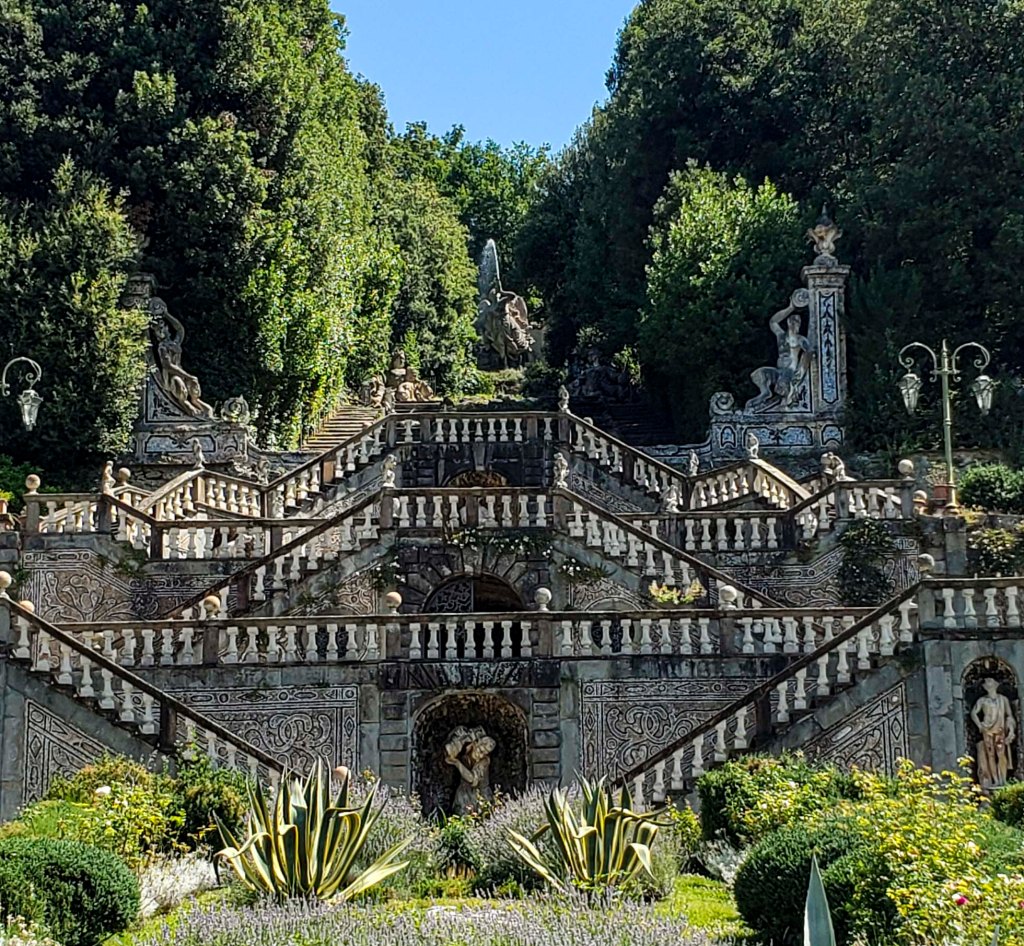
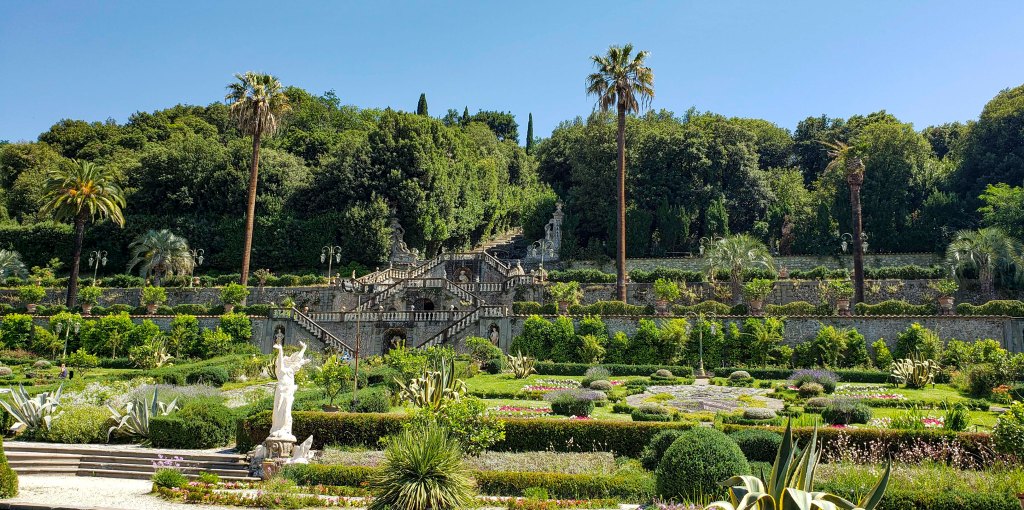
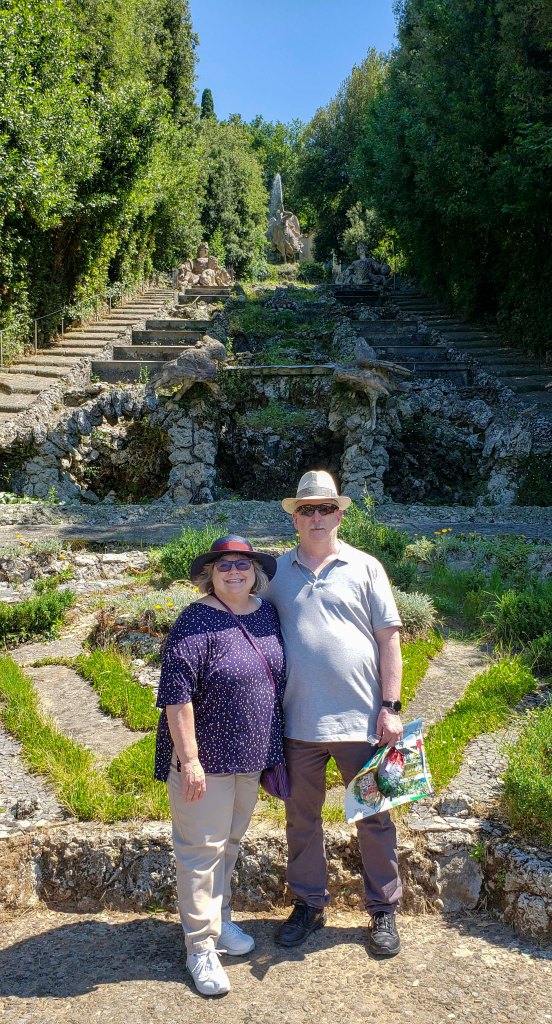
There is also a beautiful and historic garden in Collodi, considered to be one of the most beautiful gardens in Italy. Despite the heat, we explored many of the paths and wandered all the way to the top.
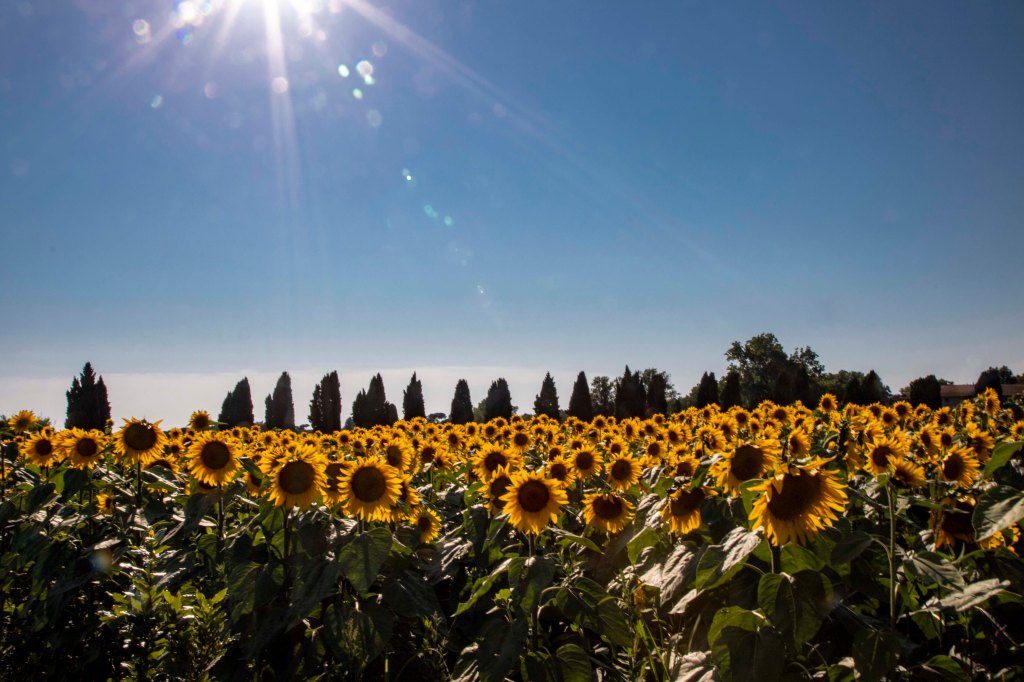
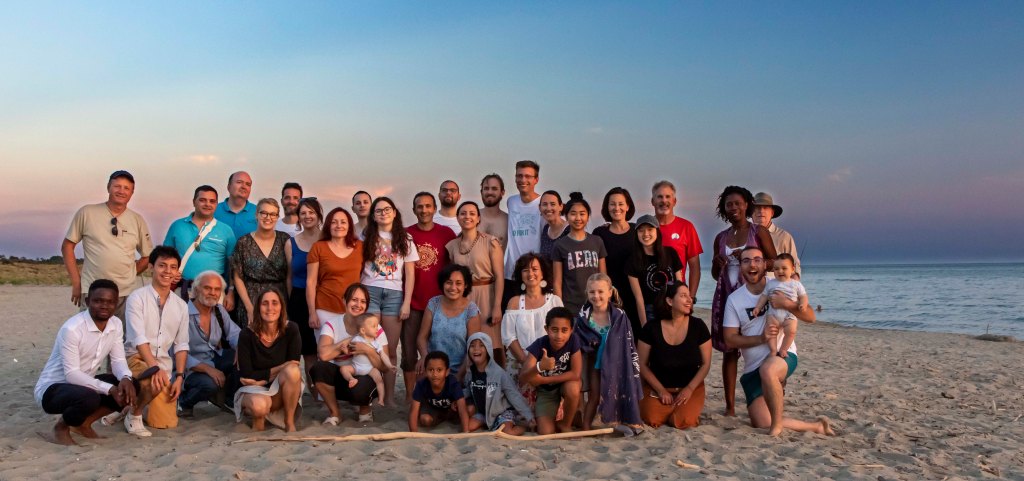
Our church had a going-away picnic for one of our families. Naturally there was lots of food. We stayed through sunset and after dark; singing songs, sharing stories, and even a short skit. The Poot family will be missed by our church! On the way to the picnic, we passed a beautiful field of sunflowers and Jim stopped to let me take a few pics.
Everyday life in Lucca… setting up our apartment
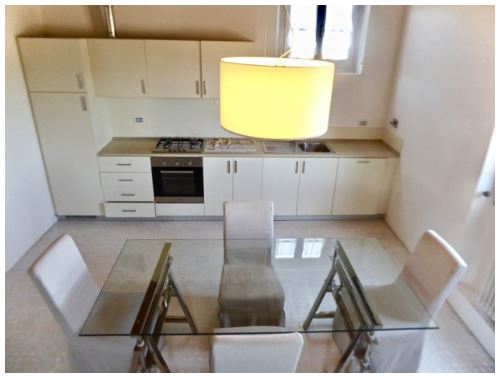
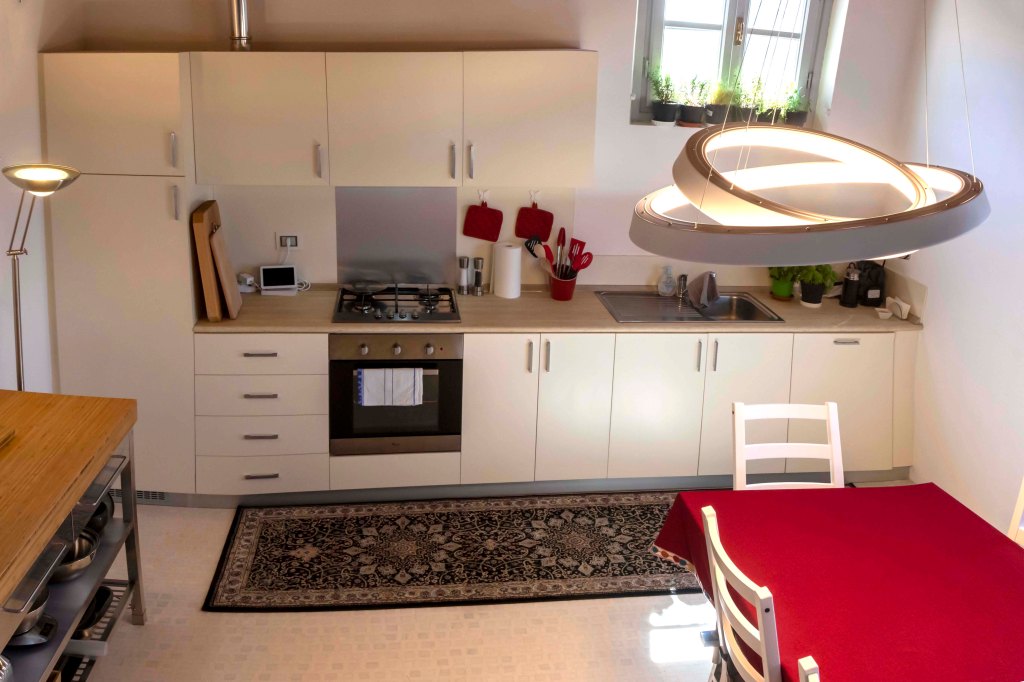
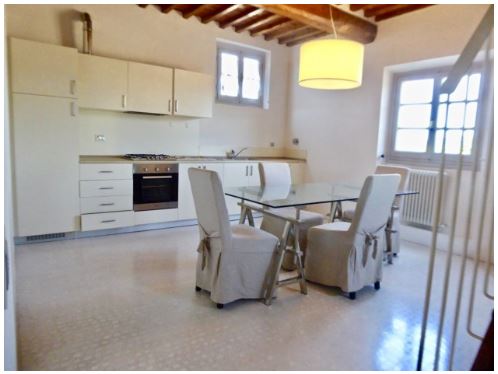
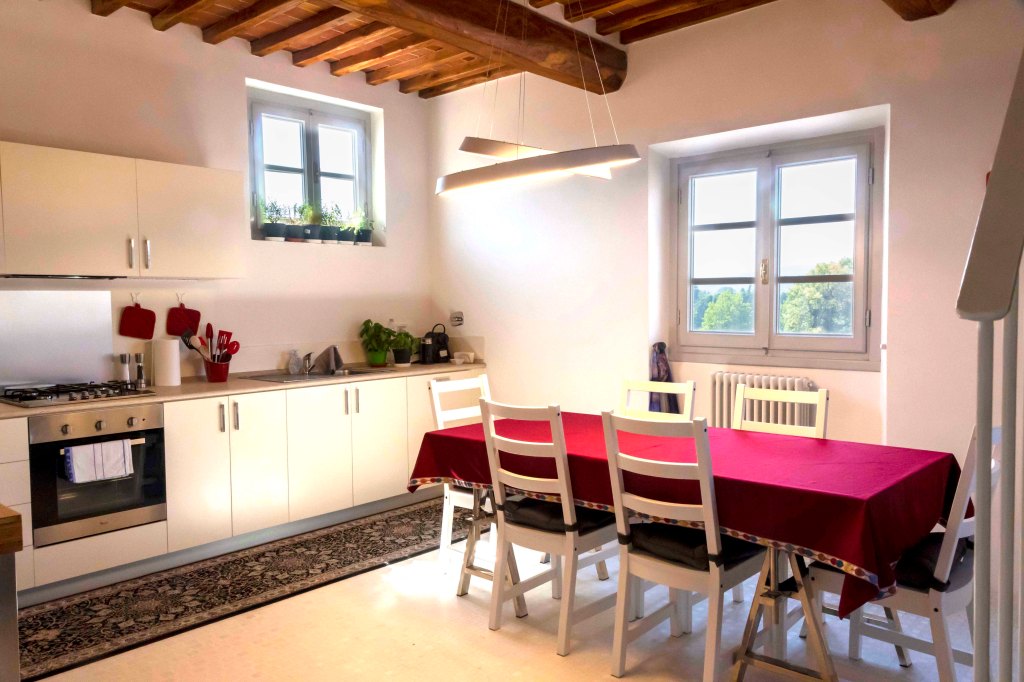
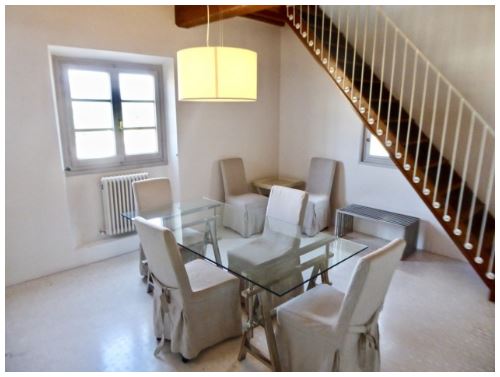
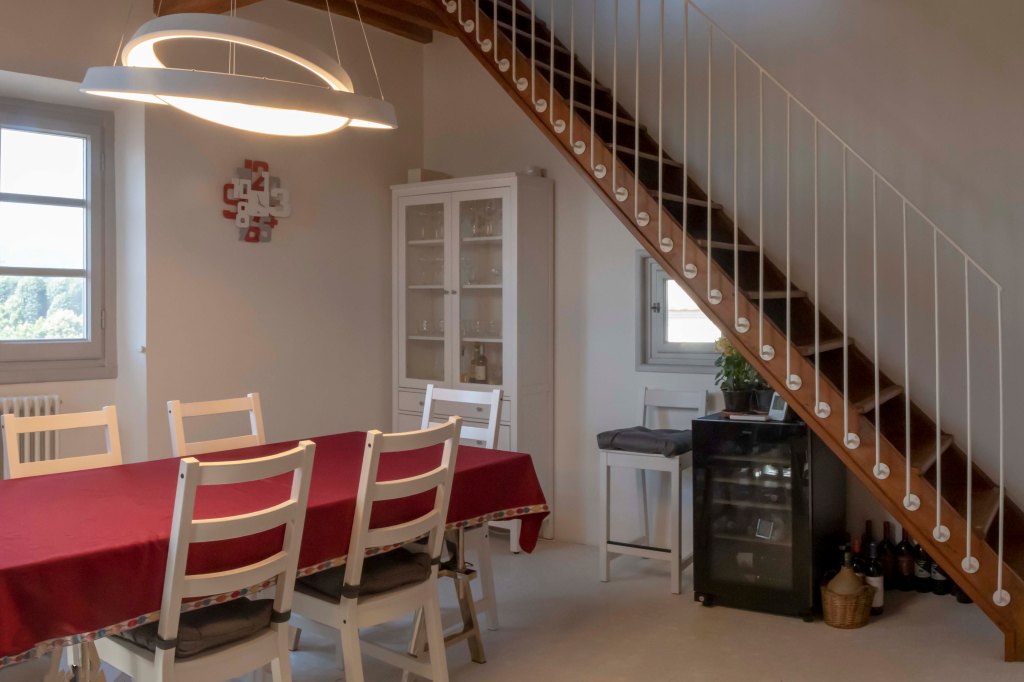
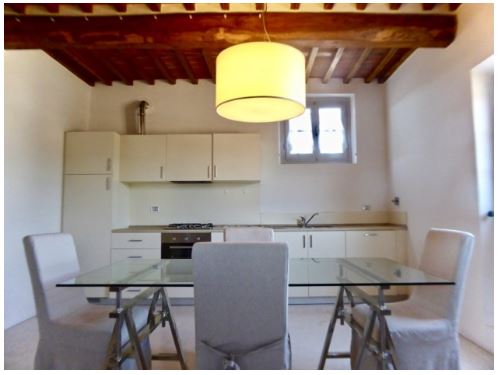
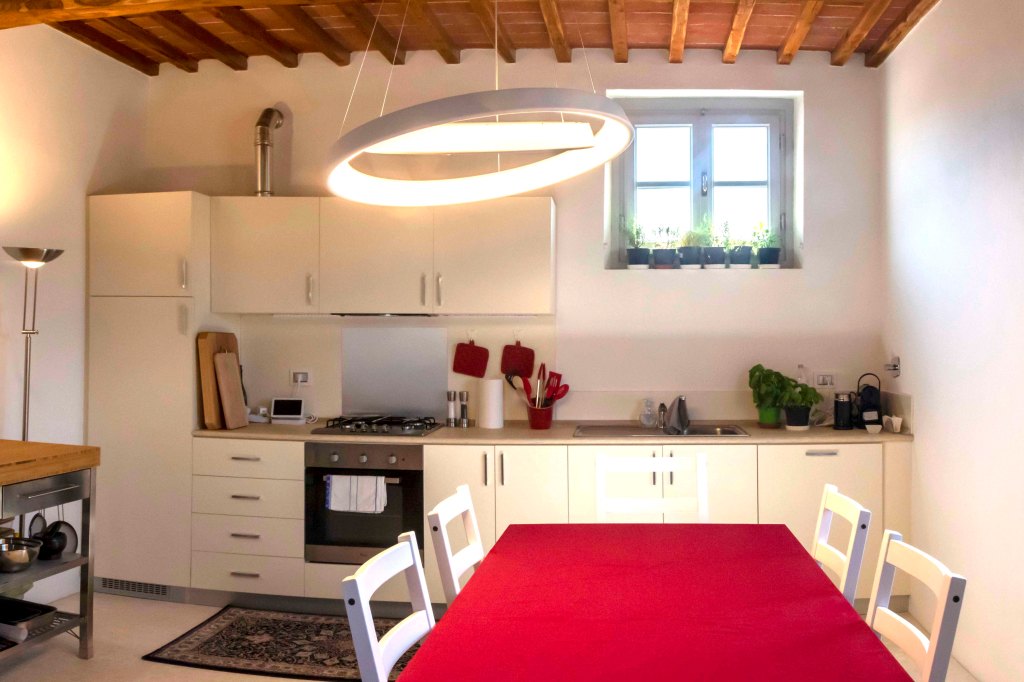
We rented a beautiful furnished apartment in the center of town. It had all of the basic furniture, such as beds, kitchen table/chairs, couches, tables, and lamps. But it was far from “move-in” ready. We needed to buy lots of household items, like dishes, pots, pans, linens, TV, etc. As we did that, we slowly morphed the apartment into a home that really meets our needs. So here are some “before” and “after” pictures of our apartment.
The Kitchen: rotated table, added island (on left) and replaced light
The Kitchen: new chairs, linens, carpet runner
The Kitchen: added cupboard, wine cooler and fun clock
The Kitchen: a fully functional kitchen!
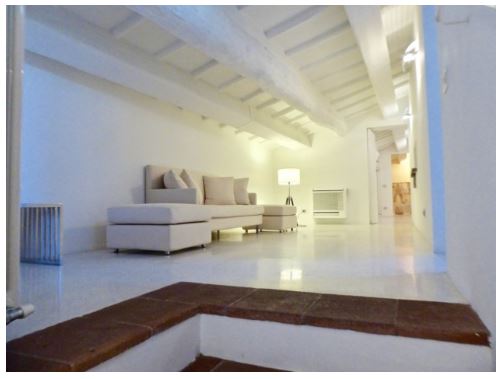
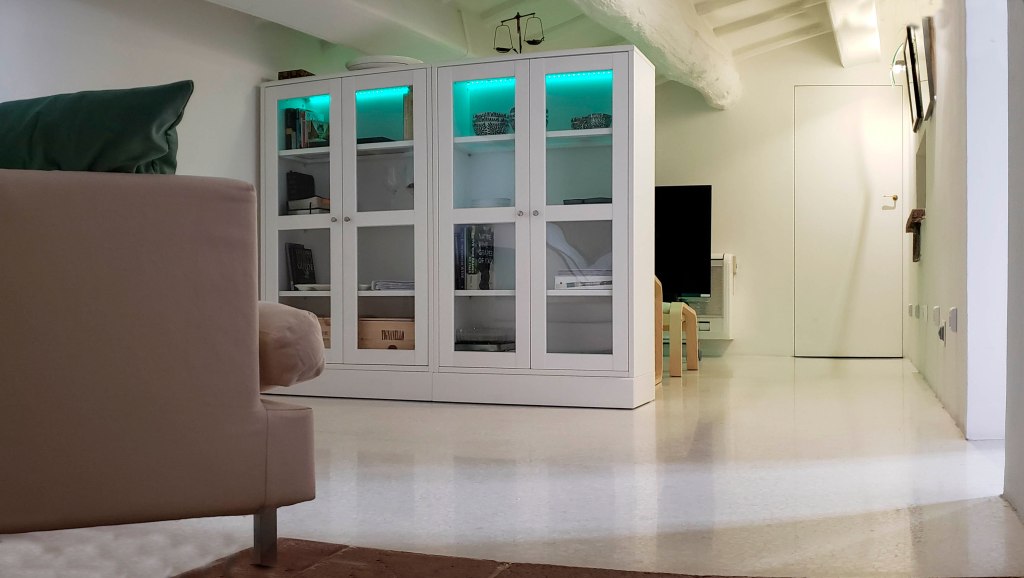
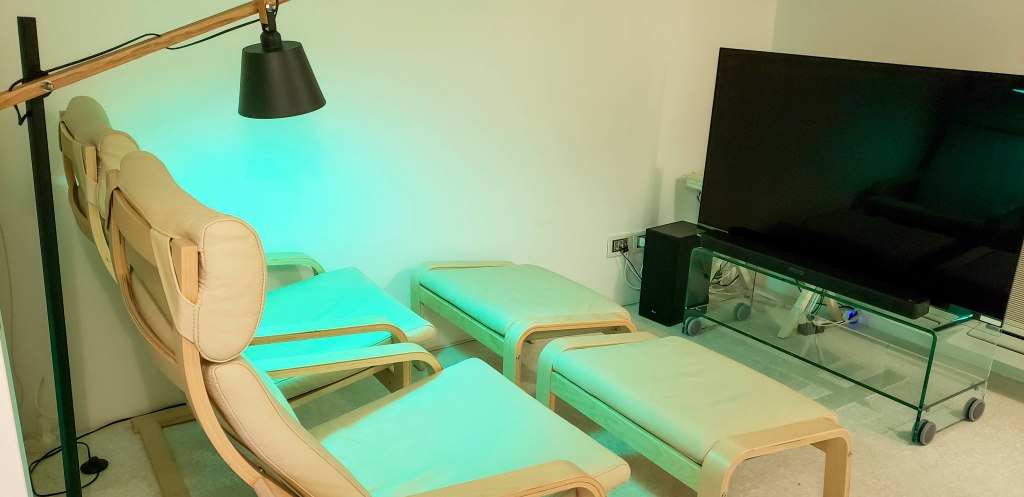
The TV Room: The website description of the next room says “A long corridor, furnished with a sofa to be a warm and cosy reading-corner”. We weren’t quite sure how to use this space with a low & slanted ceiling and consider many options. Our current setup is one of the most useful rooms of the apartment – a reading-corner, bookcases to separate the room into two parts, and a very comfy TV view area. And Jim had lots of fun lighting this area… One “before” picture and several “after” pictures for this space!
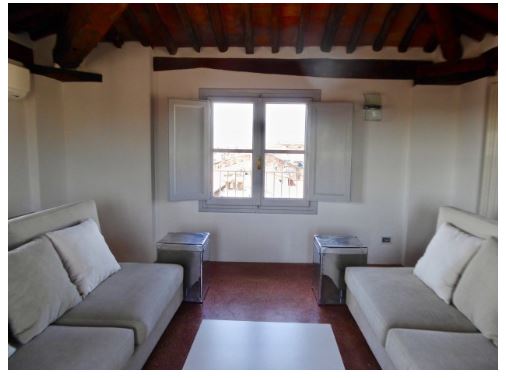
The Altana: Our favorite room… up the steps in the kitchen leads to a square room with large windows on each side, giving us a 360° view of Lucca and the surrounding mountains. We mostly moved furniture from other parts of the apartment to set up this room. And bought a great piece of art from a local artist… Jim again had fun with the lighting. One “before” and one “after” picture:
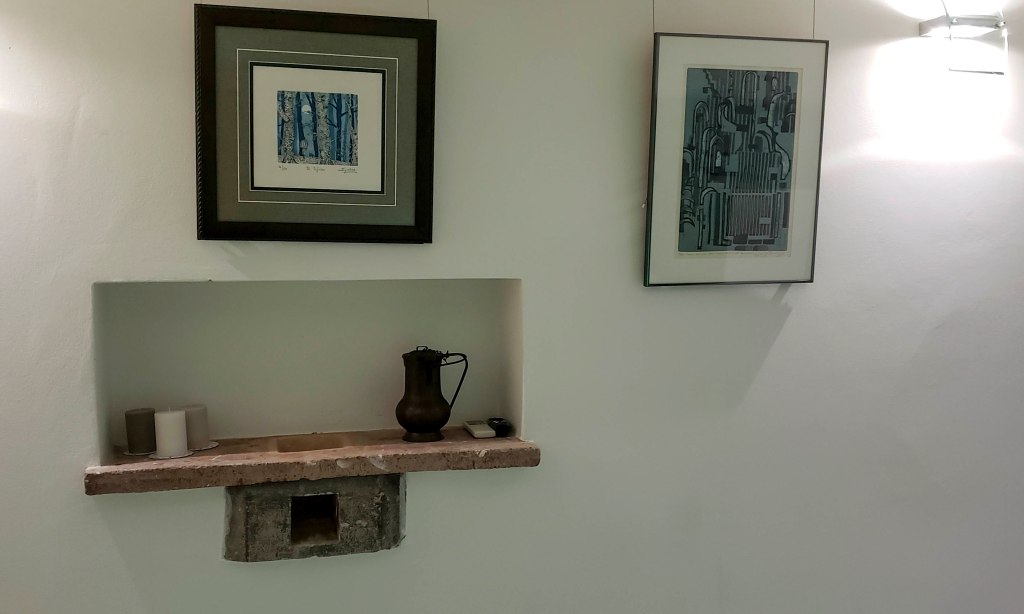
We still have a lot of decorating to do. We visited the local antique market a few weekends ago and found some fun items. They are held monthly so more treasure hunting ahead for us. There are also lots of local artists here that we are discovering. Italians say “piano, piano” which means slowly, you’ll get it, don’t rush. We are trying to learn this concept!

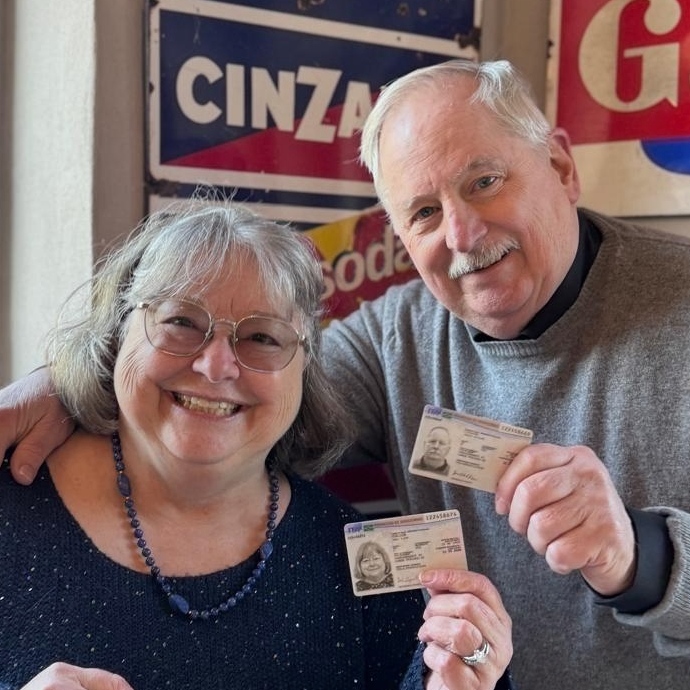 Saturday we reached a big milestone — we now have our permanent carta di soggiorno, or permission to stay in Italy indefinitely.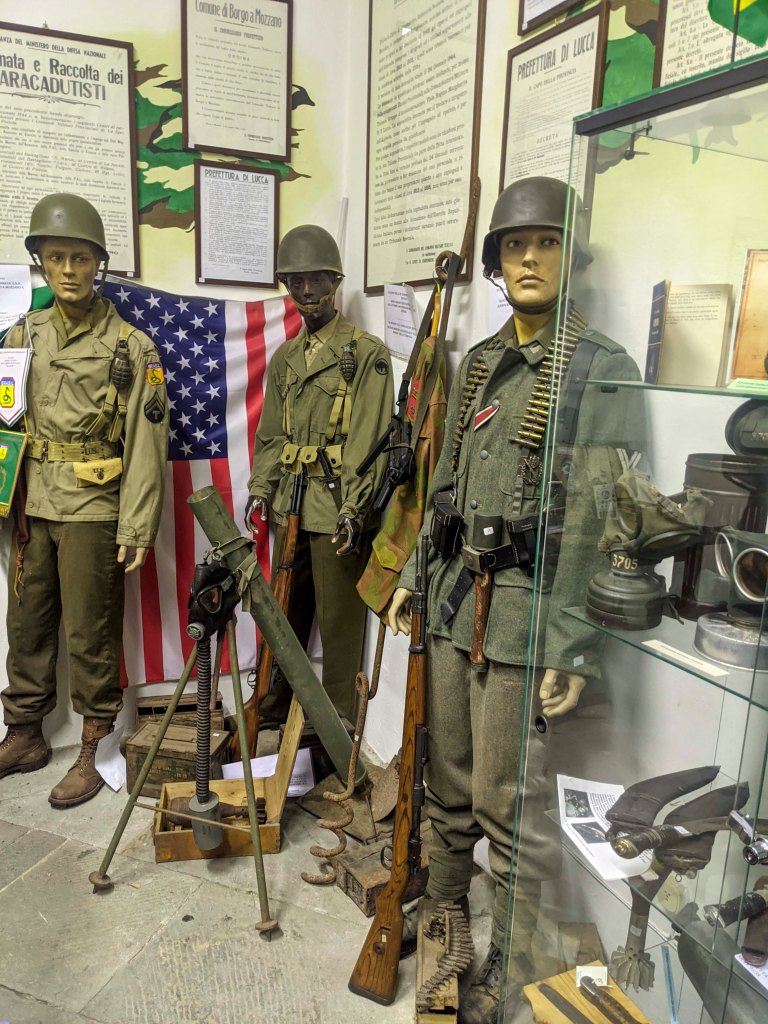



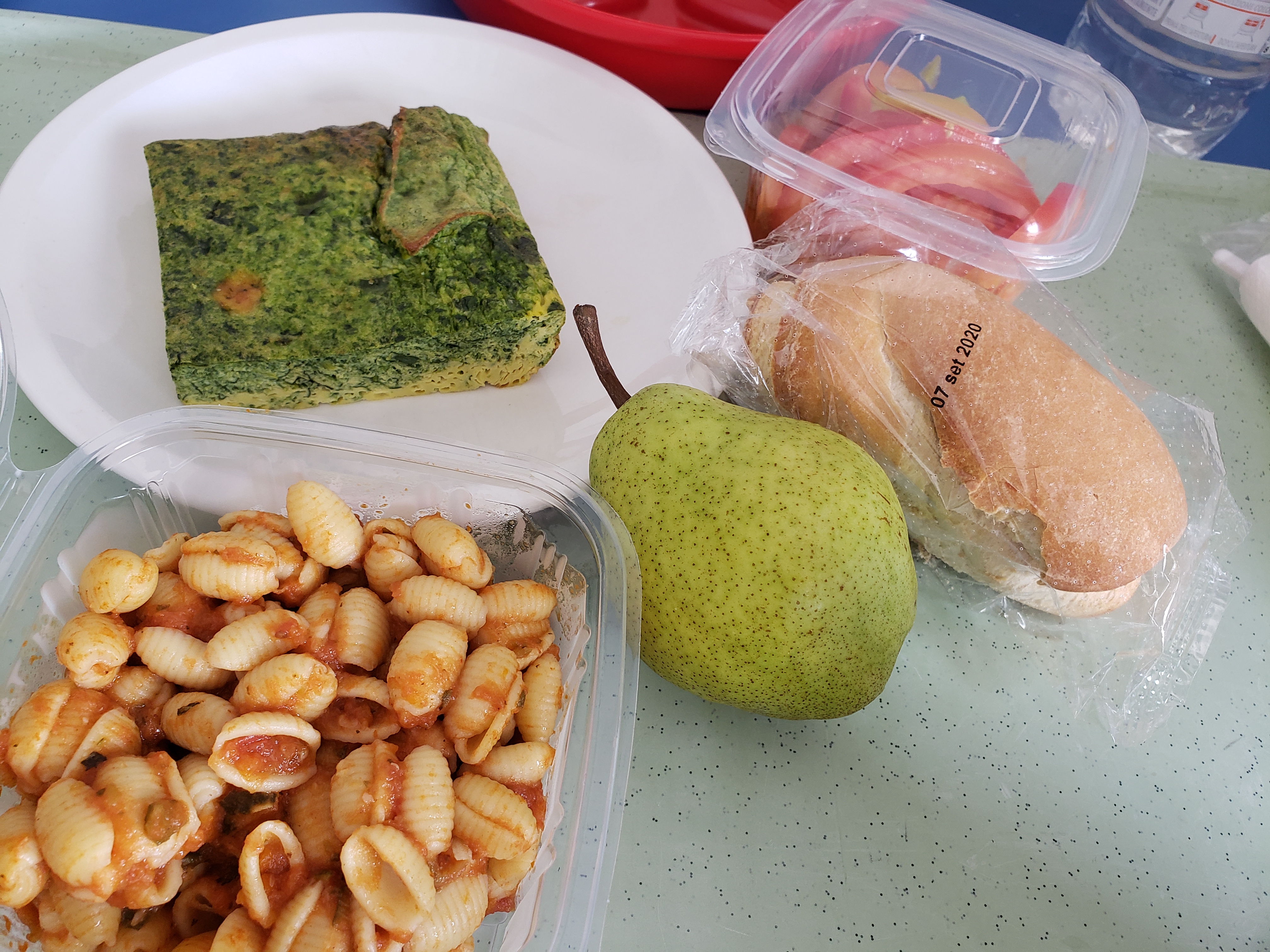 They finally said that the surgery would be later than planned, probably around 2pm. Piano, piano… This “out-patient” surgery was going to include a night in the hospital.



 My Next Adventure